

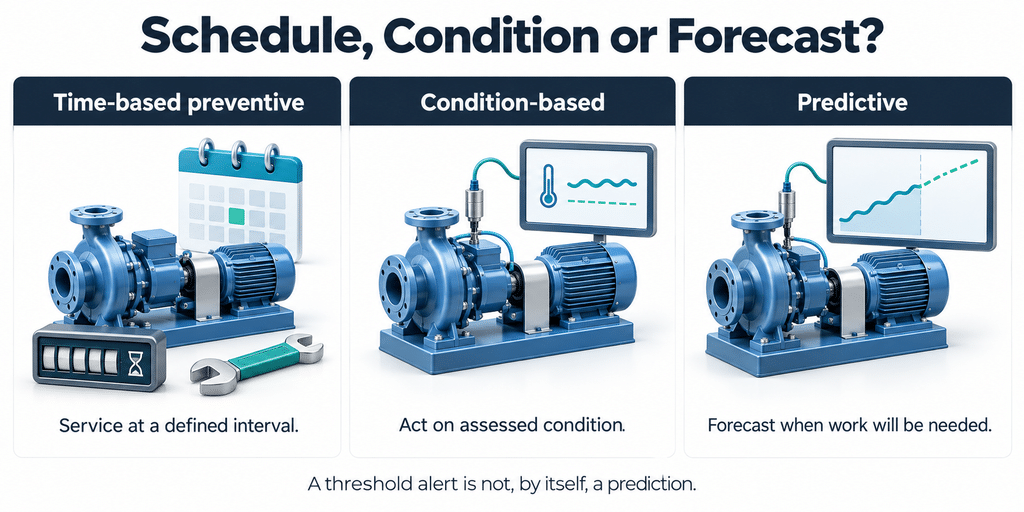
Predictive vs preventive maintenance comes down to what triggers the work. Time-based preventive maintenance schedules work at fixed calendar or usage intervals, while predictive maintenance analyzes equipment condition to estimate when maintenance will be needed. Both aim to reduce the probability of failure, but they need different data, budgets and skills.
Facilities often combine the two because neither covers every failure mode. NASA’s guide to reliability-centered maintenance explains that predictive testing and inspection cannot cover every type of equipment or possible failure mode and should not be the only maintenance approach used.
In the worked example below, the same monitoring budget can pay off or lose money, depending on downtime cost, how many failures give a usable warning and how reliably the team acts on it.
Definitions of Preventive, Condition-Based and Predictive Maintenance
Standard vocabulary does not treat the two approaches as opposites. In IEC and EN terminology, condition-based and predictive maintenance are kinds of preventive maintenance. Preventive maintenance aims to mitigate degradation and reduce the probability of failure.
Because sources use “predictive” in different ways, this article compares time-based preventive work with condition- and forecast-driven work, by trigger and output.
Time-Based Preventive Maintenance
Time-based, or predetermined, preventive maintenance runs on a clock. Inspection and maintenance take place at predefined intervals based on calendar time, operating hours or cycles, regardless of equipment condition.
Examples include scheduled lubrication, consumable replacement and inspections at specified operating-hour intervals.
Condition-Based Maintenance
The IEC definition of condition-based maintenance describes preventive maintenance based on an assessment of physical condition.
That assessment can come from operator observations, scheduled inspections or monitoring of system parameters. Condition-based work does not require a sensor or a forecast.
Predictive Maintenance
Predictive maintenance adds a forecast. EN 13306:2017 describes it as condition-based maintenance following a forecast derived from repeated analysis or evaluation of relevant degradation parameters.
A US Department of Defense manual, DoDM 4151.25, describes predictive maintenance tasks as being triggered by a process or capability that uses data to predict a component’s remaining useful life.
NASA and the US Federal Energy Management Program use “predictive maintenance” more broadly for condition-based work, while other sources distinguish between assessing current condition and predicting future failure.
Corrective Maintenance and Run-to-Failure
Corrective maintenance takes place after a fault is detected to restore the item.
Run-to-failure belongs in a program only as a conscious decision. It can suit low-cost, easily repaired, non-critical equipment where the consequences of failure are acceptable.
Is a Threshold Alert a Prediction?
No. A threshold alert reports that a measured condition has crossed a limit. A prediction estimates how the condition will develop or when a defined failure limit may be reached.
ISO 13374 separates state detection from prognostic assessment. ISO 13381-1:2025 describes prognosis in terms of estimating time to failure and risk.
The label on the software matters less than the output. An alarm can also come from a forecast, so ask which analysis produced it.
For example:
- Threshold alert: Bearing temperature has exceeded its configured limit.
- Condition-based action: Inspect the bearing because its measured condition warrants attention.
- Predictive output: Based on the observed degradation trend, the bearing is expected to reach a defined failure threshold within an estimated period.
The P-F interval is the time between a potential failure becoming detectable and the equipment reaching functional failure.
Monitoring is useful only if that interval gives the team enough time to detect the problem, assess it and act. Time-based preventive tasks follow a separate schedule because they are performed regardless of measured condition.
Comparison Table: Preventive vs Predictive Maintenance
| Comparison | Time-Based Preventive Maintenance | Predictive Maintenance |
|---|---|---|
| Trigger | Elapsed calendar time, operating hours or cycles, regardless of condition | A forecast of how measured condition will develop |
| Data requirements | Asset register, task list, manufacturer recommendations and maintenance history | Repeated condition measurements, an operating baseline and enough suitable data to support a forecast |
| Initial cost | Planning and task setup; the time-based trigger itself does not require condition-monitoring equipment | Diagnostic equipment or sensors, connectivity, software, integration and staff training |
| Ongoing cost | Labour, parts and planned stops at every interval, including work on items that may not need it | Analysis, software, monitoring-system upkeep, false-alert checks, early repairs and preventive tasks that remain |
| Implementation effort | Establish applicable tasks and intervals, then schedule and track them in the CMMS | Identify failure modes, select techniques, establish baselines, assign alert ownership and connect findings to maintenance planning |
| Benefits | Straightforward planning; suitable for justified age-related tasks, consumables and required examinations | Earlier warning can help turn unplanned failures into planned repairs |
| Limitations | Can replace serviceable parts; age-based replacement may not improve reliability without an age-related failure pattern | Requires detectable deterioration and enough warning time; false and missed alerts remain possible; savings are not guaranteed |
| Typical fit | Wear-out mechanisms with justified intervals, consumable servicing and required tests | Critical assets with measurable warning signs and costly failure consequences |
| Skills needed | Maintenance planning and craft skills | Maintenance skills plus condition analysis and the ability to adjust work schedules |
| Where condition-based maintenance fits | An inspection may identify work before the next scheduled replacement | A measured limit can trigger work without a forecast; forecast-driven work remains a form of condition-based maintenance |
Rule of thumb: If a preventive vs predictive maintenance comparison lists no limitations for predictive maintenance, treat it as a sales sheet.
Preventive Maintenance Examples and What Condition Data Adds
Suitability is decided per failure mode, not per machine type. One motor, pump or compressor can need several maintenance approaches.
Electric Motors
Scheduled work: Bearing lubrication where required by the manufacturer, cooling-system cleaning, terminal checks and supply-balance checks.
Condition-monitoring techniques: Vibration trends and spectra, bearing temperature, thermography of electrical connections and motor current signature analysis.
What these techniques can reveal: Bearing faults, some rotor-bar problems, misalignment and overheating connections.
Limitations: Some rotor-bar faults may have no clear early symptoms. Thermography requires a suitable line of sight, and low load can hide problems. Several insulation tests require the motor to be de-energized.
Centrifugal Pumps
Scheduled work: Manufacturer-specified lubrication, packing inspection or adjustment, coupling alignment and bearing or belt inspections where applicable.
Condition-monitoring techniques: Vibration, bearing-housing thermography, ultrasound and pressure, flow and power measurements.
What these techniques can reveal: Bearing damage, imbalance, misalignment, cavitation and performance deterioration. Inspection can also identify seal leakage.
Limitations: A pump operating far from its design point has a process problem that a bearing sensor will not fix. Warning time depends on the failure mode, operating conditions and monitoring technique.
Air Compressors
Scheduled work: Manufacturer-specified oil changes, filter and drain-trap servicing, oil sampling and required checks of protective devices.
Condition-monitoring techniques: Ultrasound for leaks, vibration on rotating components, oil analysis and temperature trends. Reciprocating compressor valves may also be assessed using in-cylinder pressure measurements.
What these techniques can reveal: Air leaks, lubricant degradation, bearing wear and certain valve faults.
Limitations: Reciprocating machinery can be difficult to assess using vibration alone. In-cylinder pressure monitoring requires additional instrumentation. A hidden failure of a protective function requires an appropriate test.
Gearboxes and Drive Trains
Scheduled work: Lubricant changes at justified intervals, alignment checks and coupling inspections.
Condition-monitoring techniques: Vibration, oil analysis and wear-debris analysis.
What these techniques can reveal: Misalignment, bearing defects, gear wear and lubricant deterioration.
Limitations: Vibration and oil analysis detect different aspects of deterioration. Wear debris may reveal damage without locating the affected component in a complex gearbox. Low-speed and variable-speed equipment can be harder to assess using vibration.
For all four asset types, combining measurements with operating context matters. An industrial data management approach helps organize equipment readings, timestamps and quality information so analysts can interpret changes against the conditions in which they occurred.
Predictive Maintenance Costs: A Worked Example
Published evaluations of condition-monitoring economics vary in scope and assumptions. A worked calculation is more useful than treating a general savings percentage as a forecast for an individual plant.
Scenario and Assumptions
This is an illustrative scenario. Every input is an assumption, not a benchmark, customer case or typical value.
Consider a plant with 12 rotating assemblies: two compressors and ten pumps, each with its drive motor.
The current program uses time-based preventive maintenance on all 12 assemblies. The alternative keeps every preventive task and adds condition monitoring and forecasting on the six most critical assemblies: two compressors and four pumps.
The comparison covers one year. Money is rounded to the nearest whole US dollar. Fractional failure counts represent expected values rather than actual event counts.
| Input | Assumed Value |
|---|---|
| Preventive tasks | Four per assembly per year; 48 in total, unchanged in both strategies |
| Labour per preventive task | Two hours |
| Labour rate, including employer costs | $60 per hour |
| Parts per preventive task | $75 |
| Planned stop per preventive task | One hour |
| Value of a planned stop hour | $250 |
| Failures remaining under preventive maintenance | Four annually on the six monitored assemblies, plus two on the other six |
| Share of monitored failures giving a usable warning | 75% |
| Share of warnings acted on in time | 80% |
| Repair after failure | Six labour hours, $1,500 in parts and $500 in secondary damage |
| Unplanned stop per failure | Eight hours |
| Value of an unplanned stop hour | $1,500 in lost contribution, rather than revenue |
| Early planned repair following a warning | Four labour hours, $900 in parts and a two-hour planned stop |
| One-off monitoring setup | $8,160 |
| Annual monitoring running cost | $9,840 |
| False alerts requiring investigation | Two per year, requiring two labour hours each |
The $8,160 setup cost consists of:
- Sensors: six assemblies × $500 = $3,000.
- Gateway: $1,000.
- Integration: 40 hours × $80 = $3,200.
- Training: 16 hours × $60 = $960.
The $9,840 annual running cost consists of:
- Software: $2,400.
- Connectivity: $600.
- Upkeep and calibration: $600.
- Analysis: two hours per week × 52 weeks × $60 = $6,240.
Cost Comparison
Each scheduled preventive task costs:
(2 labour hours × $60) + $75 in parts + (1 planned stop hour × $250) = $445.
Across 48 tasks, the annual scheduled preventive cost is $21,360.
Each unplanned failure costs:
(6 labour hours × $60) + $1,500 in parts + $500 in secondary damage + (8 unplanned stop hours × $1,500) = $14,360.
An early planned repair costs:
(4 labour hours × $60) + $900 in parts + (2 planned stop hours × $250) = $1,640.
Each intercepted failure therefore avoids $12,720.
The expected number of intercepted failures is:
4 failures × 75% usable warnings × 80% timely action = 2.4 intercepted failures.
| Cost Line: USD, Year 1 | Preventive Only | Preventive + Predictive on Six Assemblies |
|---|---|---|
| Scheduled preventive tasks: 48, unchanged | $21,360 | $21,360 |
| Failures that still occur: six vs 3.6 expected | $86,160 | $51,696 |
| Of which: unplanned downtime, already included above | $72,000 | $43,200 |
| Early planned repairs: 2.4 expected | $0 | $3,936 |
| Monitoring setup, charged entirely to year 1 | $0 | $8,160 |
| Monitoring running cost | $0 | $9,840 |
| False-alert checks | $0 | $240 |
| Total | $107,520 | $95,232 |
Monitoring the six assemblies costs $18,240 in year 1, including setup, running costs and false-alert checks.
It must intercept approximately 1.43 failures to break even:
$18,240 ÷ $12,720 = 1.43.
The expected 2.4 interceptions make the combined program $12,288 less expensive in year 1.
Break-Even and Sensitivity Analysis
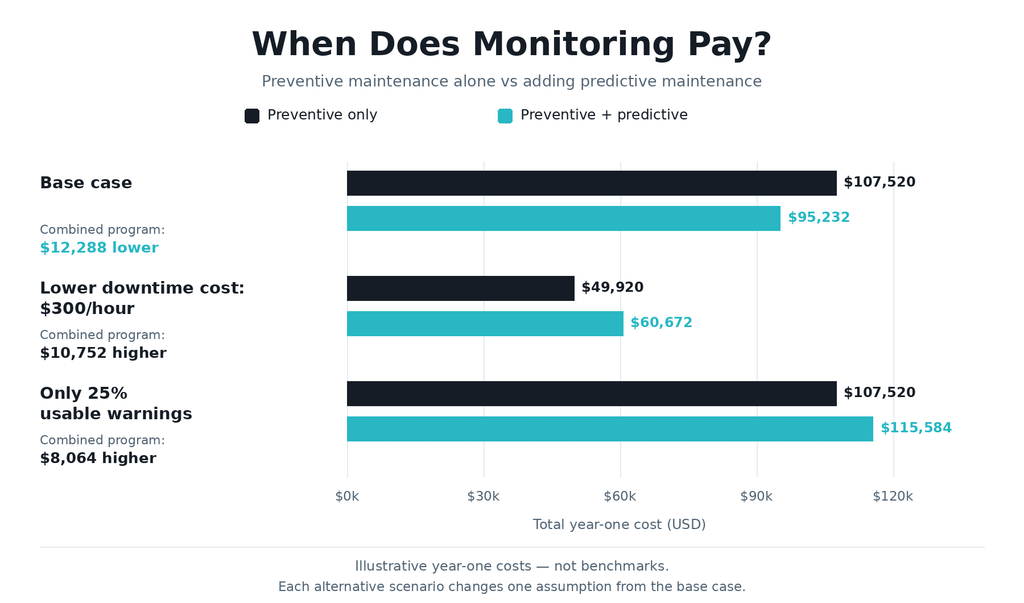
Each scenario below changes one input while keeping the others fixed. A positive difference means the combined program costs less.
| Change | Preventive Only | Preventive + Predictive | Difference | Pays in Year 1? |
|---|---|---|---|---|
| Base case | $107,520 | $95,232 | +$12,288 | Yes |
| Unplanned stop worth $300 per hour | $49,920 | $60,672 | −$10,752 | No |
| Only 25% of failures give a usable warning | $107,520 | $115,584 | −$8,064 | No |
| Failure stop lasts four hours instead of eight | $71,520 | $73,632 | −$2,112 | No |
| Sensor cost and integration hours tripled | $107,520 | $107,632 | −$112 | No |
| Team acts in time on only 40% of warnings | $107,520 | $110,496 | −$2,976 | No |
| Unplanned stop worth $3,000 per hour | $179,520 | $138,432 | +$41,088 | Yes |
For the tripled-cost scenario, sensors cost $1,500 per monitored assembly and integration requires 120 hours.
Five of the six changes reverse the base-case result.
With other assumptions unchanged, monitoring breaks even at approximately:
- $860 per unplanned stop hour, compared with $1,500 in the base case.
- 44.8% of monitored failures giving a usable warning, compared with 75%.
- 2.39 annual failures on the six monitored assemblies before adding predictive maintenance, compared with four.
The last figure is the underlying failure count, not the number of expected interceptions.
In this scenario, adding predictive maintenance pays in the first year. Lower downtime costs, fewer usable warnings or slower responses can reverse that result.
What the Example Cannot Tell You
The proportion of failures that give a usable warning, false-alert costs and actual payback must come from the plant’s own records.
The model excludes scrap and rework, lost-sales penalties, inventory effects, energy, safety and environmental consequences, preventive interval changes and asset-life extension. These effects are outside the calculation; they should not be assumed to have zero value.
Condition data also do not, by themselves, justify extending statutory examination intervals.
When to Choose Each Approach: A Maintenance Decision Checklist
Reliability-centered maintenance selects tasks for individual failure modes according to their probability and consequences. Apply these eight criteria before choosing monitoring technology.
1. Criticality and Consequence
Predictive work can fit assets whose failure stops production, causes secondary damage or has no effective redundancy.
Run-to-failure can suit inexpensive or redundant items with acceptable failure consequences. Time-based work still requires an applicable scheduled task.
2. Failure Pattern
Predictive work can help where there is no clear wear-out age and where measurable deterioration provides warning.
Time-based work fits mechanisms with a justified age or usage relationship, as well as applicable consumable servicing.
Avoid applying failure-pattern statistics from aviation or naval equipment directly to manufacturing assets. Establish the relevant pattern for the equipment and failure mode being assessed.
3. Detectability
Without a measurable precursor, condition monitoring cannot provide early warning of that failure mode.
The alternatives may include preventive work, run-to-failure, protective measures or redesign, depending on the consequences.
4. Warning Time Versus Inspection and Response Time
The US Department of Defense reliability-centered maintenance manual identifies the need for detectable potential failure, a sufficiently consistent P-F interval, practical monitoring intervals and enough time to act.
The warning must allow time to obtain parts, assign people and arrange a stop.
5. Downtime Cost Versus Monitoring Cost
Avoided downtime and damage must exceed setup costs, running costs and false-alert investigations.
A technically possible measurement is not automatically economical. Replacing low-cost lubricant may, for example, cost less than analyzing it.
6. Data Availability
Predictive work is easier when control systems already capture relevant parameters.
It becomes harder when sensors must be retrofitted, operating context is unavailable or the plant has little useful failure history.
7. Team Capability and Workflow
Someone must own each alert, interpret the evidence and arrange the necessary work.
A correct forecast provides little value if the maintenance team cannot respond before failure.
8. Protective Devices and Statutory Duties
Hidden protective functions require appropriate failure-finding tests. Statutory examinations follow applicable regulations and examination schemes.
Monitoring may provide additional information, but it does not automatically replace required tests or examinations.
Choosing tools is a separate question, covered in our guide to predictive maintenance software for manufacturing.
Adding Predictive Maintenance to an Existing Program
Predictive maintenance provides evidence for reviewing the preventive plan. Introduce it through a controlled pilot.
- Start with the existing preventive plan. Review which tasks are applicable and effective.
- Rank asset criticality. Identify the largest downtime and maintenance-cost drivers.
- Name the failure modes before choosing a technique. Check whether deterioration is detectable and whether the warning time supports action.
- Pilot on a few assets and establish a baseline. Record normal behaviour under known operating conditions before interpreting changes.
- Define alert handling and the work-order flow. Decide who receives an alert, who investigates it and what evidence triggers a CMMS or EAM work order.
- Use condition data to review justified preventive intervals. Evidence may support extending, shortening, adding or removing particular tasks. Required examinations and protective-function tests need their own justification.
- Measure maintenance outcomes. Track scheduled versus unscheduled work, condition-driven work orders, false alerts and completed interventions.
For an implementation example of operator acknowledgement, see the Iotellect documentation on acknowledging alerts.
Building the Data and Alert Workflow with Iotellect
Iotellect is a low-code IoT/IIoT platform for building custom industrial applications.
Teams can use its predictive maintenance platform capabilities to connect PLCs, SCADA and DCS systems, IoT gateways and condition-monitoring sensors in one environment. Supported protocols include Modbus, OPC DA/HDA, OPC UA, MQTT and IEC-104.
The platform supports data preparation, dashboards, alerts and integration with maintenance-management systems. Its analytics capabilities include value prediction, anomaly detection and classification using supervised and unsupervised learning.
Teams can develop remaining-useful-life and time-to-failure estimates and display results on dashboards. The plant’s team still needs to run the pilot, validate models against its equipment and records, and decide which alerts become work orders.
Frequently Asked Questions
What Is the Main Difference Between Predictive and Preventive Maintenance?
The difference is the trigger. Time-based preventive maintenance follows calendar time, operating hours or cycles, regardless of measured condition. Predictive maintenance uses condition data and a forecast to estimate when work will be needed.
The data requirements differ too: scheduled work needs task lists and maintenance history, while predictive work needs repeated measurements, operating context and a suitable baseline.
Is Predictive Maintenance Always Cheaper?
No. Predictive maintenance adds monitoring, analysis, integration and training costs. It pays where avoided downtime and damage outweigh those costs.
A NIST-authored survey of US manufacturers illustrates why the distinction matters. After excluding respondents most reliant on reactive maintenance, greater reliance on predictive maintenance was associated with an 18.5% lower downtime share and an 87.3% lower defect rate, alongside 212.3% higher direct maintenance costs relative to shipment value.
The study used 2016 data from US discrete manufacturing, with 85 responses before exclusions. Its authors caution that the smaller-group comparisons are anecdotal evidence. These associations do not establish causation or forecast another plant’s results.
Can Predictive Maintenance Replace Preventive Maintenance?
It can replace some time-based tasks on particular assets where analysis supports that change.
Applicable age-based tasks, consumable servicing, protective-function tests and statutory examinations retain their justified schedules. Failure modes without measurable warning signs require another appropriate strategy.
What Equipment Is Suitable for Predictive Maintenance?
Equipment is a candidate when the relevant failure mode has:
- A measurable precursor.
- A sufficiently consistent warning period.
- Enough time for the team to act.
- Failure consequences that justify monitoring costs.
Motors, pumps, compressors, gearboxes, fans and blowers are common candidates. Low-speed, variable-speed and reciprocating machinery may require more specialized techniques.
How Does Predictive Maintenance Differ from Condition-Based Maintenance?
Condition-based maintenance acts on an assessment of current physical condition. Predictive maintenance adds a forecast of future deterioration or time to a defined failure limit.
The labels overlap in practice. Ask whether a system detects an abnormal condition, diagnoses a fault or predicts future failure. These are different outputs.
Does Predictive Maintenance Require Machine Learning?
No. Forecasts can also use statistical models, degradation trends or physics-based models.
Machine learning alone does not make a system predictive. A model may detect anomalies without estimating time to failure.
Choosing a Maintenance Mix
Schedules suit tasks with justified time or usage intervals. Condition monitoring suits failure modes that provide detectable warning. Predictive methods add value when a reliable forecast gives the team enough time to act.
Start with critical assets, validate the warning signals and compare the full monitoring cost with the failures and downtime the program can realistically avoid.