
Artificial intelligence is reshaping industrial software faster than we expected. Predictive maintenance, anomaly detection, optimization engines, generative copilots—they are rapidly moving from experimentation to production.
The natural question follows:
What happens to IoT platforms when intelligence becomes the main value layer?
Some market professionals assume AI will sit directly on cloud infrastructure, bypassing traditional IoT platforms altogether. In reality, AI does not eliminate platforms, it increases the need for the right kind of platform.
The difference will not be about features. It will be about architecture.
AI Exposes Structural Weakness
AI systems are extremely sensitive to inconsistency. They depend on stable data models, contextual hierarchy, and long-term continuity. Most IoT deployments were originally built for connectivity and visualization, not for structured intelligence.
When device schemas drift, metadata is missing, or each site is implemented differently, models degrade. Retraining becomes expensive. Scaling becomes chaotic.
AI does not replace IoT platforms. It reveals whether they were built as products or assembled as projects.
The Platform Becomes the System of Structure
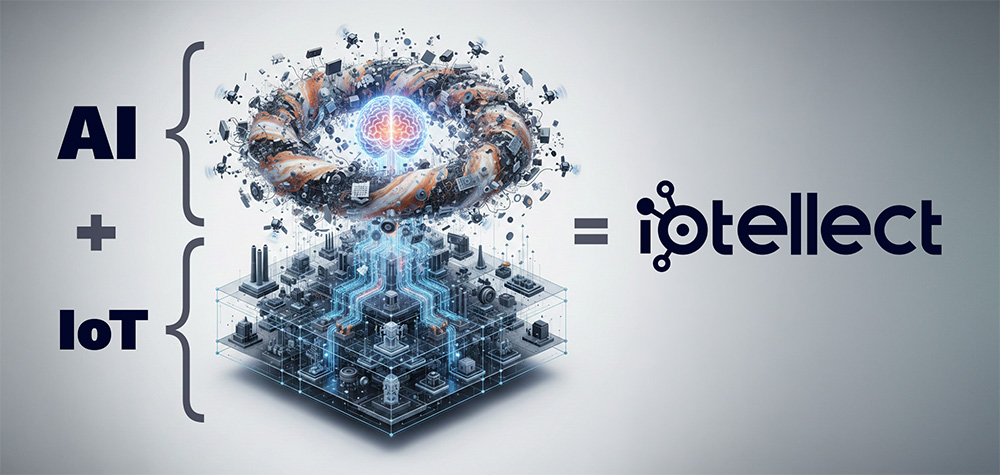
In the AI era, the role of the IoT platform shifts upward. It is no longer a data transport layer or a dashboard builder. It becomes the system that stabilizes operational reality.
Raw telemetry has little value on its own. A temperature reading matters only if it belongs to a defined asset, inside a structured hierarchy, with lifecycle history and contractual context. AI operates on that structure, not on raw signals.
The platform must therefore:
- Maintain consistent asset models across sites and customers
- Enforce metadata discipline and version control
- Govern lifecycle changes without breaking historical continuity
Without this foundation, AI remains an experiment layered on unstable ground.
Monitoring is not Enough
The first generation of IoT platforms was focused on monitoring: trends, alarms, dashboards. AI shifts the center of gravity toward decision infrastructure – optimization, prediction, simulation, automation.
That requires deeper architectural capabilities. The system must preserve state, coordinate events, and integrate with business processes in a secure and controlled way. Visualization becomes an interface, not the core value.
Platforms that remain UI-centric will commoditize. Platforms that become runtime environments for operational logic will gain relevance.
Multi-Tenancy Becomes Strategic
AI improves with scale and consistency. Platforms that standardize models across fleets, factories, or customer groups gain compounding advantages. They can benchmark, detect anomalies earlier, and refine optimization algorithms across populations.
Custom, single-site deployments struggle to create that leverage. The future favors platforms that enforce repeatable architecture while still allowing controlled configurability.
This is where lifecycle thinking matters. Ten-year product horizons demand disciplined evolution, not ad hoc customization.
Edge Intelligence Needs Governance
Edge AI will expand. Devices and gateways will preprocess data, execute inference locally, and reduce latency. Edge devices (think about cars and robots here) will directly co-operate in most mundane activities bypassing the cloud. But edge without governance creates fragmentation.
There must be a central layer that manages identity, policies, updates, and global coordination. Smart edge systems still require a structured cloud or hybrid runtime to maintain coherence.
Very roughly, this is why (generally independent) humans got themselves organized into states, companies and many other structures.
The winning architecture is not edge versus cloud. It is coordinated intelligence governed by a stable application platform.
What Will Separate Survivors From Casualties
AI will not eliminate IoT platforms. It will eliminate weak ones.
The platforms that endure will share three characteristics:
- Strong, structured data models with lifecycle control
- Multi-tenant architecture that enables scale and productization
- Clear separation between configuration, runtime logic, and deployment
Those that remain collections of connectors and dashboards will fade into infrastructure noise.
The Strategic Shift
The market conversation is gradually changing. It is no longer about connecting devices or selecting a cloud service. It is about defining the architectural foundation on which AI-enabled industrial products will run for the next decade.
Once intelligence becomes embedded in operations, refactoring the underlying platform becomes exponentially harder. Architectural discipline at the beginning determines flexibility at scale.
In the AI era, the IoT platform does not shrink—it matures. It becomes the structured runtime that turns connected systems into intelligent, long-lifecycle digital products.
This is exactly what I meant by calling mature IoT platforms “next-gen OS”. Are you really scared the AI will kill operating systems (together with the VM hypervisors and container orchestrators) that add formalized structure atop of computer hardware? Don’t hesitate to let me know if you are – and how do you see an agent running straight atop of the bare metal CPU and memory 🙂