
Modbus and OPC UA are both widely used in industrial automation, but they serve different integration needs. Modbus is generally simpler for bounded device communication, while OPC UA provides richer data modelling, stronger built-in security mechanisms, and more structured interoperability options.
This article compares their architecture, data structure, security, interoperability, performance, PLC and SCADA integration, scalability, implementation effort, and suitability for Industry 4.0 workloads.
Protocol architecture
Modbus is an application-layer protocol built around request/reply communication. It is commonly used over serial networks as Modbus RTU or over Ethernet as Modbus TCP. Its simplicity makes it practical for connecting meters, sensors, drives, PLCs, and other industrial devices with known register maps.
The protocol defines how a client reads or writes data, but the meaning of each register is usually defined by the device vendor. This makes Modbus straightforward for stable, well-understood device integrations, but it can require more manual mapping as systems grow.
OPC UA uses a broader service-based architecture. It supports client-server communication and publish-subscribe messaging, allowing systems to exchange industrial data without relying only on direct request/reply patterns.
Unlike Modbus, OPC UA is designed to describe data in a structured way, including its type, context, relationships, and permissions. A related OPC UA vs MQTT comparison explains how OPC UA differs from another common IIoT communication approach.
Data structure
Modbus uses a simple data model based on coils, discrete inputs, input registers, and holding registers. A Modbus register is a numbered data location that can represent values such as temperature, pressure, status, counters, or configuration settings.
However, the protocol does not fully define how complex values should be interpreted. Engineers often need to configure data types, byte order, scaling, units, and read/write permissions separately for each device. The Modbus Application Protocol Specification confirms that the mapping between the Modbus data model and a device application is vendor-specific.
OPC UA uses an AddressSpace made up of typed Nodes, Attributes, and References. This allows industrial data to carry more meaning. For example, a temperature value can be linked to its engineering unit, asset, alarm limits, historical records, or maintenance context.
This structured approach is especially useful when information must be shared between PLCs, SCADA systems, MES platforms, historians, cloud applications, and enterprise software.
Security
Security is one of the clearest differences between Modbus and OPC UA.
Base Modbus RTU and Modbus TCP were designed for trusted industrial networks. They do not include built-in encryption, certificate management, or user authentication. Modbus/TCP Security is available as a separate specification that uses TLS and mutual authentication, but it is not automatically included in every Modbus TCP deployment.
OPC UA includes security capabilities such as application certificates, encryption, message signing, user authentication, and trust lists. It supports security modes including None, Sign, and SignAndEncrypt. In production environments, secure configuration is essential because simply supporting OPC UA does not guarantee that encryption or certificate validation is enabled.
The OPC UA Security specification outlines these security modes and related mechanisms. In practice, security should be validated during commissioning, including certificate lifecycle management, access rights, network segmentation, and secure remote access.
Interoperability
Protocol support alone does not guarantee interoperability.
With Modbus, the main integration task is creating and maintaining a reliable register map. Each device may use different addresses, data types, scaling rules, and conventions. This is manageable for a limited number of devices but can become harder to govern across multiple sites, vendors, and applications.
OPC UA provides a more structured interoperability model through information models, Profiles, Companion Specifications, and machine-readable NodeSets. These mechanisms help standardize how industrial assets and their data are represented.
However, OPC UA interoperability still depends on the exact products, Profiles, services, transport methods, security configuration, and information models being used. A project should test the actual connection between selected devices and applications rather than assuming compatibility from protocol support alone.
Performance
Neither protocol has one universal performance advantage. Real performance depends on network architecture, PLC resources, gateway capacity, polling intervals, point count, security settings, and application design.
Modbus is lightweight and efficient for simple point exchange. It is often well suited for predictable read/write communication with field devices. Modbus RTU is common on serial networks, while Modbus TCP is often used for Ethernet-connected industrial equipment.
OPC UA can require more processing resources because it supports sessions, subscriptions, monitored items, certificates, structured data, and multiple clients. However, it can reduce integration complexity at higher system levels by providing more contextual data and standardized service models.
For either protocol, performance should be tested under expected operating conditions. This includes device count, client count, sampling rates, network load, CPU and memory use, recovery time, and error handling.
PLC connectivity
Both Modbus and OPC UA are available across many PLC, gateway, and industrial software environments. However, support depends on the exact controller family, firmware version, licence, role, and available resources.
Many PLCs support Modbus RTU or Modbus TCP because the protocol is widely established and relatively simple to implement. It is commonly used for connecting PLCs to meters, variable-frequency drives, remote I/O, sensors, and legacy equipment.
OPC UA support is increasingly available in modern PLCs and industrial gateways. A PLC may act as an OPC UA server, client, or both, depending on the product configuration. However, not every controller supports every OPC UA role, feature, or workload.
Before choosing either protocol, verify the exact PLC documentation, firmware requirements, licensing, redundancy support, maximum connection limits, and security capabilities.
SCADA integration
Both protocols can be used in SCADA architectures.
Modbus is commonly used to collect data from field devices and map it into SCADA tags. It remains practical for straightforward monitoring and control applications where device registers are stable and well documented.
OPC UA can provide a more standardized connection between PLCs, SCADA platforms, historians, MES systems, and other industrial applications. It can expose structured information rather than only raw register values, which can simplify data sharing across larger industrial environments.
When planning SCADA integration, teams should test sampling, timestamps, quality codes, alarms, certificates, licences, restart behaviour, and failover. The broader distinction is explored in this traditional SCADA vs modern IIoT platform comparison.
Scalability
Scalability depends on the workload rather than protocol name alone.
Modbus can scale effectively for many device-level integrations, especially where each connection involves a defined set of registers. However, large deployments may require gateways, polling strategies, register-map governance, and careful handling of TCP-to-serial communication.
OPC UA supports sessions, subscriptions, monitored items, queues, and multiple client connections. This can make it suitable for larger distributed systems, but it also creates additional server resource requirements.
A credible scalability test should include expected point count, client count, polling or publishing rates, queue depth, CPU and memory usage, network load, recovery behaviour, and acceptable error rates.
Implementation complexity
Modbus is generally simpler to start with. It standardizes basic read/write operations and a compact data model, making it familiar to many industrial engineers. The complexity usually appears in the device-specific mapping work: register addresses, data conversion, scaling, units, and maintenance of documentation.
OPC UA can require more initial planning because teams must consider certificates, trust relationships, server roles, Profiles, namespaces, information models, and lifecycle ownership. However, this effort can create a cleaner and more reusable integration model for complex systems.
For both protocols, a strong implementation plan should define:
- Who owns the mapping and documentation
- How changes are approved and tested
- How failures and reconnections are handled
- Who manages certificates and access rights where applicable
- How rollback and maintenance procedures work
Industry 4.0 suitability
OPC UA is often a strong fit for Industry 4.0 environments that require structured industrial data, cross-system interoperability, asset context, events, methods, and secure integration across OT and IT systems.
Its typed information model can help organizations connect field equipment with SCADA, MES, cloud analytics, digital twins, and enterprise applications. The OPC UA information model specification explains how Nodes, Attributes, and References provide this structured approach.
Modbus remains useful in Industry 4.0 architectures when it is used for a clear device-level purpose. A common design is to keep Modbus southbound for data acquisition from existing devices while exposing selected information northbound through OPC UA or an IIoT platform.
The key question is not whether one protocol fully replaces the other. It is which protocol best fits each interface in the architecture.
Where Modbus RTU, Modbus TCP, and OPC UA are typically used
Modbus RTU is commonly used on serial communication links, particularly with legacy devices, meters, sensors, drives, and remote I/O.
Modbus TCP is used when the same Modbus communication model is carried over Ethernet and IP networks. It is often found in PLC, gateway, building automation, energy monitoring, and industrial equipment integrations.
OPC UA is commonly used where devices, controllers, SCADA systems, historians, MES platforms, cloud applications, and enterprise software need to exchange more structured data. It is especially relevant when security, data context, interoperability, and lifecycle management are important.
What is the difference between Modbus and OPC UA?
Modbus vs OPC UA
Modbus
OPC UA
- Simple register communication
- Easy device integration
- Fast implementation
- Best for field devices
- Structured data
- Built-in security
- Better interoperability
- Best for system integration
Choose the protocol that fits your workload.
Modbus is a compact request/reply protocol based on device-specific register mapping. OPC UA adds a typed AddressSpace, structured information models, multiple communication services, and built-in security mechanisms.
Modbus is often easier to implement for a bounded data exchange. OPC UA is often better suited to integrations that need richer context, structured data, secure communication, or reuse across multiple industrial applications.
Is OPC UA replacing Modbus?
OPC UA is not universally replacing Modbus. In many industrial environments, the two protocols coexist.
Modbus remains common at the device and field level, particularly for existing equipment and simple control or monitoring tasks. OPC UA is increasingly used at higher integration layers where systems need standardized, secure, and contextual data exchange.
A practical architecture may use Modbus to collect device data and OPC UA to expose selected information to SCADA, MES, cloud, or enterprise applications.
Which is better for IIoT?
OPC UA is usually the stronger choice for IIoT workloads that require structured data models, secure communication, interoperability, events, methods, or integration across multiple systems.
Modbus is often the better choice for simple, stable, and well-defined device communication where a register-based approach is sufficient.
The best choice depends on the endpoint, device capability, required security level, data model, workload, available resources, licence requirements, and long-term ownership of the integration.
Can Modbus and OPC UA be used together?
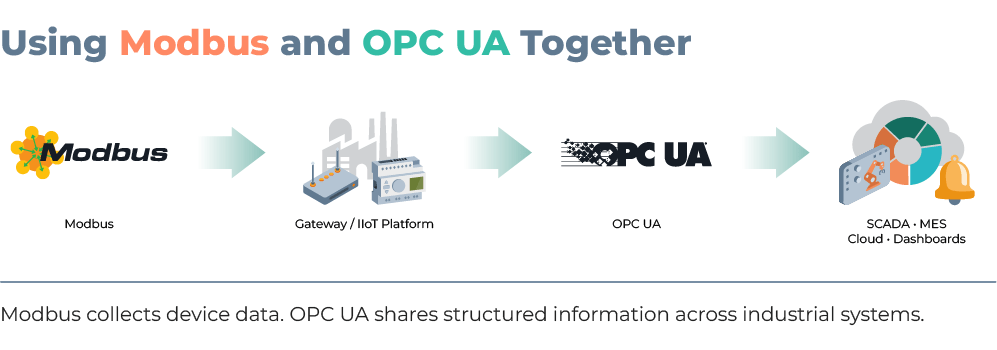
Yes. Modbus and OPC UA can be used together in the same industrial architecture.
For example, Modbus may collect data from meters, sensors, drives, or legacy controllers. A gateway, SCADA system, or IIoT platform can then map selected information into OPC UA for higher-level applications.
The project team should define how addresses, data types, scaling, units, timestamps, quality, write permissions, security, and recovery behaviour are managed across that boundary.
How Iotellect fits
Iotellect supports Modbus RTU, Modbus ASCII, Modbus TCP, Modbus UDP, and OPC UA connectivity. This allows industrial teams to connect field devices using Modbus while also integrating structured OPC UA data into wider SCADA, IIoT, analytics, and enterprise environments.
The right architecture still depends on the specific devices, required protocol roles, security configuration, data model, and operational requirements. Modbus and OPC UA should be selected as complementary tools where that produces the most reliable and manageable industrial integration.