
TL;DR
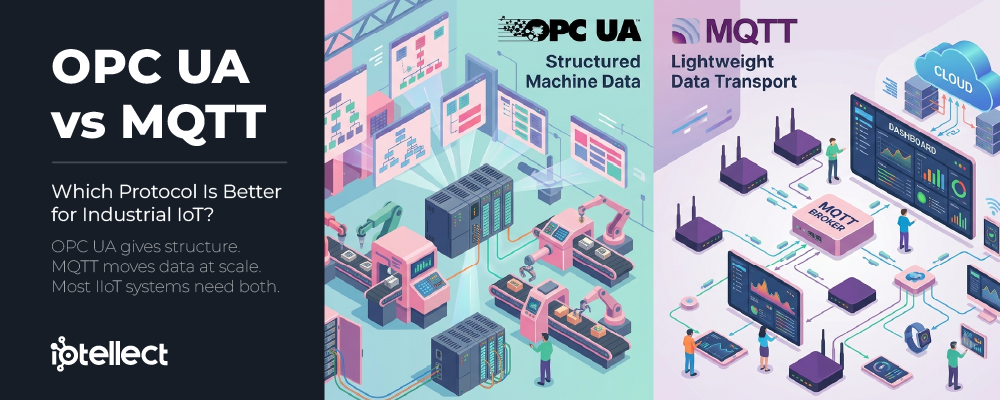
- OPC UA is a machine-to-machine interoperability standard with a built-in typed data model. Use it where structured machine data and OT interoperability inside the plant matter.
- MQTT is a lightweight publish/subscribe transport with no native data model. Use it where data needs to travel from gateways to cloud, across constrained networks, at scale.
- Most production IIoT architectures use both. OPC UA collects structured data at the edge or shop floor; MQTT carries it upstream. Treating them as competitors is where architectures go wrong.
- The real question for a project quote is not which protocol wins, but whether your platform speaks both out of the box, so you are not hand-building the bridge on every deployment.
What Is OPC UA?
OPC UA (Open Platform Communications Unified Architecture) is a machine-to-machine interoperability standard from the OPC Foundation. It does more than move bytes from a PLC to a client. It defines what those bytes mean.
OPC UA Architecture: Nodes, Namespaces, and the Information Model
Every value in OPC UA lives inside an address space organized as a graph of nodes. A node for a temperature reading does not just carry a number. It carries the data type, engineering units, timestamp, quality flag, and its position in a namespace that a client can browse without a pre-shared spec. This is the information model: a self-describing structure that tells a client “this is a Float in degrees Celsius, measured at this PLC, with this quality status.”
Communication happens over two patterns. Client-server (the original OPC UA model) lets a client subscribe to a server’s nodes and pull or receive updates. PubSub (introduced in Part 14 of the specification) adds a publish/subscribe model, optionally riding over MQTT or AMQP as a transport.
What OPC UA Does That MQTT Cannot
- Semantic interoperability. Two OPC UA-compliant systems from different vendors can exchange data without a custom mapping document for each integration. Companion specifications extend the standard for specific industries (machinery, packaging, robotics).
- Browsable server. A client can connect to an unknown OPC UA server and discover what it exposes at runtime. There is no equivalent in plain MQTT.
- Built-in security. Certificate-based authentication, message signing, and encryption are defined in the standard, not bolted on by convention. This matters for OT environments where a security audit asks how machine connections are verified.
- Data quality and timestamps from the source. A PLC timestamp and quality flag travel with the value, not as a separate convention.
What Is MQTT?
MQTT (Message Queuing Telemetry Transport) is a lightweight publish/subscribe protocol standardized by OASIS. It was designed for constrained devices and unreliable networks: low bandwidth, high latency, intermittent connectivity. Its fixed header starts at two bytes. That footprint is the point.
How MQTT Pub/Sub Works in Industrial Environments
Devices publish messages to named topics on a central broker. Any subscriber with the right permissions receives those messages. The broker decouples publishers from subscribers, so a sensor publishing temperature readings has no knowledge of whether one consumer or fifty are listening. Quality-of-service levels (QoS 0, 1, 2) control delivery guarantees. MQTT 5.0 added retained messages, user properties, and better error reporting.
The broker is the architectural center. In industrial deployments, this is often Mosquitto, HiveMQ, or a managed cloud broker (AWS IoT Core, Azure IoT Hub, HiveMQ Cloud). The edge gateway publishes; the cloud backend subscribes. Everything in between is the broker’s concern.
What MQTT Does That OPC UA Cannot
- Operates on constrained hardware. MQTT clients run on microcontrollers with kilobytes of RAM. A full OPC UA stack is far heavier.
- Tolerates unreliable networks. Cellular, LoRaWAN backhaul, satellite, and flaky Wi-Fi are native territory for MQTT. OPC UA assumes a reliable, lower-latency connection.
- Scales to large device fleets cheaply. One broker handling thousands of devices publishing at short intervals is a well-solved MQTT problem. OPC UA client-server at that fan-out is not.
- Decoupled architecture. Adding a new consumer (a new analytics pipeline, a new dashboard, a new alerting service) does not require touching any publisher. Topic subscriptions are additive.
OPC UA vs MQTT: Head-to-Head Comparison
| Dimension | OPC UA | MQTT |
| Standard body | OPC Foundation | OASIS |
| Communication model | Client-server + PubSub (Part 14) | Publish/subscribe via broker |
| Data model | Rich, typed, self-describing address space | None native; payload is up to you |
| Discovery | Browse server address space at runtime | None; topic structure by convention |
| Built-in security | Certificate auth, message signing, encryption | TLS + broker ACLs (you configure it) |
| Device footprint | Heavier (full stack requires real CPU/RAM) | Very light (runs on microcontrollers) |
| Network assumptions | Reliable, local/plant LAN | Tolerant of high latency and low bandwidth |
| Typical layer | OT / shop floor / edge | Transport to IT layer, cloud, applications |
| Structure in payload | Yes, part of the standard | Only with conventions (e.g., Sparkplug B) |
| Best fit | Machine data, vertical OT integration | Telemetry at scale, device-to-cloud |
Security and Authentication
OPC UA defines three security modes: None, Sign, and SignAndEncrypt. In production OT environments, SignAndEncrypt with certificate-based mutual authentication is the standard. The OPC Foundation’s security model has been audited for ICS use cases and is referenced in industrial cybersecurity frameworks.
MQTT security depends entirely on what you layer on top. TLS for transport encryption, broker-side access control lists for topic-level permissions, and external identity systems for authentication are all common, and all something your team configures and maintains. MQTT 5.0 improved error codes and session handling, but it added nothing to security architecture.
For a system integrator quoting a project with an OT security requirement, OPC UA’s built-in model is an easier story to tell. For a cloud-side telemetry pipeline where TLS and managed broker ACLs are already in place, MQTT is adequate.
Data Modeling and Semantic Context
This is the sharpest difference. An OPC UA server exposes a namespace where every node has a defined type, a browsable hierarchy, and metadata. A Modbus register becomes a structured variable with engineering units and quality. A Siemens S7 PLC exposes its program variables with their actual names, not just memory addresses.
MQTT is payload-agnostic. A topic like factory/line1/temperature carries whatever JSON (or binary, or plain text) the publisher chose. Every consumer must know the schema. When two teams in the same project use different payload structures, or a payload evolves, downstream consumers break silently. Sparkplug B from Eclipse addresses this by specifying a topic namespace and Protobuf payload model for MQTT in industrial settings. It is a widely used convention, but it is still a layer on top of MQTT.
Bandwidth and Constrained Devices
MQTT wins here without qualification. A two-byte fixed header, topic as a string, and raw payload keep message overhead minimal. Modern PLCs and industrial gateways have no trouble running OPC UA clients, but a $3 microcontroller sensor or a LoRaWAN node does not. MQTT’s design for constrained devices is not a historical accident. It is still the right choice wherever compute and bandwidth are limited.
OPC UA vs MQTT: Where Each Fits
OPC UA Fits Best When…
MQTT Fits Best When…
- Machines need structured data.
- PLCs and SCADA systems need interoperability.
- Data must include type, quality, timestamp, and context.
- Security and authentication are required at the OT level.
- Data must move from edge to cloud.
- Devices use limited bandwidth or unstable networks.
- Many systems need to subscribe to the same data.
- Large fleets need lightweight and scalable communication.
OPC UA explains what the data means. MQTT helps move the data efficiently.
When Should Industrial Teams Use OPC UA?
Three situations where OPC UA is the right call:
- The project requires machines or PLCs from different vendors to share a data model without a custom mapper for each integration.
- The OT environment has a security audit requirement for authentication and encryption at the protocol level.
- The plant is doing brownfield modernization and the goal is to expose legacy PLC data to modern SCADA or cloud systems with types, units, and quality intact.
OPC UA in SCADA Environments
SCADA systems that pull real-time data from PLCs have been using OPC UA (and its predecessor OPC DA) as the standard data path for years. A SCADA layer built on OPC UA reads tags from multiple PLCs, regardless of vendor, through a single client interface. Alarm states, setpoints, and historical values all carry the semantic context the SCADA system needs without per-vendor mapping.
For a system integrator, this means a project that adds a new vendor’s PLC to an existing SCADA installation does not require writing a new driver, as long as both sides are OPC UA compliant. To understand where these connections sit within the wider system, see our guide to SCADA architecture, components, and communication paths.
OPC UA for Machine-to-Machine on the Shop Floor
The OPC UA companion specifications define standard information models for vertical industries. The OPC UA for Machinery spec, for example, lets a robot cell and a CNC machine share data without a point-to-point integration. As more OEMs ship OPC UA servers in their equipment, the shop-floor integration overhead drops, but only if the platform layer above can consume OPC UA natively.
When Should Industrial Teams Use MQTT?
Three situations where MQTT is the right call:
- The project involves moving telemetry from many distributed sources (remote assets, edge gateways, mobile equipment) to a central cloud platform.
- Devices operate on cellular, LoRaWAN, satellite, or other bandwidth-constrained links where protocol overhead matters.
- The architecture needs to fan data out to multiple independent consumers (dashboards, historians, analytics engines, alerting) without tight coupling between publishers and subscribers.
MQTT for Edge-to-Cloud Pipelines
The most common MQTT pattern in IIoT: an edge gateway sits on-site, collects from local devices over OPC UA, Modbus, BACnet, or other protocols, and publishes upstream over MQTT to a cloud broker or platform. The cloud side subscribes and routes data to time-series storage, dashboards, and analytics. MQTT handles the uplink cleanly because it was designed for exactly this topology: one publisher, multiple consumers, unreliable WAN between them.
MQTT for Resource-Constrained Devices and LoRaWAN Gateways
LoRaWAN network servers (ChirpStack, TTN, Actility) emit device uplinks over MQTT as a standard integration pattern. Agricultural sensors, remote metering infrastructure, cold-chain monitors, and environmental sensor networks connect through LoRaWAN and deliver their data to an application platform via MQTT. Running OPC UA on these endpoints is not practical. MQTT is the protocol this tier was built around.
Can OPC UA and MQTT Work Together? (Yes – Here Is How)
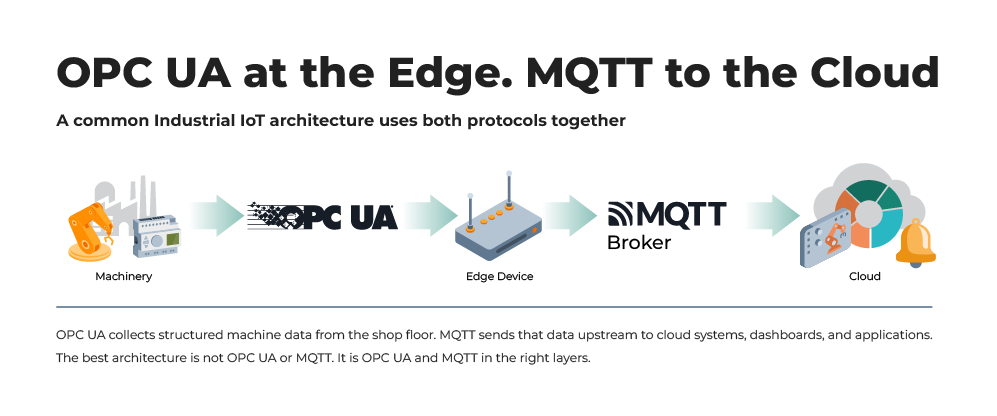
The “OPC UA vs MQTT” framing is the wrong question. In most real IIoT deployments, both protocols run simultaneously, each in the layer where it fits.
The Unified Namespace Pattern: OPC UA at the Edge, MQTT to the Cloud
The unified namespace (UNS) architecture, popularized by Walker Reynolds and adopted in Industrie 4.0 discussions, places a single logical namespace at the center of the enterprise data model. In practice, the common implementation looks like this:
- OPC UA at the OT layer. Edge gateways and SCADA servers pull structured, typed data from PLCs and machines over OPC UA. Data arrives with quality, timestamps, and semantic context.
- MQTT as the distribution transport. The gateway publishes that structured data to a central MQTT broker. Applications, historians, analytics engines, and cloud platforms subscribe from there.
This pattern separates the concerns: OPC UA handles the semantic richness of machine data; MQTT handles the efficient, scalable distribution. Neither does the other’s job poorly. The transport architecture also needs clear application boundaries: see how SCADA, MES and ERP exchange production data.
OPC UA over MQTT (PubSub / Part 14): What It Means in Practice
OPC UA Part 14 defines a PubSub mechanism that can use MQTT or AMQP as a transport. An OPC UA publisher pushes dataset messages, complete with the typed OPC UA information model, to an MQTT topic. Subscribers receive the full OPC UA semantics without running a direct OPC UA client-server connection.
This matters: it lets you run OPC UA’s data model across a broker-based architecture without the point-to-point client-server topology. In large deployments with many consumers of the same machine data, OPC UA over MQTT scales better than polling hundreds of OPC UA subscriptions. The trade-off is implementation complexity. OPC UA PubSub is newer and less universally supported than core OPC UA client-server.
How One Platform Connects OPC UA, MQTT, Modbus, and Your Cloud
The protocol discussion is an architecture discussion. Wiring OPC UA, MQTT, Modbus, BACnet, and SCADA together without a platform means writing and maintaining a parser and bridge for every combination on every project. That is precisely the integration work that cuts into the margin on a fixed-price quote.
What to Look for in an Industrial IoT Platform
A platform that covers IIoT protocol diversity needs to handle at least three things:
- Native drivers for both OPC UA and MQTT, plus the industrial protocols that actually exist on project sites (Modbus RTU/TCP, BACnet, SNMP, LoRaWAN). “REST/HTTP adapter” answers do not count as industrial protocol coverage.
- Edge deployment so the platform can run close to the machines and bridge protocols locally, not over a cloud round-trip.
- Deployment flexibility across cloud, hybrid, on-premises, and edge, so the architecture choice follows the client’s requirements, not the platform’s limits.
Pricing matters here too. Usage-based platforms like Losant, Cumulocity, and ThingWorx meter per device, per message, or per data point, which changes the project economics every time a client adds sensors. Fixed annual pricing is the only model where a system integrator can quote a multi-protocol project confidently at the proposal stage and still hold margin at delivery.
How Iotellect Connects OPC UA, MQTT, Modbus, BACnet, and 47 More Protocols
Iotellect is a low-code IIoT platform with 50+ protocol drivers out of the box, covering OPC UA, MQTT 5.0, Modbus RTU/TCP, BACnet/IP, SNMP, LoRaWAN (ChirpStack), KNX, DALI, CAN bus, and more. On a single project, an OPC UA connection to a Siemens S7 PLC, a Modbus link to legacy sensors, and an MQTT uplink to a cloud broker are all configured through the same platform. No custom parser development, no separate middleware.
The edge gateway component handles local collection and buffering, then forwards upstream over MQTT, replicating the OPC-UA-in, MQTT-out pattern in configuration rather than code. The SCADA module handles real-time monitoring, alarm management, historical trending, and control, fed by whatever protocols the site runs. Deployment runs on cloud, hybrid, on-premises, or edge, depending on where the client’s data needs to live.
Pricing is fixed annual with no per-device, per-message, or per-data-point fees. An MQTT telemetry fleet that grows from 500 to 50,000 points mid-project does not renegotiate the contract.
See the full protocol coverage matrix – OPC UA, MQTT, Modbus, BACnet, and 47 more drivers: iotellect.com/technology/connectivity
FAQ: OPC UA vs MQTT
What is the difference between OPC UA and MQTT?
OPC UA is an interoperability standard with a built-in typed data model, browsable address space, and native security. MQTT is a lightweight publish/subscribe transport through a broker, with no native data model. OPC UA describes what data means; MQTT moves data efficiently.
Is OPC UA or MQTT better for industrial IoT?
Neither is universally better. OPC UA is better for structured machine data and OT interoperability inside the plant. MQTT is better for lightweight telemetry transport to cloud systems, especially over constrained networks. Most IIoT architectures use both.
When should I use OPC UA?
Use OPC UA when connecting PLCs and machines from multiple vendors that need to share a common data model, when the OT environment requires protocol-level authentication and encryption, or when building SCADA and brownfield modernization solutions.
When should I use MQTT?
Use MQTT when moving telemetry from distributed devices to a cloud platform, when devices operate on constrained networks (cellular, LoRaWAN, satellite), or when the architecture needs to fan data out to multiple independent consumers through a broker.
Can OPC UA and MQTT be used together?
Yes. This is the standard pattern. OPC UA collects structured data from machines at the edge; MQTT carries it upstream to the cloud or application layer. OPC UA Part 14 PubSub also lets OPC UA dataset messages ride over an MQTT broker, combining semantic richness with scalable distribution.
How can an IIoT platform connect OPC UA, MQTT, Modbus, SCADA, edge gateways, and cloud systems?
A platform built for industrial environments needs native drivers for all major OT and IT protocols, not REST adapters. Iotellect connects OPC UA, MQTT 5.0, Modbus RTU/TCP, BACnet, SNMP, LoRaWAN, and 47 additional protocols through 50+ protocol drivers out of the box. The edge gateway component bridges OPC UA at the machine level to MQTT uplinks to the cloud. The SCADA module handles real-time monitoring and control across all connected protocols. Deployment runs on cloud, hybrid, on-premises, or edge. Pricing is fixed annual – no per-device or per-message fees – so multi-protocol projects remain quotable from proposal to delivery.