
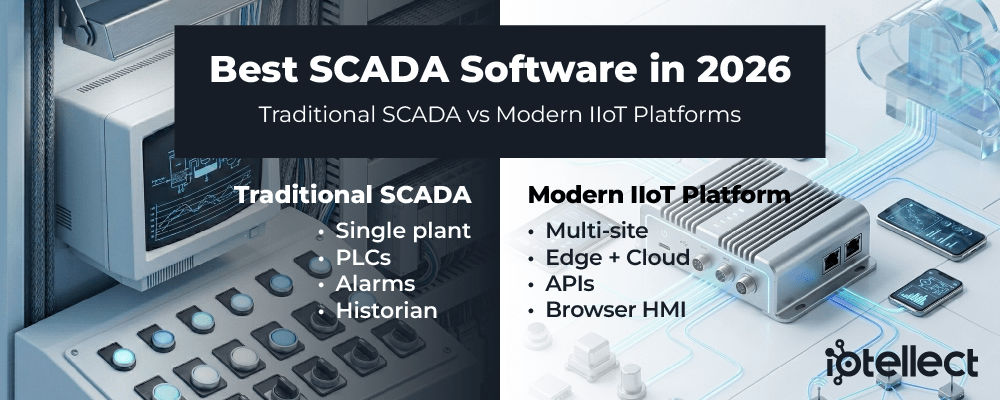
The most-cited “best SCADA software” lists in 2026 share a structural problem. They rank UI features and protocol counts on products whose runtime architecture, corporate owner, and pricing model can all change inside a single procurement cycle. Velotic launched on 17 March 2026 with Proficy CIMPLICITY + iFIX + Kepware + ThingWorx under one PE owner. Kepware shipped a 20% price hike inside 90 days of the close. SQL Server 2016 reaches Extended Support end on 14 July 2026, which forces concurrent OS + database + SCADA migrations across the legacy install base. The SCADA list a procurement team built in early 2025 is not the SCADA list that survives the second half of 2026.
A more useful question replaces the ranking question. Not “which SCADA software is best.” Rather, “what workload is the SCADA system carrying, what architecture does that workload require, and which products still match that architecture under their current corporate owner.” The honest 2026 answer is workload-by-workload, with the runtime architecture as the primary cut.
This article walks the question the way an integrator would walk it. What SCADA software actually does. What the 2026 must-have features look like under audit. How to evaluate products against the architectural axis that matters. Where legacy SCADA hits its real limits. When a modern IIoT platform covers the SCADA workload better. And where the corporate-ownership variable now belongs in the scoring rubric.
What SCADA Software Actually Does
Supervisory Control and Data Acquisition software sits between the PLC and the enterprise IT stack. The traditional core is straightforward: a tag database that mirrors PLC variables, a driver server that speaks the field protocols (Modbus, OPC UA, OPC DA, EtherNet/IP, Profinet, S7, DNP3, IEC 60870-5-104, IEC 61850 in utility contexts, BACnet in building contexts), a human-machine interface that renders the operator screens, an alarm engine that prioritises and routes notifications, a historian that records time-series telemetry, and a scripting layer for site-specific automation logic.
The supervisory role is what distinguishes SCADA from a dashboard. The system is expected to participate in deterministic real-time loops, to maintain redundant runtime servers with sub-second failover, to enforce role-based access on the control surface, and to survive plant network failures without losing operator visibility. ISA-18.2 (“Management of Alarm Systems for the Process Industries”) sets the lifecycle for alarm rationalisation, shelving, journaling, and performance metrics. ISA/IEC 62443 sets the cybersecurity zone-and-conduit model. IEC 61850 governs substation automation. None of these are optional in regulated process industries.
The 2026 SCADA product category covers everything from single-site supervisory installations on a single Windows server up to enterprise platforms managing 1.5 million I/O points across distributed control centres. The protocols, the standards, and the operator expectations have stayed remarkably stable across the last decade. What has changed is what sits above the SCADA system – the data lake, the AI/ML model, the multi-site fleet view, the mobile operator tablet, the IT/OT-converged identity provider – and whether the SCADA architecture can participate in those layers without a parallel rewrite.
The 2026 Must-Have Features Under Audit
The 2026 procurement checklist for SCADA software has shifted from “does it draw the screens” to “does it survive an enterprise IT and OT audit.” The non-negotiable items belong on the RFP before any vendor demo:
- ISA-18.2 / IEC 62682 alarm-management lifecycle. Native rationalisation database, shelving, journaling, performance reporting. Not all SCADA products ship the full lifecycle features – many ship the alarm engine without the rationalisation tooling.
- ISA/IEC 62443 secure-by-design with explicit IIoT scope. The 2026 update of the standard explicitly includes Industrial IoT and cloud-based analytics that interact with field devices. Procurement increasingly requires SL 2 or higher.
- Native protocol coverage at the wire level. OPC UA Part 14 PubSub (EN IEC 62541-14:2026), MQTT, Sparkplug B (with QoS caveat), Modbus, BACnet, DNP3, IEC 60870-5-104, IEC 61850, EtherNet/IP, Profinet, S7. Native means the SCADA gateway speaks the protocol – not “via a Kepware add-on” or “via a Cirrus Link gateway.”
- HTML5 HMI client on a cross-OS server runtime. Browser HMI is the new floor for new deployments. Browser-as-engineering-tool is the higher bar – an HTML5 operator client on top of a Windows-bound engineering IDE is half a modern stack, not a whole one.
- Git-friendly project files. JSON or text, not proprietary binary. Without diff and merge, no peer review, no CI/CD, no audit trail at the project level.
- OIDC / SAML SSO. Local user databases and bare AD integrations do not pass enterprise identity reviews in 2026.
- Native historian throughput at production scale. Below 200,000 data points per second, modern analytics pipelines start to choke. Above that, the SCADA can feed an AI/ML training set without an intermediate ETL.
- Native redundancy. Hot standby or active-active built into the gateway, not licensed as a separate module on top.
- Unlimited-tag pricing tier, or a resource-priced alternative. Per-tag tiers scale unfavourably above 5,000 tags. Above 25,000 tags the tier cost becomes the dominant TCO line. Resource-priced models (CPU + memory + disk) sidestep the per-object meter entirely.
- REST API and webhook-grade integration. OT systems no longer live behind a closed perimeter. The SCADA must publish events and accept queries from the IT stack on equal terms.
- Multi-tenancy. Required for any system integrator or OEM use case. Most legacy SCADA installs as single-tenant by design.
The Three-Check Runtime Audit
The single most useful diagnostic a buyer can run on a “modern SCADA” claim is the three-check runtime audit. It asks three questions of every vendor’s product page and install guide:
- What operating system does the server runtime require?
- What database backend does the platform require?
- What format does the platform use to store project files?
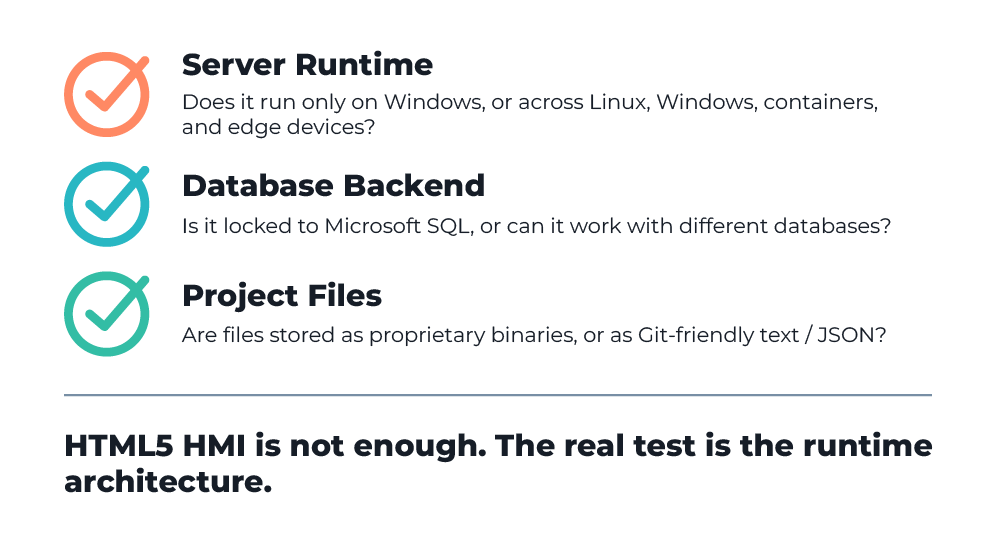
The diagnostic separates UI modernisation from runtime modernisation. HTML5 clients ship on top of legacy server cores routinely in 2026 – the brochure says “modern web-based SCADA,” the install guide says “Windows Server 2019 or later” plus “Microsoft SQL Server 2019 or later” plus a proprietary binary project bundle. The result is a 1990s server architecture with a 2026 paint job.
The products that pass all three checks at the architecture level form a short list. Inductive Automation Ignition gateway runs on Linux, Windows, or macOS, supports multiple SQL backends, and shifted project storage to JSON files in Ignition 8.3 (September 2025). Copa-Data zenon 15 (February 2026) supports Linux and Windows engineering with the same project files. Siemens WinCC Open Architecture v3.21 supports Linux runtime and added PostgreSQL cluster support with Patroni failover plus OpenID Connect SSO. Tatsoft FrameworX 10.1 runs cross-OS with native multi-protocol. Iotellect runs the same codebase across edge, on-premise, and cloud, with multi-tenancy native and a fully browser-based engineering surface that needs no desktop IDE.
Rule of thumb: HTML5 client is the new floor, not the new ceiling. If the runtime stays on Windows + Microsoft SQL + proprietary binary project files, the product is UI-modernised, not architecturally modernised.
The Defensible 2026 SCADA Short-List
The following short-list is built from active 2025-2026 development plus production references plus runtime audit. Brand listicle rankings are excluded as evidence – the procurement-grade test is the architecture, not the press release.
| Product | Owner / 2026 Status | OS Runtime | Database | Project File | Native MQTT / Sparkplug | Pricing Model |
| Inductive Automation Ignition (8.3) | Inductive Automation, private | Linux + Windows + macOS | Multiple SQL | JSON (8.3+) | Native via Cirrus Link | Public list, unlimited-tag |
| Siemens WinCC OA v3.21 | Siemens, stable | Linux + Windows | PostgreSQL + Patroni | Engineered | Native (Northbound Manager) | Contact sales |
| Siemens WinCC Unified | Siemens, stable | Windows | MS SQL | TIA Portal | Via OPC UA + MQTT | Contact sales |
| AVEVA System Platform + InTouch HMI | Schneider Electric / AVEVA | Windows Server | MS SQL | ArchestrA Galaxy binary | Via AVEVA Edge | Contact sales |
| AVEVA Plant SCADA (Citect successor) | Schneider Electric / AVEVA | Windows Server | MS SQL | Proprietary binary | Via AVEVA Edge | Contact sales |
| Rockwell FactoryTalk View SE | Rockwell Automation | Windows Server | MS SQL | .mer / .med binary | Via gateway | Contact sales |
| Rockwell FactoryTalk Optix | Rockwell Automation | Cross-OS + Kubernetes | Multiple | Versioned | Native | Contact sales |
| Velotic Proficy CIMPLICITY / iFIX | TPG / Velotic | Windows Server | MS SQL | Proprietary binary | Via Kepware | Contact sales |
| Schneider EcoStruxure (Geo SCADA Expert, Power Operation) | Schneider Electric | Windows Server | MS SQL | Proprietary | Limited native | Contact sales |
| Copa-Data zenon 15 | Copa-Data, private | Linux + Windows | Multiple | Cross-OS shared | Native | Contact sales |
| Tatsoft FrameworX 10.1 | Tatsoft, private | Cross-OS | Multiple | Text-based | Native | Contact sales |
| Iotellect | Iotellect, independent, 24-year technology | Linux + Windows + ARM + container | Multiple, partner choice | Cross-OS shared | Native | Resource-based (CPU + memory + disk), SCADA product pricing TBD |
| Open-source: Rapid SCADA, FUXA, OpenSCADA, ScadaBR, Scada-LTS, JSON-SCADA | Various community | Linux primary | Multiple | Text / JSON / XML | Native (varies) | Free |
The list is short on purpose. Every product on it has active 2025-2026 development, documented production references, and a procurement-grade pricing or licensing position. Products marketed as “modern SCADA” but still requiring Windows-only runtime + MS SQL + proprietary binary project files belong on the list with that fact made visible, not hidden under the HTML5 client.
The pricing column is the most honest line on the page. Inductive Automation publishes a list price. Iotellect publishes a resource-based pricing model at the platform level and is still finalising the SCADA product pricing scheme. The rest gate procurement behind a sales call. The opacity itself is a signal. Vendors that publish their pricing model trust the architecture to defend the number. Vendors that do not, do not.
Legacy SCADA’s Real Limits in 2026
The legacy SCADA stack rests on assumptions that have aged unevenly. The product still works. The architecture is what shows its age.
The Windows + Microsoft SQL Server tax compounds invisibly. Wonderware InTouch, AVEVA System Platform, AVEVA Plant SCADA, FactoryTalk View SE, GE iFIX, GE CIMPLICITY, and WinCC Classic all require Windows Server and Microsoft SQL Server. The SQL Server licence is bundled or separate depending on the deployment, but the Client Access Licence compounds when scaling across multiple database servers or high-availability topologies. SQL Server 2016 reaches Extended Support end on 14 July 2026. Customers running SCADA on SQL 2016 face Extended Security Updates at premium pricing or a triple-migration of OS + database + SCADA at the same time. That is the worst kind of synchronised change a controls team can plan.
Per-tag licensing scales unfavourably above 5,000 tags. A manufacturer monitoring 10,000 tags across 200 machines can pay $50,000 to $200,000 in SCADA software licensing alone, before hardware, support, integration, or training. The cost curve is non-linear at tier boundaries (250 / 500 / 1,000 / 5,000 / 10,000 / 25,000 / 50,000), and the tier jump is exactly where buyers discover they bought the wrong tier. The dominant pricing pressure across 2024-2026 came from Inductive Automation’s unlimited-tag perpetual model. AVEVA introduced InTouch Unlimited in 2025 as a direct response, with similar All-Inclusive System Platform licensing. Per-tag tiers are dying. Customers on existing tiered contracts still pay the legacy curve until renewal.
Proprietary binary project files block Git, peer review, and CI/CD. FactoryTalk View SE stores .mer and .med binary. AVEVA System Platform stores an ArchestrA Galaxy backup container. WinCC Classic stores mixed binary projects. GE iFIX and CIMPLICITY store proprietary binary. None of these diff cleanly in a Git repository. Without diff and merge, no peer review of HMI changes, no rollback at the project level, no auditable change history that an IT/OT-converged programme can defend. Ignition 8.3 broke the pattern by moving to JSON. FactoryTalk Optix shipped version control as a first-class concern. The split is now visible across the vendor map.
Native MQTT and Sparkplug B coverage is uneven. Inductive Automation co-authored the Sparkplug B specification with Cirrus Link, so native support is the reference implementation. Siemens WinCC OA v3.21 added a Northbound Manager with native MQTT and Sparkplug B. Copa-Data zenon and Tatsoft FrameworX ship native MQTT. AVEVA System Platform, AVEVA Plant SCADA, FactoryTalk View SE, GE iFIX, and CIMPLICITY all require a separate gateway product to publish MQTT or Sparkplug. The gateway adds latency, a licence, and a point of failure. Sparkplug B itself mandates QoS 0 (fire-and-forget) – Cirrus Link’s own documentation acknowledges data loss can occur in the MQTT Keep Alive window when connections fail ungracefully. The honest architecture uses Sparkplug for telemetry and OPC UA for alarm-critical paths.
Single-tenancy breaks SI and OEM use cases. Most legacy SCADA installs as one instance per customer. System integrators and OEMs serving multiple customers run one SCADA per customer, multiplying licence cost, admin overhead, and patching cycles. Modern IIoT-covering platforms ship multi-tenancy as a first-class concern. Iotellect, ThingsBoard, Cumulocity, and Ubidots all treat multi-tenancy as architecture, not as a workaround.
Migration cost is the limitation that buyers underestimate. AVEVA documents the InTouch → System Platform migration path, but the scripts, alarm databases, and historian links require rework. FactoryTalk View ME → SE has no direct conversion path – migration requires redevelopment, RSLinx Enterprise shortcuts are not preserved, and ME user accounts do not transfer. GE iFIX → CIMPLICITY consolidations carry similar re-engineering cost. “Just upgrade” is the marketing answer. Re-engineering is the operational reality.
Warning sign: when a SCADA vendor sales engineer says “the migration is straightforward,” the buyer should ask which RSLinx Enterprise shortcuts, which alarm rationalisation database entries, and which Galaxy backup elements survive without rework. The list of survivors is shorter than the demo suggests.
How Web HMI, Edge, Dashboards, and Analytics Change SCADA
The architectural change in 2026 is not the HMI getting prettier. The change is the SCADA system moving from “the centre of the operational world” to “a participant in a Unified Namespace.”
Web HMI removes the thick-client deployment burden. An HTML5 client renders on any browser-equipped device with zero install, zero version drift, and zero plug-in. That is the floor that Ignition Perspective set in 2018 and that every serious 2026 product now matches at the client tier. The higher bar is the engineering surface – when the IDE itself runs in the browser, configuration, HMI screen design, data-source setup, alarm rules, and reports all happen in the same surface that operators use, with no per-machine install for engineering staff. Iotellect’s engineering environment is the browser itself, not a desktop tool with a web companion. The runtime question stays open – an HTML5 client on top of a Windows-only Microsoft-SQL server is still a Windows-only Microsoft-SQL server.
Edge computing pushes deterministic real-time loops out to the asset. The SCADA system no longer carries the full latency budget – the edge runtime handles the 10 ms loop, the SCADA handles the 100 ms supervisory query, the cloud handles the 10 second analytics roll-up. KubeEdge graduated as the first cloud-native edge project from the CNCF in October 2024, with production deployments at electric vehicle fleets, satellite-ground links, and highway tolls. Ignition Edge, FactoryTalk Optix on Kubernetes, AVEVA Edge in Docker, Copa-Data zenon Linux runtime, and Iotellect’s cross-OS codebase all run the same container topology at the edge that the gateway runs in the data centre. AWS Greengrass and Azure IoT Edge are separate products from their cloud twins, with separate engineering surfaces, separate release schedules, and separate licence terms. That architectural split is the renewal-risk argument procurement teams underestimate.
Dashboards become a query surface on the UNS, not the primary operator interaction. Walker Reynolds at 4.0 Solutions framed the Unified Namespace as a real-time single source of truth for industrial data, semantically organised like the business and built to be open. In a UNS architecture, the SCADA system publishes to the broker (MQTT, Sparkplug, OPC UA PubSub), and dashboards, analytics, AI models, ERP queries, and mobile apps all subscribe from the same source. The SCADA is one publisher among many, no longer the single canonical surface. That architectural reframe is the most important shift in industrial software in the last decade.
Analytics live in time-series stores tuned for the workload – QuestDB, InfluxDB, TimescaleDB, or the platform-native historian. Ignition 8.3 Power Historian on QuestDB hits up to 2 million data points per second under optimal conditions, WinCC OA v3.21 added PostgreSQL clusters for historian, and cross-OS multi-protocol platforms tend to expose a partner-selectable storage back end (relational, NoSQL, round-robin, or file) so the historian fits the workload rather than the other way around. AI/ML training sets feed from the historian or from the UNS, not from the SCADA tag database directly. The SCADA does not need to be the analytics engine – it needs to publish clean enough data that the analytics engine can do its job.
Hint: the SCADA system that participates in a UNS is more valuable than the SCADA system that owns the data alone. Architecture moves the value up the stack.
When Traditional SCADA Still Wins
The reframe is not “abandon SCADA.” Traditional SCADA still owns workloads that no IIoT platform addresses well. Pretending otherwise is the listicle’s mirror error.
Single-plant deterministic supervisory control is SCADA territory. A regulated process running ISA-18.2 alarm rationalisation, with audited shelving and journaling, with sub-second redundancy and operator certification, on a tightly coupled PLC estate – that is the workload SCADA was built for. Ignition, WinCC, AVEVA System Platform, and Copa-Data zenon all defend this workload competently.
ISA-18.2-audited regulated alarm regimes belong on SCADA. Pharma plants, oil and gas refineries, chemical batch operations, water utility control centres. The alarm rationalisation lifecycle, the change-management discipline, and the audit trail are first-class concerns. Most IIoT platforms ship an alarm engine. Few ship a full ISA-18.2 lifecycle with the supporting governance tooling.
IEC 61850 substation automation belongs on utility-grade SCADA. ETAP, AVEVA, VTScada, Arteche saTECH, and a small set of utility-specialist products carry native MMS, GOOSE, and SV implementations. General-purpose IIoT platforms do not.
Brownfield single-vendor PLC estates favour the matching SCADA. A Siemens-PLC-heavy plant gets engineering productivity from WinCC Unified or WinCC OA inside TIA Portal. A Rockwell-PLC-heavy plant gets the same from FactoryTalk View SE inside Studio 5000. The tag re-entry overhead, the engineering workflow integration, and the lifecycle alignment are real – the modern multi-protocol platforms cannot match the single-vendor productivity on the single-vendor estate.
Process-historian-heavy operations favour AVEVA System Platform + PI System. The PI System is the de-facto process industry historian and runs decades of plant-historian data with continuity that an IIoT platform cannot reproduce on day one. Schneider Electric’s ownership of AVEVA stabilises the corporate-ownership variable on this stack.
Rule of thumb: if the workload is one plant, one PLC vendor, one regulated process, and one historian discipline, traditional SCADA still wins.
Choose by Workload, Not by Category
The best platform depends on the job it must do.
Traditional SCADA Fits Best When…
Modern IIoT Platform Fits Best When…
- One plant
- PLC-heavy environment
- Application user interface and UX implemented using platform-provided UI design tools, such as visual dashboard designer and HMI editor
- Regulated alarms
- Local historian
- Deterministic control
- Many sites
- Edge + cloud architecture
- Multi-protocol data
- Dashboards and APIs
- Multi-tenant users
When a Modern IIoT Platform Is the Better Fit
The other side of the cut is where the 2026 procurement decision tilts. Modern IIoT platforms that cover the SCADA workload win on workload axes that classical SCADA was never built for.
Multi-site supervision across more than three plants tilts toward the IIoT-covering platform. The fleet view, the cross-site asset model, the central operator dashboard, the multi-site historian roll-up – these all live more naturally on a multi-tenant, multi-protocol platform than on three or four parallel SCADA installs glued together by ETL middleware.
Multi-protocol estates where Modbus and OPC UA and BACnet and MQTT and HTTP coexist tilt toward the platform with native coverage. Smart-building portfolios, distributed energy back-offices, telecom infrastructure monitoring, and mixed OT/IT environments all carry this mix. A platform shipping 50+ protocol drivers in one license normalises the mix at the ingest layer. A SCADA installed per-protocol cannot.
Multi-tenant system integrator and OEM workloads tilt toward platforms with multi-tenancy native and full white-label as a first-class feature, not a workaround layer. White-label products for industrial customers, regional water-utility deployments under one operator brand, fleet monitoring for OEM equipment in the field, ISV products built on a platform foundation instead of stacked on Java and JavaScript libraries – all of these break on single-tenant SCADA. The vendor list that supports the workload on an architectural default rather than a custom build is short. Iotellect, ThingsBoard, and Cumulocity all qualify under different positioning.
IT/OT-converged programmes that require Git, REST, OIDC, and container deployment tilt toward platforms built for IT review on day one. The enterprise architect asking “where are the project files in version control” gets a different answer from Ignition 8.3 JSON, Iotellect text-based projects, or open-source XML than from a Galaxy backup or a .mer binary.
Deployments that need to run on-premise with a cloud overlay – sovereignty-locked plants in regulated jurisdictions, MENA infrastructure under in-country processing mandates, defence-adjacent estates – tilt toward platforms that run the same codebase across edge, on-premise, and cloud. The “rewrite for edge” tax that hyperscaler stacks ship every few years is a documented procurement liability. Inductive Automation Ignition, Copa-Data zenon, Tatsoft FrameworX, and Iotellect all run a single-codebase model across the three tiers.
Pricing architecture is its own decision axis. Per-tag legacy SCADA scales unfavourably at multi-site fleet density. Per-device or per-event IIoT-platform pricing carries the same shape under a different label. Resource-priced models – CPU cores, memory, disk – sidestep the per-object meter and stay predictable across workload mixes.
Hybrid is also legitimate. Many plants run SCADA on the deterministic control loop and an IIoT-covering platform above it as the fleet supervision and UNS host. The SCADA system publishes to the broker. The platform consumes from the broker. The two coexist as architectural layers, and neither one replaces the other.
Bottom line: pick by workload, not by category.
The Corporate-Ownership Variable
Gartner’s 2025 quadrant scores capability. It does not score ownership stability. In 2026 that gap matters.
Velotic launched on 17 March 2026 under TPG, combining Proficy CIMPLICITY + iFIX (carved out of GE Vernova) with Kepware and ThingWorx (carved out of PTC) into a single industrial software entity. Brian Shepherd is CEO, James Heppelmann is Executive Chairman. ARC Advisory profiled the launch as “a leading independent industrial software company with a 40+ year installed base” – a characterisation that preceded Kepware’s 20% price hike by fewer than 90 days. ABI Research framed it as a threat to incumbent providers. Kepware’s 20% price hike effective June 2026 – inside 90 days of close – is the first visible PE compression-cycle tax on the new stack.
Apply the same mechanic across the broader opaque-pricing SCADA tier. Any single vendor changing PE ownership has a probability under 15% in any 12-month window. The cumulative 36-month exposure across the contact-sales SCADA tier is materially higher. The buyer’s hedge: diversify on a transparent-pricing primary SCADA (Inductive Automation Ignition or an open-source option for non-regulated workloads) plus an architecturally-modern multi-protocol platform (Iotellect with its independent 24-year technology base, Copa-Data zenon, or Tatsoft FrameworX) for the IIoT-covering layer. Treat opaque-pricing legacy SCADA as a renewal-risk asset, not a long-term lock-in default.
Warning sign: any single vendor name moving from “stable independent” to “PE-owned rollup” inside the procurement window is the signal that pricing, support terms, and roadmap can shift inside the renewal cycle. The Velotic precedent is the live case.
Where Iotellect Fits in This Picture
Iotellect is not the best SCADA software. There is no single best SCADA software. The product is the natural fit on a specific set of workload axes that traditional SCADA does not serve well, and the architectural specifics deserve to be named rather than summarised.
The fit starts at the HMI tier, which is where most IoT-platform-meets-SCADA comparisons quietly fail. Most IoT platforms render data into dashboard grids the platform dictates – typical elements, typical layouts, a look the platform wants. Iotellect implements design prototypes the way the design team drew them, pixel for pixel, through low-code configuration rather than scripting. Iotellect’s product team reports that their own market scan from PTC down to open-source IoT dashboards found no equivalent low-code pixel-perfect HMI configuration path on a competing platform – a claim buyers should verify in a live benchmark. The visualisation scale matches utility control rooms rather than departmental dashboards – modular screens up to 20,000 by 10,000 pixels with thousands of objects per screen, the order of magnitude electrical-grid operators, pressure-pipeline supervisors, and water-distribution control centres actually run on a daily basis.
Underneath the HMI sits a patented Unified Data Model – a tree of devices, users, alerts, and process objects with formal variable, function, and event definitions that feeds the SCADA core, the MES product, the BI product, the Predictive Maintenance solution, the EAM solution, the Edge runtime, and the IT Infrastructure Manager from a single canonical structure. For wire protocols outside the 50+ native list, a Flexible Driver lets an engineer parse a non-standard format through Excel-style formulas instead of writing a custom adapter, an option Iotellect’s product team reports finding no equivalent for in their market scan – a claim that merits hands-on comparison during evaluation. For classical PLC logic, the platform speaks IEC 61131-3 Function Block Diagram and Structured Text alongside its query language and its expression language, keeping engineers fluent in soft-PLC productive without a vendor-specific scripting layer.
The engineering surface treats SCADA projects the way modern software teams treat code – multiple engineers work on the same project concurrently, changes merge live, no file locks, no check-out / check-in rituals. AI-assisted low-code replaces the scripting window with visual configuration and Excel-style formulas, and browser-based engineering means the IDE is the browser itself rather than a desktop tool with a web companion. Standard practice in software development for two decades. Still rare in SCADA.
The numeric envelope sits at the utility-grade end of the market: single-server capacity up to 10,000,000 tags and 1,000,000 historian samples per second, sustained acquisition at 200,000 values per second per node, and a distributed architecture for unlimited horizontal scaling. The reference base is 600+ production deployments across manufacturing, energy and power, water and wastewater, oil and gas, pharma and biotech, data centres, food and beverage, and buildings infrastructure. Production workloads need load testing per message-rate, not headline tag count, and the same audit standard applies symmetrically to every vendor’s headline.
The deployment surface is the same code from cloud down to ARM single-board computer. The runtime ships on Windows, Linux, and ARM hardware – a rack server in a data centre, an industrial PC on the factory floor, a Linux-based touch panel, or an ARM single-board computer inside an equipment cabinet – with every feature available subject to local CPU, memory, and disk. Develop the application in the cloud, transfer it to the edge, it runs without rewrites.
Pricing on the broader platform is resource-based. The unit of subscription is CPU cores, memory, and disk – with no per-user, per-device, per-tag, per-event, per-stored-sample, per-concurrent-user, or per-API-call meter on top. The SCADA product pricing scheme is still under final selection across three options the product team is weighing – tag-based, fixed price, or per-CPU-core – and will be published once the scheme is finalised. The structural argument holds regardless of the final scheme – resource-based pricing is the predictable variable against both legacy per-tag SCADA and event-billed IIoT platforms.
System integrator and OEM workloads run on architectural multi-tenancy and full white-label – the installer, the login screen, the documentation, and the runtime UI all rebrand under the partner identity. SI partners ship turnkey projects on one platform across many end-customer estates, OEMs embed the runtime in industrial hardware and resell it alongside the device, and ISVs build software products on the platform instead of starting from raw Java, JavaScript, and .NET libraries. The “one SCADA per customer” tax that breaks single-tenant legacy stacks does not apply.
Beyond the SCADA core, the same platform ships complex event processing, statistical process control, granulation, object-and-process modelling, classes for relational ERP-class apps, and a machine-learning module – the upsell path system integrators can plan against without bringing in another vendor, and the consolidation path customers can plan against to reduce vendor lock-in points, security surface, and infrastructure overhead. Adjacent solutions reuse the Unified Data Model, the HMI editor, the engineering surface, and the deployment story rather than introducing a parallel stack with its own learning curve.
The workloads outside the natural fit are explicit. Single-site deterministic control loops with ISA-18.2-audited regulated alarm regimes belong on Ignition, WinCC, or AVEVA System Platform. IEC 61850 substation automation belongs on utility-vertical products. Brownfield Siemens-PLC-heavy estates that need TIA Portal integration favour WinCC Unified. The natural-fit positioning is on multi-protocol, multi-tenant, pixel-perfect-HMI, resource-priced, cross-OS workloads – not on every workload.
Bottom line: the architectural, engineering, and pricing models that match the deployment that has to run in 2030 are where this platform fits. Traditional SCADA still covers the workload where the architecture matches a single plant under audit today.
Limitations and Open Questions
The same scepticism standard belongs on this article as on every vendor claim.
- Per-tag pricing curves above 25,000 tags are not benchmarked publicly across the major vendors, and each tier behaves differently at scale with the cliff position varying by vendor.
- The Iotellect positioning section relies on canonical product-team and CEO sources – the product passport, the SCADA landing page copy, and the CEO walkthrough transcript. These are product-team claims under buyer-side verification, not independent third-party benchmarks, and should be treated as the start of due diligence rather than the conclusion.
- Practitioner direct quotes are limited in this analysis. Perspective is sourced through aggregated technical-reference and consulting blogs (Corso Systems, NFM Consulting, Industrial Monitor Direct) that cite the underlying threads. Direct community-forum quotation belongs in a follow-up piece.
- Multi-site TCO comparisons depend on payload profile. A 5,000-tag-per-site deployment across 20 sites carries different per-tag economics than a 50,000-tag-per-site deployment across 3 sites, and the article does not model the curves.
- The “Connect” SaaS overlay layer (AVEVA Connect, similar) is still maturing in 2026 and feature parity claims belong with a 12-month wait-and-see qualifier.
- The IEC 61850 substation segment has utility-vertical specialists (ETAP, Arteche, VTScada) that this article touches but does not deep-dive – substation procurement is its own category.
- Open-source SCADA (Rapid SCADA, FUXA, OpenSCADA, ScadaBR, Scada-LTS, JSON-SCADA) has matured to small-deployment viability but does not yet match commercial SCADA on redundancy modes, 24×7 support, or full ISA-18.2 lifecycle tooling. Treat as a tier, not a replacement.
Final takeaway: the best SCADA software in 2026 is the product whose runtime architecture, pricing model, and corporate owner all match the production workload that has to run in 2030 – not the brand that wins the demo this quarter. Run the three-check audit on every product on the short list. Score the workload against the architectural axis. Factor corporate-ownership stability into the renewal-risk model. The honest answer changes depending on the plant.
For teams ready to test the framework on a live procurement plan, the next step is concrete. Walk the Iotellect connection guide against the current vendor shortlist. The protocol matrix, the runtime audit, the multi-tenancy model, the HMI architecture, and the ownership map all belong on the same page before the next procurement review.
A SCADA list answers what software runs today.
A runtime audit answers what software survives until tomorrow.