
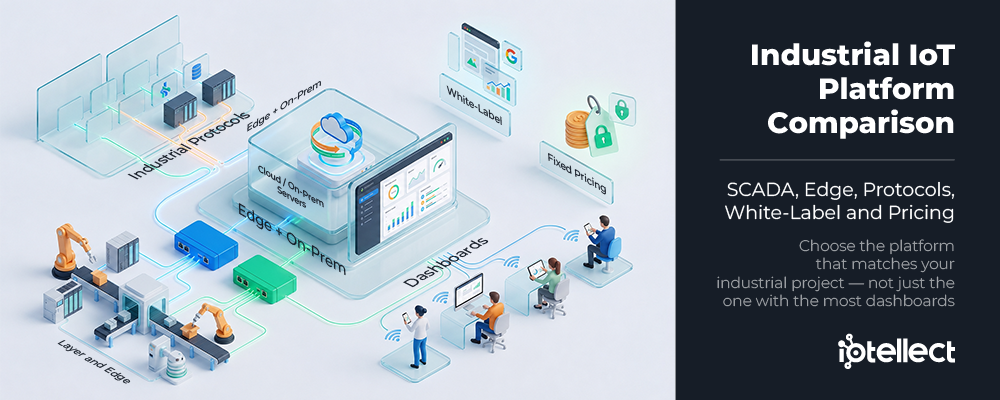
ThingsBoard is one of the most widely deployed open-source IoT platforms in the world, and for a large share of connectivity and dashboarding projects it remains a solid choice. This article is not about whether ThingsBoard is good. It is about the specific point — SCADA/HMI depth, industrial protocol coverage, white-label packaging, or predictable pricing — where teams outgrow it and start evaluating a ThingsBoard alternative.
In short:
- ThingsBoard is a capable open-source IoT platform for connectivity, dashboards, and MQTT-centric projects. Teams usually look elsewhere for SCADA/HMI maturity, deeper industrial protocol support, white-label packaging, or a fixed price they can quote to a client.
- According to ThingsBoard’s own documentation, ThingsBoard Edge PE instances can run offline for up to 7 days before they need to reconnect to ThingsBoard’s server for a license check — a detail worth knowing before you plan an air-gapped deployment.
- If you need SCADA/HMI and 50+ industrial protocol drivers on one fixed annual price, Iotellect is built for that today. If your priority is real-time HMI depth at the OT layer specifically, Ignition is the category incumbent. If you need enterprise device-fleet scale or an MSP contract, Cumulocity or ThingWorx are the conservative default.
- This piece compares 8 ThingsBoard alternatives — Iotellect, ThingWorx, Cumulocity, Losant, Ignition, Ubidots, Akenza, and AWS IoT Core — across protocol depth, SCADA/HMI, white-label/multi-tenant support, on-prem/edge, and pricing model.
The Best ThingsBoard Alternatives at a Glance: An IoT Platform Comparison
The right ThingsBoard alternative depends on what you are actually building — a client-facing industrial IoT platform, a plant-floor SCADA/HMI system, a white-label product for OEM customers, or an internal dashboard. There is no single winner across all of those cases, which is why an honest IoT platform comparison has to be criteria-based rather than a ranked list.
The table below compares eight platforms that show up repeatedly when teams search for ThingsBoard alternatives or thingsboard competitors, across the dimensions that decide a project: industrial protocol depth, SCADA/HMI, white-label and multi-tenant support, on-prem/air-gapped deployment, edge processing, pricing model, and target user.
| Criteria | Iotellect | ThingWorx | Cumulocity | Losant | Ignition | Ubidots | Akenza | AWS IoT Core |
| Industrial protocol depth | 50+ drivers built in (Modbus, OPC UA, BACnet, SNMP, LoRaWAN, Zigbee, KNX, DALI, CAN bus, more) | Strong, mostly via Kepware | Good, via connectivity agents | REST/MQTT only | Deep OT coverage (OPC UA, Modbus, EtherNet/IP); LoRaWAN/Zigbee arrive via add-on modules (MQTT/Sparkplug), not native drivers | Light, prototyping-oriented | Strong LoRaWAN, weak on Modbus/OPC UA | None native — DIY via Greengrass or partner gateways |
| SCADA/HMI | SCADA Module built in today; a dedicated HMI Module with mobile access ships end of summer 2026 | Yes, via Mashup builder | Dashboards, not purpose-built SCADA | None | Deep, OT-native real-time HMI (Vision/Perspective) | None — generic dashboards | None | None |
| White-label / multi-tenant | Built into the platform | Possible, heavier implementation effort | Modular, enterprise-oriented setup | Limited, cloud-only | Per-server licensing model complicates multi-tenant packaging | Limited | Limited | No native multi-tenant UI layer |
| On-prem / air-gapped | Cloud, hybrid, on-prem, and edge; on-premises deployment is documented as supporting air-gapped installs | On-prem heavy, complex to run lean | Cloud plus on-prem options | Cloud-only | Self-hosted server software you operate yourself | Cloud-only | Cloud-only | Cloud-only (AWS-hosted) |
| Edge processing | Edge gateway runtime included | Yes, but a heavier implementation | Agent-based edge connectivity | None | Not edge-native — designed as server software, not a lightweight edge runtime | None | Gateway-dependent | AWS Greengrass, a separate product to integrate |
| Pricing model | Fixed annual, no per-device/message/data-point fees | Enterprise bundle, PTC-priced | Enterprise contract, often opaque | Usage-based — devices, data points, and workflows all meter | Perpetual per-server license plus 16-24% annual support | Credit/tier-based, scales with devices and data | Subscription tiers | Pay-per-use — per message and per connection |
| Target user | Mid-market SI teams and enterprise operations teams | Large manufacturers, PTC-ecosystem shops | Enterprises and telcos/MSPs at scale | Application developers | OT/SCADA engineers and certified integrators | Hardware and SaaS prototyping teams | Smart-building managers, mostly DACH region | Developers building a fully custom stack |
A few things the table cannot show in one line. ThingsBoard itself is not in the table because it is the baseline this whole article is written against — see the feature comparison in ThingsBoard’s own documentation for its side of the story. Ignition is the only platform here that is SCADA-native rather than IoT-platform-with-dashboards. AWS IoT Core is the “build it yourself” option — it gives you device connectivity primitives, not an application layer, so the real comparison is against your own engineering team’s time, not against a finished product.
Iotellect is also listed as a ThingsBoard alternative on AlternativeTo, a community-curated software directory — check it directly if you want an unfiltered, third-party view before reading vendor claims, including Iotellect’s.
Why Companies Look for a ThingsBoard Alternative
Most teams that start evaluating a ThingsBoard alternative are not unhappy with ThingsBoard as a connectivity layer. They have hit one of five specific ceilings: the Community-to-Professional Edition wall, the rule-engine customization limit, SCADA/HMI immaturity, self-hosted install friction, or public security concerns. Each is worth looking at on its own terms.
The Community Edition to Professional Edition wall
ThingsBoard’s free Community Edition (CE) is genuinely open-source and self-hostable, but several features that a commercial product typically needs are gated behind the paid Professional Edition (PE). According to ThingsBoard’s own CE-vs-PE comparison, LoRaWAN payload decoding, advanced role-based access control, white-labeling, and SSO/OAuth 2.0 login are all PE-only. Self-registration — letting your own customers sign themselves up — is also blocked in CE. The community has documented a workaround using a custom AWS Lambda function to bypass this restriction, which tells you how fundamental the gap is for a customer-facing product versus an internal tool.
The rule-engine customization ceiling
ThingsBoard’s rule engine is a drag-and-drop canvas, and reviewers on G2 describe hard limits once logic gets complex: there is no programmatic way to build a rule chain, and no way to unit-test one. That is fine for straightforward alert-and-forward logic. It becomes a real constraint once your integration logic needs branching conditions, testable business rules, or version-controlled configuration — the kind of thing a system integrator needs to hand off to a client with confidence.
SCADA/HMI is a recent addition, not a foundation
ThingsBoard added SCADA-style dashboard widgets starting with release 3.8.0 — recent, relative to a platform first released in 2016. A community feature request (#11942, “SCADA Mode — High Performance HMI Concepts”) asked for high-performance HMI symbols shortly after that release, and ThingsBoard has since shipped parts of it in the 3.9 and 4.0 releases. Basic monitoring screens are well within reach. SCADA/HMI is still an addition to a dashboarding platform, though, not its foundation — which matters if your project’s primary deliverable is an operator screen, not a chart.
Documentation and install friction for self-hosted CE
Two GitHub issues illustrate the kind of friction a self-hosted CE install carries. In #12590, a user working through port conflicts on a Windows CE install then discovered that dashboards only appear after manually creating a tenant — a step the UI does not prompt for. In #14096, ThingsBoard’s own AI assistant suggested a docker run command mapping port 9090, contradicting the port 8080 used throughout the documentation; the ticket was closed for inactivity without a clarifying answer. None of this is unusual for open-source software — it is the DevOps cost that gets traded for a $0 license.
Public security concerns
A Hacker News thread from a self-described one-year Professional Edition user states the platform is “riddled with security issues ranging from trivial to absolutely critical” and that the team “completely ignored them, despite being repeatedly notified.” This is a single account, not a systematic audit, and should be weighted accordingly. Read it in full before a production security review rather than dismissing it or over-weighting it.
ThingsBoard vs. Industrial IoT and SCADA/HMI Platforms
ThingsBoard competes in two different markets at once — general-purpose IoT connectivity platforms and, increasingly, industrial IoT (IIoT) platforms with SCADA-adjacent ambitions. It performs differently in each.
Where ThingsBoard is genuinely strong
ThingsBoard’s open-source model, active GitHub community, and MQTT/CoAP/HTTP connectivity are real strengths, not marketing claims. ThingsBoard Cloud’s pricing is also unusually transparent for this market — full dollar figures are published for every tier up to the Enterprise level, so a prospect can build an exact cost estimate in minutes without talking to sales. If your project is developer-led, connectivity-focused, and comfortable with usage metering that scales with device and data-point counts, ThingsBoard is a legitimate default, not a compromise.
Where dedicated SCADA platforms win
For plant-floor HMI specifically, Ignition by Inductive Automation is the incumbent. Its Designer environment and Vision/Perspective modules are built around real-time industrial screens as the primary deliverable, with deep native support for OPC UA, Modbus, and EtherNet/IP. Ignition’s licensing model — a perpetual per-server license plus 16-24% annual support, rather than per-device metering — is also purpose-built for the OT world’s economics. The trade-off is a per-server licensing structure that gets complicated fast in multi-tenant or white-label scenarios, and modern IIoT protocols like LoRaWAN and Zigbee reach Ignition through add-on modules such as MQTT/Sparkplug ingestion rather than native drivers.
Where Iotellect fits
Iotellect’s position is between the two: SCADA screens and 50+ industrial protocol drivers (Modbus, OPC UA, BACnet, SNMP, LoRaWAN, Zigbee, and more) are built into one platform rather than assembled from a connectivity tool plus a separate SCADA product plus a separate gateway component. As an IIoT platform aimed at system integrators and mid-market operations teams, Iotellect optimizes for fewer moving parts in a single project — not necessarily deeper OT-specific HMI tooling than a dedicated incumbent like Ignition offers today.
What to Compare in an IoT Dashboard, Device Management, and Application Enablement Platform
Before comparing vendor marketing pages, it helps to have a fixed checklist — otherwise every platform’s homepage looks similar. Use this list whether you are evaluating an open source IoT platform alternative to ThingsBoard, a commercial IoT device management platform, or a broader IoT application enablement platform:
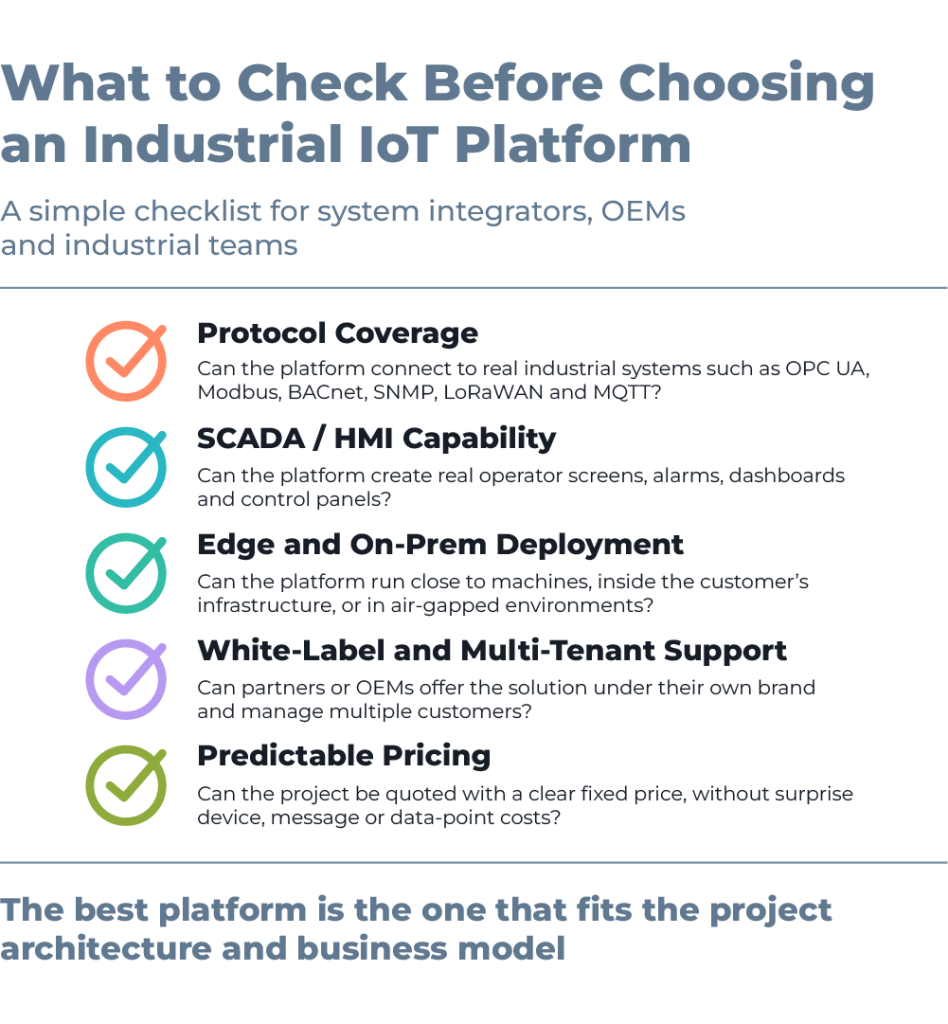
- Protocol driver count and which specific protocols you need. Not “many protocols” — the exact list: Modbus RTU/TCP, OPC UA, BACnet, SNMP, LoRaWAN, and whatever your next five projects will actually require.
- SCADA/HMI out of the box vs. custom build. Does the platform ship operator screens and alarm management, or is that a separate product you need to integrate?
- Pricing model. Device/data-point tiers that scale with success, or a fixed annual number you can quote to a client without a spreadsheet?
- On-prem and edge licensing dependencies. Does “on-premises” or “edge” mean fully self-contained, or does it still require periodic contact with a vendor server to keep running?
- White-label and multi-tenant support. Is rebranding and tenant isolation a core feature, or a paid add-on, or unavailable?
- DevOps burden for self-hosting. How many hours, realistically, from “download” to “team logged in and productive” — and is that burden ongoing (patching, scaling, upgrades) or one-time?
For projects that require supervisory control, compare the SCADA deployment architecture as well: where acquisition, operator screens, alarms, and history run, and which functions remain available during a connection failure.
An IoT dashboard platform that only charts data is a different category from an IoT device management platform that provisions, monitors, and updates fleets of devices — and both are different again from a full IoT application enablement platform (AEP) that also gives you the application logic, user roles, and UI layer to ship a finished product. Know which category you need before comparing vendors in it.
When You Need Stronger Edge IoT Platform and On-Premise IoT Platform Support
If your project needs real industrial protocol depth, true edge processing, or a genuinely self-contained on-premise IoT platform, this is usually where a ThingsBoard alternative search starts in earnest.
The Modbus/OPC UA/BACnet gap
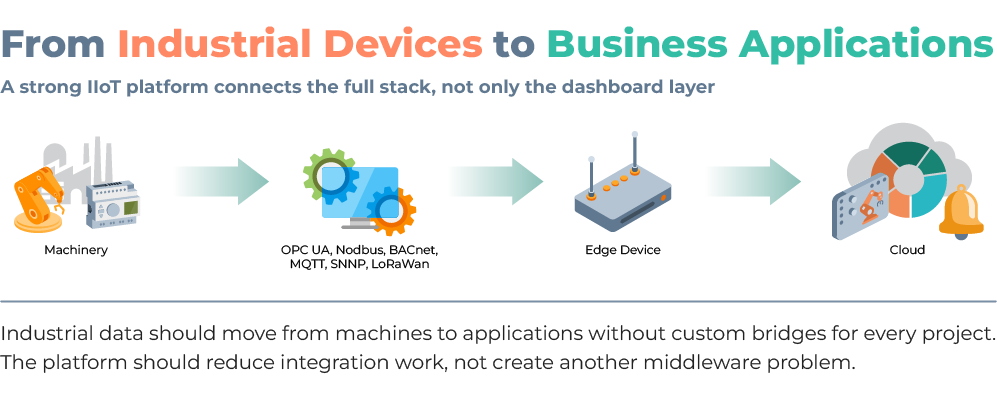
ThingsBoard’s industrial protocol support — Modbus, OPC UA, BACnet, CAN bus — is delivered through a separate component, the thingsboard-gateway, a Python microservice that runs alongside the core platform rather than inside it. That is a workable architecture, but it is an additional moving part to deploy, monitor, and keep patched. Platforms with drivers built into the core remove that extra surface. Iotellect ships 50+ protocol drivers natively, with no separate gateway service to operate — one less component for a system integrator already juggling enough on a client project.
The edge license dependency question
This is a detail worth checking on any platform, not just ThingsBoard: does “edge” or “on-premises” deployment mean fully offline, or does it still phone home? According to ThingsBoard’s own Edge FAQ documentation, ThingsBoard Edge PE instances validate their license over HTTP(S) against ThingsBoard’s cloud endpoint, and can run disconnected for up to 7 days before requiring reconnection for that check (per the same FAQ, an offline instance also should not be restarted, since a restart requires a license check). Edge instances are also recommended for roughly 1,000 devices each and are single-tenant — they cannot be shared across tenants. None of this makes ThingsBoard Edge unusable. It does mean “edge” and “fully air-gapped, indefinitely” are not automatically the same claim — so ask any vendor, including Iotellect, to specify which one they mean.
True air-gapped and on-premise requirements
For defense, critical infrastructure, and other regulated environments where indefinite offline operation is a hard requirement, this distinction is not academic. Iotellect’s deployment options include cloud, hybrid, on-premises, and edge, with on-premises deployment documented as supporting fully air-gapped installations. That claim is deliberately narrow — it does not specify Iotellect’s exact on-prem license-check mechanism. Verify the licensing behavior for your specific deployment with an Iotellect solutions engineer before committing to an air-gapped architecture, on any platform.
Best Alternative for SCADA, White-Label IoT, Enterprise Integration, and Predictable Pricing
There is no single “best ThingsBoard alternative” — the honest answer depends on which of four things you are actually optimizing for.
Best for SCADA/HMI out of the box
If plant-floor screens and alarm management are the primary deliverable, compare Iotellect’s SCADA Module and Ignition directly. Iotellect ships SCADA screens, real-time monitoring, and role-based control panels built with a drag-and-drop visual builder today, with a dedicated HMI Module, including mobile access, shipping by end of summer 2026. Ignition remains the deeper incumbent specifically for OT-native, real-time HMI at scale, with a mature Designer environment most SCADA engineers already know.
Best for a white-label IoT platform
White-label and multi-tenant support is built into Iotellect rather than sold as an add-on — relevant for OEMs, ISVs, and MSPs building a product they will resell under their own brand rather than deploying a single internal solution. These two evaluations usually happen separately — teams shopping for a white-label IoT platform rarely read ThingsBoard-alternatives content, and vice versa — even though the underlying evaluation criteria overlap heavily.
Best for enterprise integration depth
For device-fleet scale in the tens or hundreds of thousands, or an existing enterprise contract relationship, Cumulocity and ThingWorx remain the established picks — both have proven track records at telco and large-manufacturer scale, with the trade-off of enterprise contract complexity and, for ThingWorx, tighter alignment with the PTC ecosystem.
Best for fixed, predictable pricing
If the deciding factor is not being surprised by next month’s invoice, Iotellect’s fixed annual subscription has no per-device, per-message, or per-data-point fees — the opposite of ThingsBoard Cloud’s tiered device/data-point pricing, Losant’s usage-based model, and AWS IoT Core’s pay-per-message structure. This matters most for system integrators who need to quote a fixed price to a client and stand behind it for the life of the contract.
See the full protocol coverage list at iotellect.com/technology/connectivity, or compare packages at iotellect.com/pricing.
FAQ
What are the best ThingsBoard alternatives for industrial IoT?
For industrial IoT projects specifically, the strongest alternatives are Iotellect (50+ protocol drivers and SCADA built in, fixed pricing), Ignition (deepest OT-native SCADA/HMI), and Cumulocity or ThingWorx for enterprise-scale device fleets. The right choice depends on whether SCADA/HMI, protocol breadth, or enterprise contract scale matters most for your project.
Does ThingsBoard support SCADA and HMI?
ThingsBoard added SCADA-style dashboard widgets in release 3.8.0 and has continued expanding them in the 3.9 and 4.0 releases, following community requests such as GitHub issue #11942. It is usable for basic operator monitoring screens but was not built SCADA-first, unlike Ignition or Iotellect’s SCADA Module.
What’s the best low-code platform for OPC UA and Modbus?
OPC UA, Modbus RTU/TCP, BACnet, and SNMP are among the 50+ protocol drivers built natively into Iotellect, paired with a low-code visual builder for the resulting dashboards and SCADA screens. Ignition also supports OPC UA and Modbus natively at strong depth, aimed specifically at OT/SCADA engineers rather than low-code application builders.
Can ThingsBoard run fully offline or air-gapped?
Not indefinitely. ThingsBoard’s own Edge FAQ sets a 7-day maximum for offline operation of Edge Professional Edition before the instance must reach ThingsBoard’s server for a license check, and each edge instance is single-tenant with a recommended ceiling of roughly 1,000 devices. Confirm the exact licensing and connectivity requirements directly with any vendor, including Iotellect, before finalizing an air-gapped architecture.
Is there a white-label ThingsBoard alternative with fixed pricing?
Yes — Iotellect pairs built-in white-label and multi-tenant support with a fixed annual subscription that meters nothing: not devices, not messages, not data points. ThingsBoard’s white-labeling is a Professional Edition-only feature layered on top of its own device/data-point pricing tiers.
How is Iotellect different from ThingsBoard?
Iotellect ships SCADA and 50+ industrial protocol drivers built into one platform with fixed annual pricing, versus ThingsBoard’s open-source core plus a separate gateway component for industrial protocols, PE-gated white-labeling and advanced RBAC, and device/data-point-based pricing on ThingsBoard Cloud. ThingsBoard remains a strong choice for developer-led, MQTT-centric, connectivity-first projects.
What should I compare before switching from ThingsBoard to another platform?
Compare protocol driver count against your actual project list, SCADA/HMI maturity, pricing model (metered vs. fixed), on-prem/edge licensing dependencies, white-label and multi-tenant support, and the realistic DevOps burden of self-hosting. A platform that wins on one of these can still lose on another — weigh them against your specific project, not a generic scorecard.