
Prices checked on 29 September 2026. Vendor prices change. Check the linked pages before budgeting.
An IoT price list fixes one number and lets another move the bill.
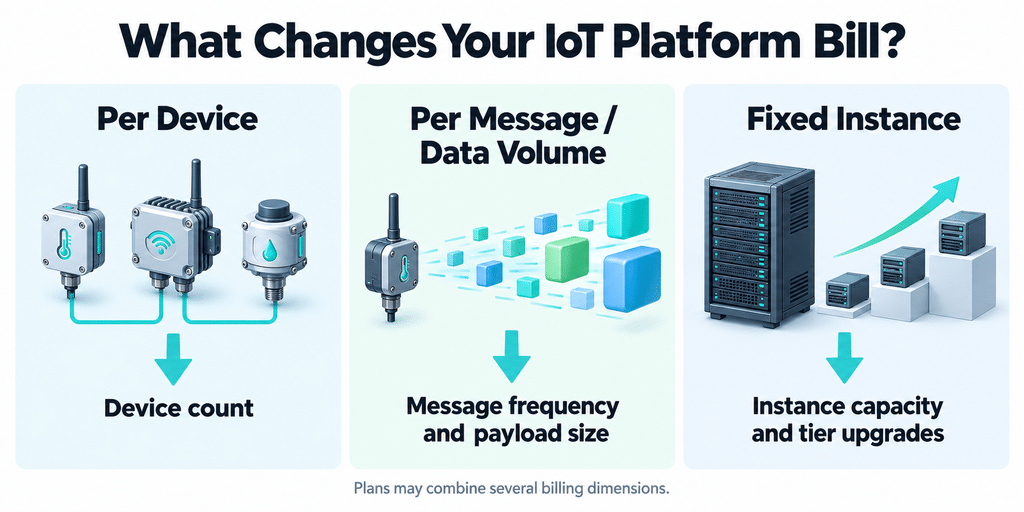
IoT platform pricing models differ in what they count: devices, messages against a size increment, data volume, users or instance capacity. Most published price lists checked combine two or more, and many add a custom enterprise tier. Metered bills follow the telemetry profile (message rate and size) and can be forecast once measured. Fixed-instance pricing removes the usage meter, not the capacity ceiling, and holds for the subscription term.
Why IIoT Platform Pricing Is Hard to Compare
One price list often counts several things. AWS, for instance, bills IoT Core connectivity, messaging, Device Shadow, registry and rules engine usage separately.
“Per message” is not a common unit either. AWS meters messages “in 5 KB increments” and Microsoft charges IoT Hub messages in 4-KB chunks, so a message is billed in whole blocks of that size. ThingsBoard counts data points instead, each “a single telemetry measurement (e.g., temperature=22)”. Scope differs too: ThingsBoard’s Cloud plans include hosting and its on-premises plans do not, and the AWS and Azure figures below cover the broker or hub only.
Sellers of several different models promise predictability: ThingsBoard’s perpetual licence offers “predictable costs”, Golioth says “Get predictable pricing”, and Iotellect calls its total cost of ownership “fully predictable and transparent”. Because the label is shared, only the arithmetic separates the models. Under metered pricing the bill follows the telemetry profile – message rate, payload size against the billing increment, data points per message, batching at the edge – not just the device count. It is forecastable once that profile is measured. AWS and Azure budget alerts do not stop usage on their own: Microsoft states that “your consumption isn’t stopped”, and AWS warns that costs “may continue to increase or decrease after you receive the notification”. Both let the buyer configure an action at a threshold.
In Flexera’s 2026 State of the Cloud survey of 753 respondents, 85% named cost a top cloud challenge and 17% reported exceeding their public cloud budgets in the past year. The survey covers all cloud use rather than IoT specifically, and it is vendor-run. We found no IoT-specific survey that measures how often metered IoT bills overrun.
IoT Platform Pricing Models Compared: What Is Counted and How It Is Sold
The usual seven labels (per device, per message, data volume, users, infrastructure capacity, fixed instance, custom enterprise) sit on two axes: what the vendor counts and how it sells that count. Table 1 also adds what the seven labels miss: connection time, tags, throughput caps and storage as a priced line.
IoT platform pricing comparison by counted dimension (vendors’ own pages, checked 29 Sep 2026)
| What is counted | The bill follows | Sold as (examples checked) | Example, in the vendor’s own words |
|---|---|---|---|
| Devices or connections | active or registered devices | pay-as-you-go per device, or a tier with included devices and extra-device fees | Golioth “$0.25 per connection Charged per active device per month” · ThingsBoard Cloud Startup “500 devices”, Business “$0.30 /extra device Supports scaling up to 5,000 devices.” |
| Connection time | minutes connected | pay-as-you-go | AWS IoT Core “$0.08 per million minutes of connection”, “metered in one-minute increments” |
| Messages, with a size increment | message count × size units | pay-as-you-go with volume tiers | AWS IoT Core “$1.00 per million messages – first 1 billion messages/month”, “metered in 5 KB increments” (US East, N. Virginia) |
| Messages sold as capacity units | a daily message quota per unit | provisioned units | Azure IoT Hub S1 $25 per unit per month, 400,000 messages/day per unit, 4 KB meter (East US) |
| Data points | key/value readings per month or per minute | tier with an allowance or a ceiling | ThingsBoard Cloud Startup “500M data points/mo” · Private Cloud Launch “50,000 msg/minute” |
| Data volume | bytes processed | pay-as-you-go | Golioth Pipelines “$0.0080 per MB Based on total data processed and delivered” |
| Users or customer accounts | named users, customers, client sessions | plan allowance plus packs, or not counted inside a server licence | ThingsBoard Cloud “Extra Customer pack $10 /month” · Ignition “one license gives you an unlimited number of clients, tags, and connections” |
| Tags or I/O points | tag count, where a list counts it | licence bands or a per-server licence | Ignition counts servers, not tags: “Ignition is sold by the server, so you’ll need one license per server.” |
| Throughput cap | a rate ceiling per tier | tier boundary, upgrade instead of overage | ThingsBoard Private Cloud “There are no data point rate overage fees” and “sustained traffic above plan limits requires an upgrade” · Azure “Every tier has daily message limit after which you will experience throttling.” |
| Storage or retention | GB or days kept | included allowance plus per-GB or per-MB charge | ThingsBoard Private Cloud “500 GB of storage included”, then “$0.50 per GB” · Golioth LightDB Stream “$0.001 per MB Only billed for long-term retention” after “30 days” free |
| Compute capacity | a server, a unit or a dedicated instance | perpetual licence plus support, or a dedicated-instance subscription | Ignition Platform “$1,200 USD”, perpetual, per server · ThingsBoard Private Cloud Launch “$1 499 /month” |
How the count is sold
| How it is sold | What is fixed | What moves the bill | Who carries capacity risk | Example |
|---|---|---|---|---|
| Pay-as-you-go | unit rates | usage: messages, minutes, MB, devices | the buyer, as bill variance rather than a tier ceiling | AWS “there’s no minimum or mandatory usage service fee” · Golioth “No platform tiers”, “No minimums or seat licenses” |
| Tiered subscription with quotas | tier fee | extra devices, packs, a forced upgrade at a limit | shared | ThingsBoard Cloud: extra devices “can only be purchased with the Business plan” |
| Provisioned capacity units | unit price | number of units bought | the buyer (a reached quota means throttling, not overage) | Azure IoT Hub “up to 200 units for a size 1 or 2 IoT hub, or up to 10 units for a size 3 IoT hub” |
| Dedicated or fixed-instance subscription | monthly fee for the term | a tier step when a ceiling binds | the buyer (sizing) | ThingsBoard Private Cloud upgrade rule |
| Perpetual licence plus annual support | one-time licence per server | extra servers, modules, support percentage per year | the buyer (hardware) | Ignition |
| Custom enterprise quote | negotiated terms | the contract | allocated by contract, not observable from outside | see Custom Enterprise Licensing below |
Notes: prices as published on each vendor’s own page, checked 29 Sep 2026, in USD. AWS prices are for US East (N. Virginia), Azure for East US, ThingsBoard for its North America tab. A price line describes how the vendor prices, not what the product does. The risk column is this article’s reading, not a vendor statement.
Per-Device Pricing and What Drives IoT Cost per Device
Device or endpoint count is a common billing unit among IoT application platforms. On the price lists checked, though, it is rarely the only meter. Golioth charges “$0.25 per connection” per active device per month plus data by the megabyte. ThingsBoard Cloud bundles devices with a data allowance: Startup is “$399 /month” for “500 devices” and “500M data points/mo” (North America tab, checked 29 Sep 2026).
Denser telemetry changes the tier without adding a device. At 500 devices sending 1 KB with 10 data points, one message a minute fits Cloud Startup at $399. One message every ten seconds produces 1.314 billion data points a month, above Startup’s 500 million. The fleet then buys on-demand Traffic Packs (“+5M data points” for “$5”) or moves to a larger plan, such as Private Cloud Launch at $1,499.
Best for: fleets with a known device count and a light, stable message profile.
Limitations: a data allowance inside the tier can run out before the device limit is reached, and a device limit ends in an upgrade (device 501 needs Business at “$749 /month”). The per-device fee is the same at one report a day or one a second. Check whether a price list counts active or registered devices.
Per-Message and Data-Volume Pricing
Metered pricing charges for what the fleet sends, with “no minimum or mandatory usage service fee” on AWS, and the marginal price falls at volume. The condition that changes the message count: “Messages are metered in 5 KB increments. For example, an 8 KB message is metered as two messages.” Payload and topic both count.
AWS IoT Core meters (US East, N. Virginia, checked 29 Sep 2026)
| Meter | Price line (verbatim) | Condition |
|---|---|---|
| Messages | “$1.00 per million messages – first 1 billion messages/month” · “$0.80 per million messages – next 4 billion messages/month” · “$0.70 per million messages – over 5 billion messages/month” | “Messages are metered in 5 KB increments.” Payload and topic are counted |
| Connectivity | “$0.08 per million minutes of connection” | “metered in one-minute increments” |
| Rules engine | “$0.15 per million rules triggered” · “$0.15 per million actions executed” | “Rules and actions are metered in 5 KB increments of the message size.” |
| Basic Ingest | “you do not incur a messages cost for messages sent or received using the reserved topic of Basic Ingest” | rules and actions are billed as in the rules engine line |
Batching, the ingestion path and payload size change this bill. In Microsoft’s example, batching 40 sensor reads into one 4-KB message takes a device from “960 messages/day” to “24 messages/day”. At 50,000 devices on the baseline profile (1 KB per device per minute), Basic Ingest lowers the AWS estimate from $2,784 to $832. Payload size acts through the 5 KB increment: at 6,000 bytes instead of 1,000, the 500-device estimate rises from $30 to $59, because each message becomes two billing units.
Data-volume pricing follows bytes. Golioth Pipelines is “$0.0080 per MB Based on total data processed and delivered”, so payload size and frequency multiply the line.
Best for: pilots, fleets that send rarely or in bursts, teams that measure and batch their telemetry, and large steady fleets with a lower-cost ingestion path (on the baseline profile, AWS Basic Ingest is the lowest line at every fleet size below).
Limitations: the bill follows message rate × size increment × routing, not device count. At one 4 KB message a second, 500 devices come to $1,647 a month on AWS with one rule.
Per-User Pricing
Among the vendors named here, users are a plan allowance or not counted at all. ThingsBoard Cloud allows 2 to 200 customers by plan, from Free to Business, and sells an “Extra Customer pack $10 /month”. Its on-premises plans state that “Every plan includes unlimited customers, dashboards, integrations, API calls, data points and messages”, yet the monthly subscription is still “priced by the devices and assets you need”. Ignition licenses “an unlimited number of clients, tags, and connections” per server.
Best for: few, known operators and many devices.
Limitations: for a system integrator, customer accounts typically grow with the business. “Unlimited” users or clients move the limit to another unit – devices, servers or hardware.
Infrastructure-Based and Fixed-Instance Pricing
Capacity pricing ties the price to a hub unit, a server or a dedicated instance instead of to devices or messages. It gives a fixed-price IoT platform line for the subscription term.
Capacity price lists (checked 29 Sep 2026)
| Price list | Price line | What caps it | Conditions |
|---|---|---|---|
| Azure IoT Hub, S tier, East US | S1 $25, S2 $250, S3 $2,500 “Price per IoT Hub unit (per month)” | 400,000 / 6,000,000 / 300,000,000 messages per day per unit, 4 KB meter. “Every tier has daily message limit after which you will experience throttling.” | “Prices are estimates only and are not intended as actual price quotes.” Up to 200 units per S1 or S2 hub, 10 per S3 hub |
| Ignition, perpetual, per server | Ignition Platform “$1,200 USD” · Industrial Historian “$3,500 USD” | “Ignition’s unlimited licensing model has no limits but the hardware you run it on does” | “The price reflected is an estimate and not a final cost.” “Ignition is sold by the server, so you’ll need one license per server.” Support: “BasicCare is 16% … TotalCare is 20% … PriorityCare is 24% of the retail price of the software at the time of purchase and is billed annually.” |
| ThingsBoard Private Cloud, North America tab, monthly billing | Launch “$1 499 /month” · Growth “$2 199 /month” · Scale “$3 999 /month” · Enterprise “Custom” | 5,000 / 25,000 / 50,000 devices included · 50,000 / 100,000 / 500,000 “msg/minute”, counted as data points · 500 GB / 1 TB / 2 TB storage | “$0.10” / “$0.09” / “$0.08” “/extra device”. “There are no data point rate overage fees” and “sustained traffic above plan limits requires an upgrade”. “Short-term bursts up to 20 % over the dp/minute ceiling for ≤ 15 min are tolerated.” “Save 10% on annual plans” |
On the baseline profile the Azure bill steps from $50 to $450 to $2,500 across the three fleet sizes. One Ignition server with the platform and the Industrial Historian lists at $4,700 once (“an estimate and not a final cost”) plus $940 a year for TotalCare: $9,400 over five years, before hardware, database or integration work. At 5,000 devices, one extra data point per message moves a ThingsBoard fleet from Launch to Growth, a 46.7% step with the device count unchanged. Its Private Cloud tiers also add a fee per extra device, so a dedicated instance is not automatically flat-priced.
Best for: fleets with a known, steady message profile that want a fixed monthly line, and long-lived sites that prefer capital expenditure, or CAPEX (the per-server perpetual variant).
Limitations: the usage meter goes, the capacity ceiling stays – in hardware, in a daily quota or in a data-point rate. The buyer carries the sizing risk, and outgrowing a tier is a step. Headroom is paid for: AWS’s design guidance warns that a poor capacity decision can leave a buyer “sitting on expensive idle resources”. “Fixed” holds for one subscription term, a perpetual licence carries annual support fees if support is kept, and hosting can sit outside the licence (ThingsBoard on-premises plans “do not provide hosting services”). Check whether each tier states a throughput figure, and ask for one if it does not.
Custom Enterprise Licensing
Published price lists typically end in a custom quote above the listed tiers, and some vendors publish no production price at all. ThingsBoard’s top Private Cloud tier reads “Custom” and asks buyers to “Share your devices, msg/min, and retention”. Microsoft notes that “Actual pricing may vary depending on the type of agreement entered with Microsoft, date of purchase, and the currency exchange rate”. On the vendors’ own pages, quotes are typically sized on a mix of device count, throughput, retention, isolation, SLA and support tier.
Best for: large or regulated multi-site programmes and custom SLAs.
Limitations: quotes cannot be compared from public pages, and this research found no neutral benchmark of their contents. Price protection, escalation caps and SLA credits sit in the contract, not on the price page.
Industrial IoT Platform Costs at 500, 5,000 and 50,000 Devices
The examples show which variable drives each bill. They are not a ranking of vendors.
Assumptions
| Input | Value | Why |
|---|---|---|
| Month | 730 hours = 30.4167 days = 43,800 minutes | one convention for every vendor |
| Currency and region | USD · AWS US East (N. Virginia) · Azure East US · ThingsBoard North America tab · Golioth, Ignition, Iotellect as published | prices differ by region |
| Prices | list prices checked 29 Sep 2026 · free tiers not included · figures rounded to the nearest dollar | reproducibility |
| Discounts | not modelled: AWS and Azure agreements, ThingsBoard “Save 10% on annual plans”, Golioth annual contracts with “higher volume discounts”, Ignition “You can get a discount if you order in bulk” | list prices only |
| Bytes | decimal (1 KB = 1,000 bytes) for payloads. Vendor increments as the vendor states them (AWS “5 KB”, Azure “4 KB”) | vendors define units differently |
| Messages | 1 per device per minute (1,440 per day) | Microsoft’s own worked example uses this rate – a vendor illustration, not an industry norm |
| Payload | 1,000 bytes, plus a 100-byte MQTT topic for AWS | same example. One billing unit under AWS 5 KB and Azure 4 KB |
| Data points per message | 10 | needed for ThingsBoard, which counts data points |
| Connection | always connected | AWS bills connection minutes |
| AWS routing | one rule and one action per message. Hub-only and Basic Ingest also shown | AWS bills rules and actions separately |
| High-frequency variant | 500 machines × 100 tags × 1 sample per second, batched into one 4,000-byte message per second, report-by-exception off | conservative case. Sparkplug recommends report-by-exception (“SHOULD”) but gives no reduction figure |
| System-integrator variant | 50 customers × 100 devices, baseline telemetry, pooled vs isolated per customer | the integrator’s architecture changes the bill |
Baseline profile: 1 KB per device per minute (list = published list price of the tier the assumptions select, est. = estimate on stated assumptions)
| Line | What the figure covers | 500 devices | 5,000 devices | 50,000 devices | Custom quotation (not modelled) |
|---|---|---|---|---|---|
| AWS IoT Core, one rule + one action | messages in 5 KB units, connection minutes, rules, actions. Broker only | est. $30 | est. $302 | est. $2,784 | AWS agreements |
| AWS IoT Core, hub only | messages, connection minutes. Broker only | est. $24 | est. $237 | est. $2,127 | – |
| AWS IoT Core, Basic Ingest + one rule | connection minutes, rules, actions (no messaging charge on the reserved topic). Broker only | est. $8 | est. $83 | est. $832 | – |
| Azure IoT Hub, S tier | units × daily quota in 4 KB blocks. Hub only | est. $50 (2 × S1) | est. $450 (18 × S1) | est. $2,500 (1 × S3) | agreements (“Prices are estimates only”) |
| ThingsBoard | tier with included devices and a data-point allowance or ceiling. Hosted platform | list $399 Cloud Startup | list $1,499 Private Cloud Launch | list $3,999 Private Cloud Scale | at 11 data points per message: 5,000 devices → Growth $2,199, 50,000 devices → Enterprise “Custom” |
| Golioth | per active device + per MB | est. $300 ($125 + $175) | est. $3,002 ($1,250 + $1,752) | est. $30,020 ($12,500 + $17,520) | annual-contract volume discounts, unpublished |
| Iotellect | published price of the tier the page’s “≈” guidance indicates. Fit depends on telemetry rate, data model and retention and is confirmed with the vendor | list $99 Basic | list $499 Standard | list $1,999 Premium | above “≈ 10,000 – 100,000 devices”: Enterprise “Contact Us” |
Notes: (1) Scope differs by line. AWS and Azure cover the ingestion broker or hub only. ThingsBoard Cloud: “All subscription plans include hosting and email costs.” The ThingsBoard Private Cloud fee “covers the full provisioning and maintenance of your dedicated environment”. Golioth as listed. Iotellect Cloud plans include hosting of the dedicated instance, see the Iotellect section. (2) ThingsBoard lands exactly on its ceilings in all three columns (500 included devices, then 50,000 and 500,000 data points per minute). At 500 devices, device 501 needs Business at $749. (3) Golioth: MB read as 10^6 bytes (the page does not define MB), data counted once, volume discounts on annual contracts not modelled. (4) Azure: S tier modelled. B-tier unit prices are $10 / $50 / $500 per unit, and Microsoft’s page lists different features per tier. (5) AWS: the one-rule assumption adds $7 / $66 / $657 to the hub-only figures. The AWS free tier is ignored because the page shows both a 12-month allowance and a credit model for new customers. (6) Iotellect tiers follow the page’s “≈ 100 – 1,000”, “≈ 1,000 – 10,000” and “≈ 10,000 – 100,000 devices” guidance, and device count is “practically limited by platform instance’s network bandwidth, computing power, and memory size”. The next steps are $99 → $499 → $1,999 → Enterprise “Contact Us”. (7) Excluded from every line: time-series storage and database compute, egress, edge hardware, support, implementation, taxes, and hosting for any licence-only line.
At 500 devices, the metered AWS lines ($8 to $30) and the Azure capacity-unit line ($50) sit below the subscription tier prices. At 50,000 devices, the metered line (AWS $2,127 to $2,784 without or with one rule, $832 via Basic Ingest), the capacity-unit line (Azure $2,500) and the fixed-instance list prices sit in the same order of magnitude. Each covers a different scope (note 1). At that size most published price lists also end in a custom quote, so list arithmetic is a reference, not what large buyers pay.
Telemetry frequency at a fixed fleet of 500 devices or machines
| Line | 1 per minute, 1 KB (baseline) | 1 per 10 s, 1 KB | 1 per second, 4 KB, 100 data points | What drives it |
|---|---|---|---|---|
| AWS IoT Core, one rule | est. $30 | est. $173 | est. $1,647 (hub only $1,253, Basic Ingest $396) | message count × size units |
| Azure IoT Hub | est. $50 (2 × S1) | est. $250 (1 × S2) | est. $2,000 (8 × S2) | daily blocks, throttle checked |
| ThingsBoard | list $399 Cloud Startup | list $1,499 Private Cloud Launch, or Cloud Startup plus on-demand Traffic Packs (not modelled) | custom quotation (3,000,000 data points per minute exceed Scale’s 500,000) | data points per minute |
| Golioth | est. $300 | est. $1,176 | est. $42,173 ($125 + $42,048) | payload bytes |
| Iotellect | list $99 Basic by “≈” guidance | not modelled: no throughput per tier is published | not modelled: depends on sizing, confirmed with the vendor. No throughput per tier is published | instance resources |
Notes: the high-frequency variant generates 1,314,000,000 messages, 5,256 GB of payload a month and 3,000,000 data points per minute. Azure: S1 would need 108 units ($2,700) and S3 costs $2,500. The average 500 messages per second stay within the 960 per second that 8 × S2 allow. Payload sensitivity at 500 devices, one message a minute, 6,000 bytes instead of 1,000: AWS $59, Azure $100 (4 × S1), Golioth $1,176, ThingsBoard unchanged if data points are unchanged, Iotellect not modelled, since tier fit is confirmed with the vendor. Golioth figures use list rates. Golioth states that “Large fleets and high volume data streams qualify for volume discounts”, not modelled here.
At a fixed fleet of 500, one 4 KB message per second with 100 tags puts the AWS, Azure and Golioth lines in the same order of magnitude as 50,000 baseline devices. Published data-point ceilings run out, and capacity pricing needs a sizing answer from the vendor rather than a list price.
Multi-customer system-integrator variant: 50 customers × 100 devices
| Vendor | How customers are counted | Pooled (one hub, account or instance) | Isolated per customer | Licence clause on hosting for third parties |
|---|---|---|---|---|
| AWS IoT Core | not counted in the IoT Core price list | est. $302 | IoT Core cost unchanged. Business Support+ is “Whichever is greater: $29/month per account – or – 9% of monthly AWS charges”, “calculated on a per-account basis”: $1,450 per month if support is enabled on every account | none on the pricing page |
| Azure IoT Hub | not counted | est. $450 (18 × S1) | est. $1,250 (50 hubs × 1 S1) | none on the pricing page |
| ThingsBoard | Cloud: 2 to 200 customers by plan, “Extra Customer pack $10 /month”. On-premises: “Every plan includes unlimited customers” | on-premises Business $499 + 4,000 × $0.1 = $899 a month, licence only (“do not provide hosting services”) | n/a | Business Source License from v4.4, announced 29 Sep 2026: “You may serve your clients from a deployment you operate, including multi-tenant, under your own key. Their devices count toward your Organization’s limits, and ThingsBoard branding must stay visible.” Free License: “commercial use up to 100 devices on one server” |
| Ignition | not counted, “sold by the server” | one server: $1,200 platform, modules extra | one server per customer site: 50 × $1,200 = $60,000 once, TotalCare $12,000 a year (modules excluded) | Licence agreement (July 30, 2025): “Hosted Systems. You will not permit any third party to benefit from the use or functionality of the Software via a rental, lease, timesharing, service bureau, hosting service, or other similar arrangement without Inductive Automation’s written consent.” Resellers include “integrators, and original equipment manufacturers” |
| Iotellect | Tenants “Not limited”, “practically limited by instance’s computing power and memory size”. White-labeling “App UI” (Basic, Standard), “App UI + On-premise Platform Installers + Platform Documentation” (Premium) | not priced here, since hosting rights for third-party customers are not stated | n/a | not stated on the pricing page. The Terms bar customers from sublicensing (3.3) and from the right to “distribute, resell, provide to rent Software” (6b). Purchases through an “authorized Partner” follow Section 5, and partner terms are not published |
For an integrator, isolating each customer turns unit floors (Azure: one S1 unit per customer hub) and per-account minimums (AWS support, if enabled on every account) into multipliers, and per-server licences multiply with sites. Where tenants are not counted, the question moves from price to licence rights and instance capacity.
Hidden Costs in IoT Total Cost of Ownership: Storage, Support, Edge Hardware and Implementation
The platform price is one line of IoT total cost of ownership in every model. The lines in Table 8 sit outside most published prices.
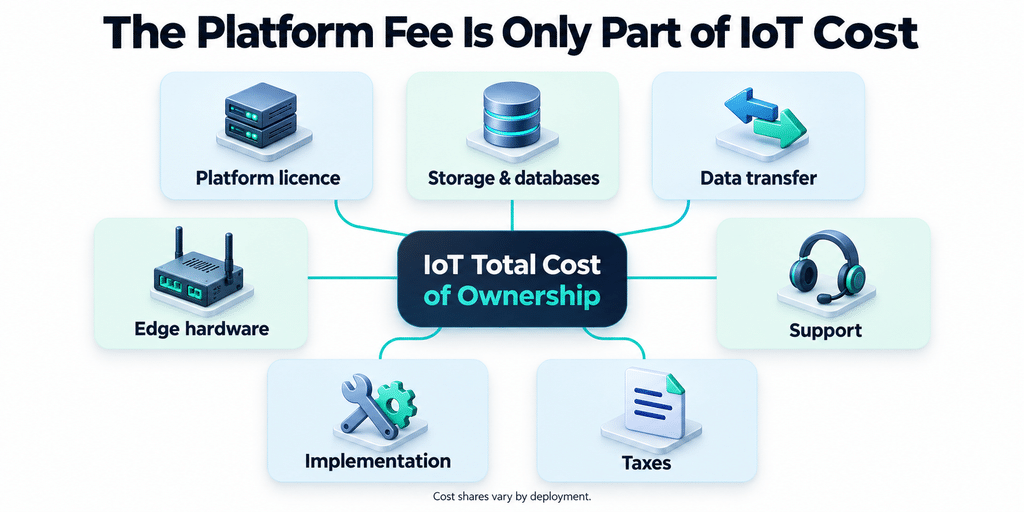
Cost lines outside the platform price (checked 29 Sep 2026)
| Cost line | Published price or evidence | Condition |
|---|---|---|
| Object storage | S3 Standard “$0.023 per GB – first 50 TB / month of storage used” | US East |
| Time-series database | AWS worked example for Timestream for InfluxDB: “Total monthly cost: $737.88”, of which storage “$40.00”. Multi-AZ “$1,476.49” | AWS’s example, region not stated |
| Egress | 100 GB a month free, “aggregated across all AWS Services and Regions”, then “$0.090 per GB – first 10 TB / month data transfer out beyond the global free tier” | US East |
| Support, AWS | “Whichever is greater: $29/month per account – or – 9% of monthly AWS charges up to $10K”, with lower percentages above | “Business Support+ fees are calculated on a per-account basis.” |
| Support, Azure | “$29 per month $100 per month $1,000 per month” | Developer, Standard, Professional Direct |
| Support, perpetual licences | Ignition 16%, 20% or 24% of the retail price per year | Virginia’s 2025 IT procurement manual: support and maintenance fees “are generally charged as a percentage of the license cost” |
| Edge hardware | $390 to $3,450 per unit | single-unit list prices on manufacturer stores, different device classes |
| Implementation | not included in any published price | no neutral source quantifies it. A NIST-funded report (January 2025) cites the IoT Advisory Board’s 2024 report, which lists “high implementation costs” among the challenges that have hindered IoT adoption |
| Users and API calls | counted by some plans (ThingsBoard Cloud customers and users by plan), included in others (ThingsBoard on-premises “unlimited customers, dashboards, integrations, API calls”) | see Per-User Pricing |
| Taxes | Ignition prices “do not include sales tax” | – |
Storage volume is arithmetic a buyer can do: points per month × bytes per point. The baseline 500-device fleet writes 219,000,000 points a month – 3.5 GB at 16 bytes per point, or 0.3 GB at the 1.37-byte compressed average that the Gorilla paper reports on Facebook monitoring data (VLDB 2015). Compare the result with a tier’s storage allowance: ThingsBoard Private Cloud includes 500 GB to 2 TB (Table 4), and Iotellect lists “80 GB”, “320 GB” and “1200 GB” for Basic, Standard and Premium, with retention “practically limited by platform instance’s disk space”.
Exit risk is a cost no price includes. Google set August 16, 2023 as the retirement date of its IoT Core service. AWS closed Amazon Timestream for LiveAnalytics to new customers effective 6/20/25, without affecting existing workloads. Price protection for the term, notice and data-export clauses, standard protocols and IoT connectivity options, and an independent copy of the data reduce that risk.
How Iotellect Pricing Works
Iotellect publishes its fixed-instance IoT platform pricing as “fixed subscription costs for dedicated platform instances” and says: “No more need to count devices, events per day, bytes sent and received, registered and concurrent users, or REST API calls!”.
The published prices are $99 per month (Basic), $499 per month (Standard), $1,999 per month (Premium) and Enterprise “Contact Us”. Demo is a free limited trial for non-commercial use. Prices are in US dollars and exclusive of taxes (Terms 4.4). Tier guidance is by fleet size: “≈ 100 – 1,000”, “≈ 1,000 – 10,000” and “≈ 10,000 – 100,000 devices”. Devices, messages, users, tenants and API calls are “Not limited” on every tier, each “practically limited by” the instance – for devices, by its “network bandwidth, computing power, and memory size”. Perpetual licences exist under the Terms (“one-off license fee upfront”), with no published price. On Cloud plans, Iotellect hosts the dedicated instance and the hosting is included in the monthly price. Standard and Premium also list hybrid and on-premise deployment, and the pricing FAQ sends on-premise and hybrid buyers to the sales team. The published plans list support hours, a service desk and training, not implementation services.
Outgrowing a tier is a step: $99, $499 and $1,999 a month (×5.0, then ×4.0), then a quote. The pricing FAQ describes an upgrade as archiving the application and restoring it “to a new Iotellect instance running under the upgraded subscription”. Commercial pilots pay the $99 floor. The price holds for the subscription term: the Terms allow pricing changes “at the start of any next Subscription period”. On-premise, the customer covers “all computer hardware and other equipment” and “all relevant third-party software and hosting costs”. No throughput figure per tier is published, so Tables 5 and 6 place Iotellect by the page’s “≈” device guidance, not by a computed fit, and fit is confirmed with the vendor. On the baseline profile, the AWS and Azure estimates, which cover the broker or hub only, sit below Basic at 500 devices, and AWS Basic Ingest sits below the Iotellect tier at every fleet size.
The model suits buyers who want the platform line of the budget fixed. The trade-off is that capacity planning moves to the buyer.
How to Choose Between IoT Platform Pricing Models
Predictable IoT platform pricing comes from sizing against the counted dimension that reaches its limit first. That sizing takes five measured inputs: messages per device per day, bytes per message against each vendor’s billing increment, data points per message, retention period, and the number of isolated customers or sites.
Then put in writing the questions list prices cannot answer:
- What happens at the limit: an overage bill (a per-unit charge above the allowance), a forced upgrade or throttling?
- Which ceiling is hit first, and what does the next step cost?
- What does the price cover – hosting, storage, support, edge licences?
- Is it protected for the term, and what are the notice, data-export and renewal terms?
- For integrators and OEMs, does the licence allow hosting for third parties or resale under another brand?
Rule of thumb: pilots and fleets that send rarely fit metered or per-device plans, steady known profiles fit capacity or fixed-instance pricing, long-lived CAPEX sites fit a perpetual per-server licence, and the largest programmes end in a custom quote.
This comparison has limits. Throughput per tier is not published on every capacity list, negotiated prices are not observable, no neutral source quantifies implementation or migration costs, and no IoT-specific survey measures metered overruns. The telemetry inputs are assumptions – replace them with measured values from a pilot or an existing fleet.
Metered pricing puts the variance in the bill. Fixed-instance pricing puts it in capacity planning.
FAQ: IoT Platform Pricing
What are the main IoT platform pricing models?
The usual labels are per device, per message, data volume, per user, infrastructure capacity, fixed instance and custom enterprise licensing. Underneath, vendors count devices, connection time, messages, data points, data volume, users, tags, throughput, storage or instance capacity, and sell the count as pay-as-you-go, tiered subscriptions, capacity units, fixed instances, perpetual licences or custom quotes. Most published price lists checked combine two or more.
How much does an IoT platform cost per device?
The device line is rarely the whole bill, because data or rate allowances run out as telemetry grows. Golioth charges “$0.25 per connection Charged per active device per month” plus data by the megabyte. ThingsBoard lists “$0.30 /extra device” on Cloud Business and “$0.10 /extra device” above the 5,000 included in Private Cloud Launch on monthly billing (North America tab, checked 29 Sep 2026).
Which IoT pricing model is the most predictable?
No model is the most predictable by label alone. Metered bills follow the telemetry profile and can be forecast once it is measured, while AWS and Azure budget alerts do not stop usage unless the buyer configures an action. Capacity and fixed-instance pricing fixes the platform price for the term and moves the risk to capacity planning.
What does a fixed-price IoT platform include?
What is included varies by plan, so check the price page line by line for hosting, storage, support and edge licences. ThingsBoard shows both cases: its Cloud plans “include hosting and email costs”, and its on-premises plans “include only the license fees and do not provide hosting services”. The other check is what caps the fixed price (devices, a data-point rate or the instance’s hardware) and how long the price holds.
What costs belong in an industrial IoT total cost of ownership?
An industrial IoT total cost of ownership includes the platform licence plus storage and database compute, egress, support, edge hardware, implementation and taxes, and per-account or per-site multipliers for integrators. On the pages checked, AWS support has a “$29/month per account” floor, AWS gives 100 GB of data transfer out to the internet free each month across all its Regions, and US East then charges “$0.090 per GB – first 10 TB”, and edge hardware lists at $390 to $3,450 per unit (single-unit list prices, different device classes).