
Why pay for an IoT platform when Node-RED can collect and process data, a database can store it, and Grafana can put it on a dashboard? For a system integrator or an equipment manufacturer whose engineers already know those tools, this is a reasonable question. Adopting a platform introduces one-time or even recurring licensing costs, a learning curve, and a relationship with another vendor. Those costs need to buy something more consequential than a different way to draw charts.
The strongest case for a platform emerges when an application must represent an infrastructure, maintain its changing state, and support an expanding set of operational requirements. At that point, the engineering challenge includes the model behind the screens, the calculations running against it, and the work required to keep the whole application dependable. In our case, Iotellect’s architectural advantage is that these capabilities can share an application foundation that the partner would otherwise have to assemble and maintain. Understanding that advantage requires looking beyond the first successful data pipeline.
Start With a Fair Comparison
Node-RED and Grafana provide substantial capabilities. Node-RED has Git-backed projects and context storage for retaining information at node, flow, and runtime-wide scopes, with persistence options. Grafana can query multiple storage systems, including relational databases, and supports alerting. An evaluation should give these tools credit for what they already do and include the database, identity arrangements, deployment tooling, and additional services needed by the proposed application.
The term “IoT platform” also covers different architectures. Here, we are considering a platform that supplies a shared application model, processing mechanisms, and operational facilities, with Iotellect as the concrete example. A vendor’s category label does not establish that it offers those capabilities. The meaningful comparison is between two complete applications meeting the same requirements, including their ongoing engineering obligations.
The Application Needs a Model of the Infrastructure
Consider a factory application that begins by collecting machine measurements and displaying trends. Later, the customer wants to navigate from the enterprise to a region, factory, shop floor, production line, and individual machine. They also want maintenance areas, service teams, spare parts, and repair histories associated with the right equipment. Several of these entities have no corresponding device message: the application must introduce them and define their relationships.
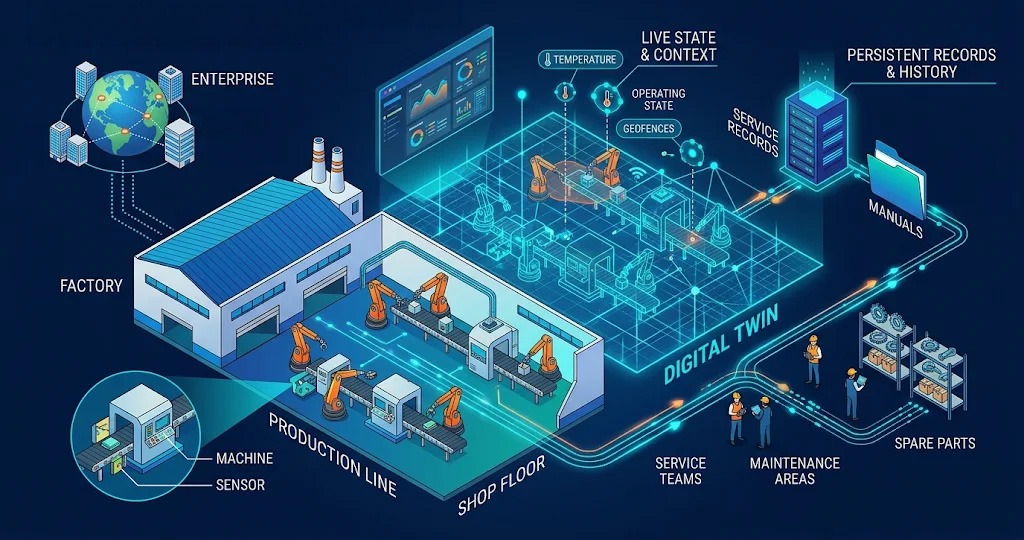
This shared representation is the operational digital twin of the infrastructure. It includes the current state of assets and the context needed to interpret that state. A temperature belongs to a particular machine; that machine serves a production line; a maintenance activity can change how its condition should be interpreted. Locations, geofences, dependencies, and organizational relationships can become just as important as the incoming measurements.
The live model also needs access to persistent information. A machine’s recent operating state may be held in memory while years of service records remain in a database and manuals reside in document storage. Stable identifiers and explicit relationships connect those representations. The design question is how the application maintains that connection and exposes it consistently to its different features.
An integrator can build this layer around Node-RED and Grafana, using relational tables, services, and reusable application code. That is a valid architecture. It also creates an asset-modeling and application-runtime responsibility that belongs to the integrator. As requirements grow, the cost increasingly comes from owning that shared layer and keeping its consumers consistent.
A Shared Model Reduces the Cost of Change
Iotellect represents devices and system objects through a hierarchical context tree. Contexts expose a common interface of variables, functions, events, and metadata. Its models can represent facilities, assets, processes, and other application entities, while classes provide persistent, related records. These architectural mechanisms give different application features a common way to refer to the infrastructure.
Consider an illustrative change: a customer wants to distinguish a machine that is unavailable because of a fault from one deliberately taken out of service for maintenance. That distinction affects the machine view, production-line availability, escalation rules, and reporting. If each feature independently derives the meaning of “unavailable”, every implementation must be located and changed. A common model allows the partner to define the relevant state and have the consuming features use that definition.
The saving comes from reducing independent interpretations of the same business concept. Engineers still need to design the rule, decide which features should consume it, and test the resulting behavior. A shared definition gives the team one meaning to review and fewer mappings that can drift apart as the application evolves. It also makes the dependencies affected by a change easier to discuss and test.
The same separation helps when equipment changes. Suppose a gateway is replaced and its tag names change while the physical machine remains the same. With a deliberate normalization boundary, the partner can update the connection mapping while preserving the application-facing model. Existing calculations and interfaces can continue using that model, provided its contract remains intact.
This is also why a shared database is only part of the answer. Tables can record identities and relationships, but the application still needs conventions for reading state, invoking behavior, reacting to changes, applying permissions, and exposing objects to engineers and operators. Iotellect’s model instances participate in standard operations such as copying, permissions management, event monitoring, and status viewing. The partner starts with a common resource lifecycle instead of implementing each of those facilities separately for every new entity type.
Scale Includes Computation Over Connected State
An application that forwards independent measurements has a different workload from one that repeatedly evaluates relationships across a live infrastructure. Assessing the effect of a network failure can require examining connected devices and service dependencies. Recalculating regional fleet assignments may involve current positions, availability, and operational constraints across many thousand vehicles. These examples show why device count alone is a poor description of the processing problem.
Node-RED’s normal JavaScript execution depends on the Node.js event loop. Asynchronous I/O lets the runtime serve many activities efficiently, but a long CPU-intensive operation on that loop can delay other work. Node.js also offers worker threads for parallel JavaScript execution and mechanisms for sharing buffers. There are therefore several ways to extend the architecture, each with its own design and integration work.
Multiple processes introduce another consideration: their application objects do not automatically become one shared in-memory model. The designer must choose how to partition the workload, share or replicate state, and coordinate calculations spanning those partitions. A load balancer distributes incoming requests, but it does not make those decisions. Node.js’s cluster documentation explicitly describes workers as separate processes and cautions against relying on process-local objects for shared session state.
Iotellect provides configurable concurrency for model processing. Its documentation also describes how moving expression evaluation close to the relevant server-side state can avoid repeated network round trips. The architectural benefit is the ability to keep related state and processing together while using the platform’s execution facilities. Specialized algorithms still need suitable implementations, and concurrency does not automatically make an arbitrary graph calculation faster. Concurrency within a server and state ownership or replication between servers remain separate design questions in Iotellect too.
Keeping a working model in memory can reduce data-access overhead, but correct results still depend on how changing values are read. A calculation may need a consistent snapshot, tolerate slightly different update times, or deliberately operate on the latest available values. That requirement belongs in the application design whichever technology is selected. A useful performance evaluation measures the actual calculation, its latency, and its effect on other workloads.
Deployment Simplicity Has an Operating Value
Distributing an application can provide independent scaling, failure isolation, and deployment flexibility. It also introduces service communication, data-consistency decisions, dependencies, and more components to observe. Typical architecture guidance identifies these as practical trade-offs of microservices. The business question is whether their benefits justify the continuing engineering obligations for the application being delivered.
A Node-RED and Grafana solution can also have a compact deployment. Additional services become relevant when the chosen design needs capabilities such as a shared model, specialized computation, or coordinated access to distributed state. Each added service brings something useful, but someone must own its configuration, recovery, upgrades, and interactions with the rest of the system. AI-assisted development can accelerate creating that code; the deployed dependencies and their operating responsibilities remain.
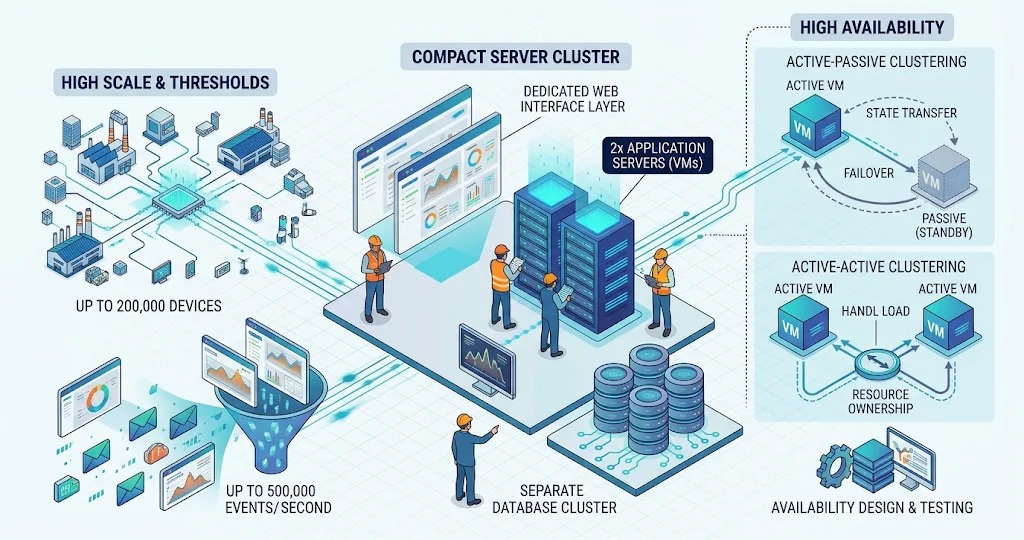
In our deployment experience, many Iotellect projects keep application responsibilities together in a compact server cluster. A representative arrangement uses two application-server virtual machines, a separate database cluster, and, where appropriate, a dedicated web interface layer. Larger or more specialized installations can distribute roles and processing further. The practical benefit is having an established deployment pattern that can serve substantial applications before the partner needs a more elaborate architecture.
Iotellect supports active-passive and active-active clustering, with resource ownership determined by the configuration. An active-passive pair provides failover capability without doubling active processing capacity. Active-active operation needs its own allocation and recovery design, and the database and operator-access paths must be considered as well. The platform supplies mechanisms; the solution still needs an availability design and commissioning tests.
For a concrete indication of scale, our officially published figures include up to 200,000 devices per server and up to 500,000 processed and stored events per second. These are separate published upper figures, not a combined benchmark for the deployment described above. Capacity depends on metric counts, update rates, application logic, storage settings, and available resources. A sizing exercise must reproduce the intended workload rather than infer capacity from the word “device.”
The Benefits Extend Beyond Performance
Fewer Interfaces to Maintain
A shared platform can reduce the number of independently evolving internal interfaces the partner must maintain. Its supplied modules use a common application interface, so the partner has less reason to build a separate adapter for every interaction between them. This can reduce the compatibility work involved in releasing changes and handing a solution to its support team. The delivered application still needs regression testing, particularly around custom logic and external integrations, but a common foundation allows more of that testing and operating knowledge to be reused.
More Consistent Access Control
Access control becomes harder to reason about when the dashboard, application logic, and data backend each apply independently maintained interpretations of a customer’s infrastructure. Iotellect provides permissions for platform resources, and its query results respect the permissions of the originating user or resource. That common mechanism can reduce the number of authorization mappings a partner needs to coordinate. External systems and custom integrations still require their own checks, but application features have a shared basis for deciding which resources a user may access.
This matters when a customer reorganizes responsibilities. Giving a maintenance team access to a particular group of assets should lead to a coherent result across the features using those assets. A dashboard filter alone cannot establish that result; backend access must follow the intended policy. A shared permission model makes the policy easier to express and test across the application.
A Clearer Path Through Failures
When an operator reports an incorrect value, engineers need to follow its path from acquisition through processing to presentation. Independently defined identifiers and transformations create additional places where meaning can change. A common object model gives the team consistent references for the asset, its state, and the logic using it. That reduces the mapping work needed to trace a value through the application and identify where it first became incorrect.
The same principle helps define support responsibilities. A supported platform gives the partner a defined escalation route for suspected runtime defects, while application configuration, custom logic, and delivery commitments remain the partner’s responsibility. Devices, networks, and external systems retain their own owners. A more consistent platform boundary can reduce uncertainty about where to direct an investigation.
More Reusable Engineering Across Customers
For an integrator, the value of a common foundation can extend across its entire project portfolio. A reusable asset model, a tested application component, and an established deployment procedure can become starting points for subsequent deliveries. Engineers can also reuse their knowledge of the model, permission system, and operating tools. That creates a practical route from one successful project to a repeatable offering.
The benefit depends on how the partner handles customer differences. If every installation accumulates unrestricted custom behavior, a platform can still end up supporting many diverging applications. Keeping reusable logic separate from customer-specific configuration makes updates and support more predictable. The commercial opportunity is to spend more engineering effort on the customer’s operational problem and less on rebuilding the underlying application machinery.
Compare the Responsibilities in Production
A useful comparison should show who implements and maintains each responsibility. The following table describes the decisions to examine, rather than a universal feature score for every possible stack. Existing frameworks, commercial extensions, and services already operated by the customer can change the effort on either side. Their costs and responsibilities belong in the comparison too.
| Production Responsibility | Node-RED + Grafana With Supporting Components | Iotellect |
|---|---|---|
| Assets, hierarchy, and relationships | Provide a shared model through schemas, services, and application conventions. | Configure models, classes, and relationships within the common application model. |
| Reusable behavior | Organize flows, backend logic, and queries so they use consistent definitions. | Build behavior around model variables, functions, events, and bindings. |
| Demanding calculations | Select worker threads, additional processes, or a compute service and design state access. | Use platform processing controls and keep calculations near model state where appropriate. |
| Authorization | Coordinate application, data-source, and dashboard access policies. | Apply common resource permissions and validate custom and external access paths. |
| Failure recovery | Coordinate recovery of components and any custom shared-state layer. | Configure platform and database recovery mechanisms and test the application’s behavior. |
| Changes and upgrades | Validate flows, schemas, queries, plugins, and custom services together. | Validate application changes against the platform, database, and external dependencies. |
| Ongoing engineering | Maintain the selected components and the application infrastructure assembled around them. | Maintain the application and deployment while relying on the vendor for the supplied platform core. |
The table also exposes the conditions under which a platform earns its cost. Its facilities need to fit the actual application, and the partner must learn to use them effectively. Licensing, platform constraints, release compatibility, and dependence on the supplier remain part of the decision. A strong platform comparison makes those costs visible alongside the engineering work it can absorb.
Choose for the Application You Will Have to Maintain
Node-RED and Grafana can be a sensible choice when the application has stable requirements, primarily transforms and displays data, or can rely on an established backend that already supplies the necessary model and business logic. A team with the skills and capacity to maintain that backend may reasonably prefer the control of a component-based approach. Existing investments and operational experience also matter. Replacing a working, maintainable system needs a clear benefit.
Iotellect becomes especially relevant when the application keeps acquiring new kinds of assets, relationships, calculations, workflows, and user responsibilities. Its shared foundation lets the partner develop those requirements within a common application environment. The benefit should be assessed across successive changes and deployments, because that is where reuse and consistent behavior have the opportunity to repay the initial learning and licensing costs. A convincing demonstration should therefore include the engineering process as well as the finished screen.
For the next evaluation, bring a realistic change request. Add a logical entity that is absent from the device data, connect it to existing assets and service records, calculate a useful state, restrict who can access it, and test what happens during a failure. Compare the resulting behavior, the effort required to achieve it, and the responsibilities left with the delivery team. The strongest reason to adopt Iotellect is the amount of application infrastructure your team can stop rebuilding while continuing to solve more valuable customer problems.