
BMS architecture is the framework that connects building sensors, meters, controllers, networks, servers, databases, and operator interfaces. It typically includes field, automation, and management levels and uses protocols such as BACnet, Modbus, KNX, OPC UA, and MQTT to integrate HVAC, lighting, energy, security, and other building systems.
ISO 16484-3 does not standardize BMS architecture. Every vendor diagram pretends otherwise.automation, and management levels and uses protocols such as BACnet, Modbus, KNX, OPC UA, and MQTT to integrate HVAC, lighting, energy, security, and other building systems.
One terminology note first. European standards state that a system complying with the ISO 16484 series should be designated a building automation and control system (BACS), and that BACS “is also referred to as BMS” – per EN 15232-1 (2017, superseded by EN ISO 52120-1). ASHRAE terminology defines the near-synonym BAS through an energy-management lens. One object, three acronyms.
In our deployments, three points decide whether a building management system architecture ages well. First, levels are levels of function, not boxes of hardware. Second, the classic pyramid survives as logical roles while the physical tiers consolidate around edge and cloud. Third, integration fails on identity and ownership, not on protocol compatibility. This guide works through all three.
The Components of a BMS: What the Standard Actually Lists
What does a BMS actually consist of? Ask five vendors and you get five diagrams. We prefer the inventory from the people who wrote the standard. ISO 16484-2:2004 grouped BACS hardware into five physical categories: devices for management functions and operator stations, controllers and automation stations (including application-specific controllers), field devices and their interfaces, cabling and interconnection, and engineering and commissioning tools. It arranged them in a generic system model – explicitly generic, a non-mandatory topology that any conforming system should fit. That edition stayed current until January 2025, so two decades of BMS-components literature trace back to its text.
ISO 16484-3 (2005) adds the parts folk component lists omit. A BACS “mainly consists of field and control devices, switchgear assembly, cabling, network, communication, and computing devices (hardware), system software and functions achieved by engineering services.” A BMS is hardware plus software plus engineering. The commissioning labor is a normative component, not an afterthought. The same part defines field devices as sensors, actuators, coupling units, and local override devices, connected over a field network or by direct wiring – both standards-conformant. It also scopes management functions to include data exchange with foreign systems, recording and archiving, and decision support for energy management, the standards basis for the servers, databases, and trending engines at the top of the stack.
The 2025 revision is the interesting one. ISO 16484-2:2025 reorganizes the hardware into four device roles: management stations and operator panels, devices for data storage and analysis “such as edge or cloud servers”, automation stations for control applications, and sensors and actuators for acquiring physical quantities. Its topology now covers devices inside and outside the building envelope, and the document shrank from 58 pages to 15. Edge and cloud servers are first-class BMS components now. The standard did not freeze the 2004 picture – it slimmed down to roles.
The Three Levels: Field, Automation, Management
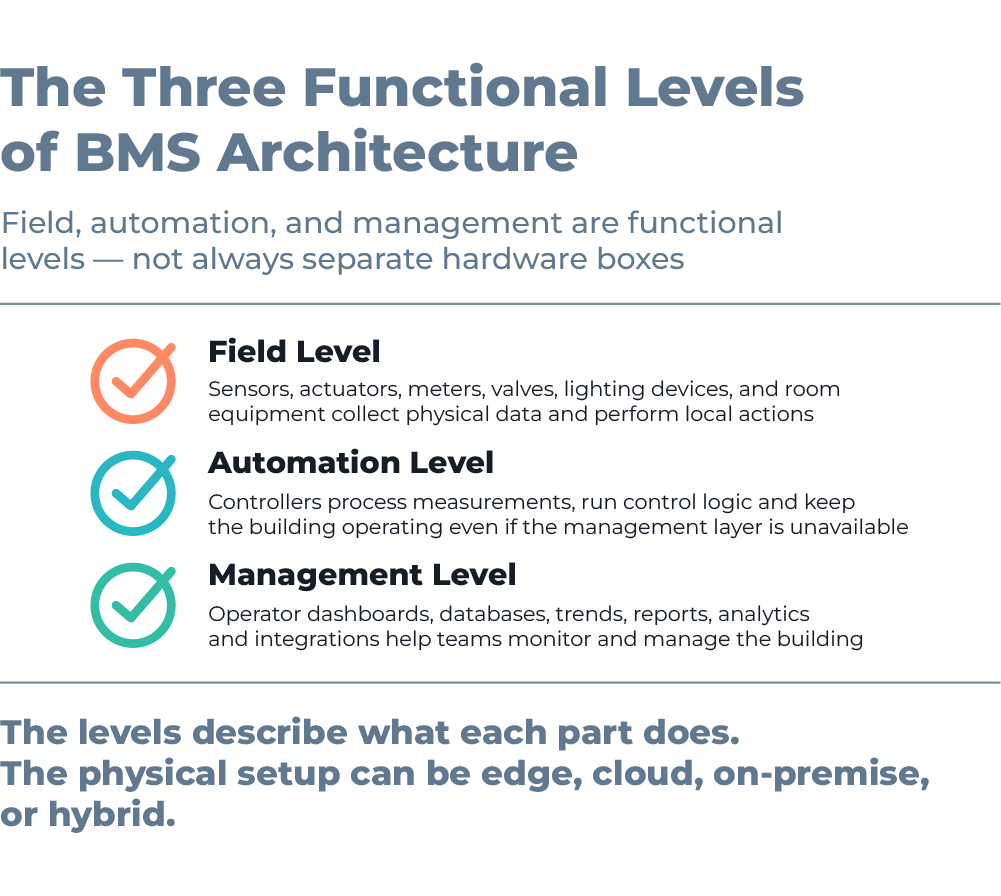
Per ISO 16484-3 (2005), the functions of a BACS are structured into three levels: management, automation and control as processing functions, and input/output as the interface to field devices. ISO 16484-3 states its purpose is not to standardize system architecture – the three levels are levels of function, and Part 2 offers a generic, non-mandatory topology. Operator functions are deliberately not assigned to any level, because an HMI can attach at an automation station, a local panel, or a management workstation. Any BMS architecture diagram that pins the operator interface exclusively to the top is over-reading the standard.
The academic literature allocates responsibilities the same way. In the review by Domingues et al. (2016), the field layer handles interaction with sensors and actuators, the automation layer processes measurements, executes control loops, and raises alarms, and the management layer hosts presentation, trending, logging, and archival. Fieldbuses dominate at the field level, while data aggregates over an IP backbone at the management level. Functions first, hardware second.
How Many Levels Does a BMS Actually Have?
So how many levels does a building automation architecture actually have? Three levels of function – and two to four tiers of hardware, depending on who draws the diagram. ASHRAE Guideline 13 introduced a “multitier” architecture model only in 2015, and it speaks in tiers, not ISO’s levels. Practitioners instantiate it as enterprise, building, and equipment tiers, each owned by a different stakeholder (IT owns the enterprise tier, facilities and vendors own the rest). The four-layer diagrams common in trade press are teaching aids – no building standard specifies them. And the US DoD’s UFC 3-410-02 (2018) specifies just two tiers, a basewide system over building-level DDC networks whose LonWorks segments it calls “logically flat”. Large procurement frameworks do not mandate a three-level topology. The BMS levels drift because they were never boxes.
Is the model obsolete, then? The standards say no. ISO re-issued Part 1 in 2024 and Part 2 in 2025, keeping the level roles and adding edge/cloud servers as a device class. The standard bent to reality instead of breaking. What genuinely moves is the hardware. Cloud BMS offerings relocate the management level into provider data centers behind secure gateways (one cloud-BMS vendor – Envigilance, 2026). And what anchors the automation level in place? Autonomy – one integrator (BC Solutions, 2025) frames it as the tier that “must maintain uninterrupted operation regardless of management level connectivity”, and that matches our field experience. PassiveLogic, a vendor selling autonomous control, concedes in its own 2026 launch materials that today’s building automation systems are “mostly Level 0”, hard-coded and black-box. The installed base remains classic scripted control. Integrators citing the ASHRAE Handbook put BAS component service life at 10 to 15 years (Building Controls & Solutions, 2025), so a controller sold in 2024 into a tiered design serves to about 2035. Note the interest symmetry: “the pyramid is dead” comes from vendors selling its replacement, “the levels are eternal” from incumbent integrators. Recap: the functional triad holds, the tier count is negotiable.
BMS Communication Protocols: Who Speaks What, and Where
When we sort protocols for a new building, the map is the levels themselves. A 2022 academic security review sorts the classic protocols by exactly this frame: BACnet at management and automation, KNX, LonWorks, and Modbus at automation and field. Among the classic building field protocols, only BACnet natively spans automation to management. The BACnet architecture was purpose-built for buildings. Committee work started in 1987, ANSI/ASHRAE 135 first appeared in 1995, ISO adopted it as 16484-5 in 2004, and the current edition 135-2024 shipped in December 2024, with specific support for HVAC, lighting, access control, elevators, and fire detection. Its core is an “abstract, object-oriented representation of information” – more on that below.
| Protocol | Standard (exact) | Typical level | Designed for | Key limit |
| BACnet | ANSI/ASHRAE 135 (first 1995, current 135-2024) = ISO 16484-5 (first 2004, current 2022) | Management + automation (BACnet/IP up top, MS/TP serial at field/automation) | Data communication for building automation with an “abstract, object-oriented representation of information” (ISO) | Legacy links unencrypted and unauthenticated. BACnet/SC (Addendum 135-2016bj, WebSockets + TLS 1.3) fixes this at the cost of certificate lifecycle management |
| Modbus | De facto standard, Modicon 1979. Open Modbus TCP/IP spec 1999. Modbus Organization since April 2004. TCP port 502 | Field + automation (device polling) | Client-server transfer of “discrete/analog I/O and register data between control devices” | Flat register model – no objects, units, or self-description. “Not protected by any cryptographic primitive” over TCP |
| KNX | ISO/IEC 14543-3 series (application layer 14543-3-1:2006). KNXnet/IP = ISO 22510:2019. KNX IP Secure = EN ISO 22510 | Field + automation (rooms, lighting, HVAC actuation) | Multi-vendor home/building control over TP, PL, RF, and IP media | KNX TP is slow – ISO itself frames IP as the “fast” backbone. The original protocol sent passwords in plaintext |
| LonWorks | ISO/IEC 14908-1 to -4 (submitted to JTC 1 in 2007). EN 14908, ANSI/CEA 709, GB/Z 20177 | Field + automation | Decentralized peer-to-peer control networks, “each distributed node having freely programmable intelligence” | Single shared network key. Application data not encrypted, no integrity checks |
| DALI | IEC 62386 multi-part (restructured late 2014, DALI-2 certification) | Field (lighting only) | Addressable two-way digital lighting control replacing one-way 0/1-10V analog | Lighting-domain bus. Reaches BMS supervision only via gateways |
| M-Bus | EN 13757-2 (physical/link), EN 13757-3 (application), EN 13757-4 (Wireless M-Bus) | Field (metering) | “Remote reading of water meter, gas or electricity meters” on two wires | Meter-readout bus, not a control bus. BMS integration via gateways/concentrators |
| OPC UA | IEC 62541 series (Part 1 current edition 2025). OPC Foundation spec, released 2008 | Management / integration (OT-IT boundary) | Platform-independent SOA with an object-oriented information-modeling framework. Built-in X.509 security | Full client-server stack is heavyweight relative to MQTT. PubSub added specifically to serve many-to-many topologies |
| MQTT | OASIS MQTT v3.1.1 (2014) = ISO/IEC 20922:2016. OASIS MQTT v5.0 (2019). Ports 1883/8883 | Management / cloud edge (telemetry transport) | Lightweight pub/sub messaging for constrained devices and unreliable networks (QoS 0/1/2) | “Agnostic to the content of the payload” – no data semantics, so interop requires a payload convention on top. Security delegated to TLS |
DALI, M-Bus, and LonWorks are domain buses: lighting, metering, and legacy peer-to-peer control respectively. They do their narrow jobs well and reach BMS supervision through gateways, which is exactly where integration effort concentrates (next section). Modbus deserves one nuance: the flat register model that keeps it semantically poor also makes it the lingua franca of meters, VFDs, chillers, and packaged equipment.
The fresh storyline in BMS communication protocols is the security retrofit. The same 2022 review finds that “all major BAS protocols lack strong authentication and encryption mechanisms in their design”: Modbus over TCP carries no cryptographic protection, classic KNX transmitted passwords in plaintext, and LonWorks relies on a single shared network key without encryption or integrity checks. The fixes arrived as transport upgrades. BACnet/SC (Addendum 135-2016bj) runs BACnet over WebSockets with TLS – it changes the datalink, not the object model, and complements BACnet/IP and MS/TP rather than replacing them (BACnet International, 2022). Integrators in a 2025 industry webinar named certificate onboarding the top BACnet/SC deployment issue. On the KNX side, KNX IP Secure is now recognized as EN ISO 22510 (2019).
Above the building protocols sits the IT-boundary pair with opposite trade-offs. OPC UA (IEC 62541, released 2008) brings an object-oriented information model (in the OPC Foundation’s words, it “turns data into information”) plus in-protocol X.509 security, at the cost of a heavyweight client-server stack. MQTT (OASIS, ISO/IEC 20922) is the opposite: a lightweight pub/sub transport that is “agnostic to the content of the payload”, meaning zero semantics and a payload convention required on top. Rule of thumb: OPC UA when the model matters, MQTT when the transport does.
System Integration and Data Flow: Where Protocol-Compatible Systems Still Fail
Data flow in a multi-vendor building typically runs on BACnet’s object model. Every piece of information is an object with properties (identifier, name, type, present value), read and written through services such as ReadProperty, and discovered via Who-Is/I-Am. A typical topology puts the workstation on BACnet/IP, with building controllers routing down to MS/TP trunks carrying dozens of field controllers. Values move in two ways: the client polls, or it subscribes to change-of-value notifications. Polling misses any event shorter than the poll interval. COV fixes that, with one caveat. Vendor documentation (Chipkin) warns that the standard does not require devices to keep subscriptions across a reset, so a power-cycled controller can silently stop reporting until the client re-subscribes.
Trend data is engineered, not free. A 2019 BCxA commissioning paper recommends 5-minute sampling during commissioning, 15-minute intervals for ongoing monitoring, COV only with a defined threshold, and 4-hour-plus-COV for setpoints and binary points – the sampling design behind any credible HVAC monitoring. The same paper’s harder question is organizational: who runs the BAS network and its security? Usually IT, it answers, and its warning is blunt: delays in IT lead to delays in commissioning.
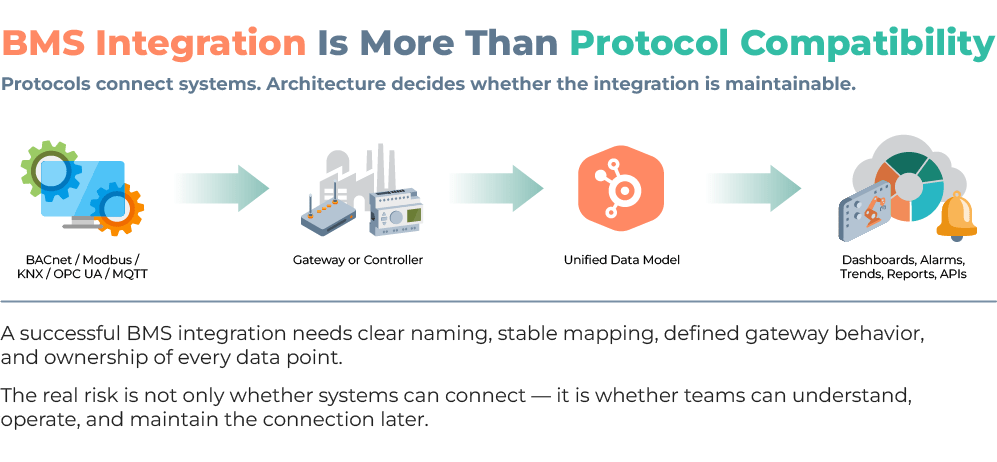
Here is the uncomfortable part: a protocol-compatible BMS integration can still fail. The corroborated failure modes are semantic and organizational – and they appear after the protocols connect. On a 2025 HVAC-Talk thread, a supervisory controller re-published 2,321 points from its subsidiary controllers as its own surrogate objects – object IDs shifted whenever a point was re-mapped, and points would “go offline and read 0”. A 2026 integrator engineering guide draws the design conclusions: pick one supervisory protocol and push translation down, and enforce the naming convention at the database so the server rejects non-conforming tags. Warning sign: an integration that works but whose points nobody can name or own.
That is why 2024-2026 standards activity concentrates in the semantic layer rather than in new field buses. Project Haystack’s founding problem statement is that “most operational data has poor semantic modeling and requires a manual, labor intensive process to ‘map’ the data”. Brick standardizes the relationships flat names cannot express (which AHU feeds which VAV). ASHRAE’s proposed standard 223P describes the meaning and context of a data point and links it to the BACnet object carrying the values. The W3C community ontology BOT adds the spatial skeleton (sites, storeys, zones). The activity is real – quantified production adoption is not yet.
Before we sign off on a BMS integration design, our team checks four things:
- Naming convention enforced at the database, not in the application.
- Gateway failure behavior defined – what does a mapped point read when the gateway drops?
- Mapping documentation maintained as a living handover deliverable, not frozen at submittals.
- One supervisory protocol, translation pushed down.
Edge, Cloud, On-Premise: Deployment Models in 2026
Where does the management level physically live in 2026? The only methodology-visible number we have: a 2025 ASHB/Harbor Research survey (n=308, US and Canada, vendor-sponsored) reports roughly half of respondents running cloud, about 40% on-premise, and about one in six self-identified hybrid – the shares sum to 106% because the categories are not mutually exclusive. The same survey names the blockers: “data security risks (49%), loss of control over systems/data (34%), and compliance/data residency requirements (36%)”. Treat these as US/Canada figures, since data-residency rules shift the split elsewhere.
Which model wins? Direction is easier to read than share. Analyst firm Memoori (2025) describes smart-building platforms evolving toward hybrid designs that “balance real-time control at the edge with portfolio-wide analytics in the cloud”, and a 2025 Scientific Reports study supplies the engineering rationale: purely centralized cloud energy management suffers “high latency, limited scalability, and privacy concerns”. One tension is worth naming. Cloud-BMS vendors pitch cloud as the security upgrade (a 2026 Envigilance page argues on-premise security depends “entirely on your organization’s cybersecurity resources”), while operators name security as the top reason not to move. Both can be true – the same vendor concedes that legacy on-premise servers often run operating systems that no longer receive patches.
Whatever the split, we treat two properties as invariants of any edge-to-cloud deployment architecture. First, autonomy: the automation level must ride out management-level outages, as covered above. Second, segmentation: NIST SP 800-82r3 (2023) classifies building automation systems as operational technology, so a cloud-connected BMS is an OT boundary problem, not just another SaaS subscription. US CISA guidance (2025) on the ABB Cylon Aspect authentication bypass (CVE-2025-53187, CVSS 9.8) is explicit: never expose BMS devices directly to the internet, operate them behind a firewall, and use a VPN gateway for remote access. The advisory is a vulnerability record, not a breach record (no known exploitation reported). Likewise, Nozomi Networks (2025) describes Niagara as a vendor-neutral integration framework and disclosed 13 vulnerabilities chaining to root there – a chain that requires a misconfiguration the security dashboard already warns about, plus network position. In the US, no regulation mandates network segmentation for commercial-building BMS. EU operators may fall under NIS2 obligations depending on sector. IEC 62443 is the international norm US guidance also points to. IEC PAS 62443-1-6 (2025) extends it toward IIoT, and ISASecure already certifies components against it, a checkable procurement criterion in 2026. Autonomy and segmentation are non-negotiable.
Architecture Mistakes That Surface as Unbudgeted Field Hours
The canonical segmentation failure is Target (2013). Attackers entered through network credentials stolen from an HVAC contractor (Krebs on Security, 2014), and the US Senate’s kill-chain analysis (2014) concluded that Target “failed to properly isolate its most sensitive network assets” – the flat network was the mistake, not the HVAC connection. A 2014 US GAO audit then found nobody at DHS assessing cyber risk to building and access control systems across nearly 9,000 federal facilities.
Below the headline cases, we keep meeting the same five mistakes:
- Proprietary lock-in. Nexus Labs (2025) documents owners of closed systems left “completely at the mercy” of the sole service contractor’s schedule, pricing, and work quality, including a healthcare facility quoted two to three weeks for an operating-room fix. An anonymous Reddit commenter (2025) reports roughly $20K per year to license Schneider PLC engineering software, then week-long waits for support. Instances, not statistics – no public dataset of lock-in costs exists.
- Gateway sprawl and brittle mappings. The surrogate-point instability above is one case. Another (HVAC-Talk, 2024): a lighting gateway whose BACnet mapping stayed frozen at the submittal stage, ghost devices left online after renovation – the verdict from five-plus sites was “big mess / time suck”.
- Naming chaos. ZnTmp, SpcTmp, Z1TMP: labels that “force every new tech to play archaeologist” (Automated Academy, 2025). Smart Buildings Magazine (2024) codifies the MSI view – no standard naming means confusion at every tenant fit-out.
- Alarm floods. A commissioning engineer (ACHR News, 2023) describes operators so overwhelmed that “the critical ones [are] not identified” in time – alarming treated as a design afterthought, with no parent-fault suppression, so one AHU failure cascades into dozens of zone alarms.
- Commissioning shortcuts. A field technician (Reddit, 2024): four hours quoted for commissioning, twelve hours in, “nothing has been done at all” – three controls firms on one small job because of a proprietary controller. MSIs report being brought in too late to influence design (Smart Buildings Magazine, 2024).
Recap: all five are architecture decisions.
Where Iotellect Fits in a BMS Architecture
Iotellect is the low-code IoT platform we deploy at the automation and management levels described above. It connects HVAC, lighting, access control, fire and life safety, metering, elevators, sensors, and edge controllers, with drivers for Modbus, OPC UA, BACnet, SNMP, MQTT, and other commonly used building automation protocols (50+ protocols overall), plus driver technology that connects proprietary building devices without coding. Drivers and agents map real-life devices and data sources into unified data model contexts, and a visual GUI Builder produces the operator dashboards.
Deployment follows the models we covered above: cloud, on-premise, hybrid, or a fully autonomous edge instance on any Edge controller with Java support, running local CEP, analytics, and machine-learning models, with encrypted transmission between edge servers and cloud. The pricing model is a fixed subscription per dedicated platform instance – devices, tags, events, users, and API calls are not metered. Open driver technology, one data model, predictable cost. Details live on the building management system platform page.
Bottom line: design the levels as functions and the handover as a deliverable. The protocols connect the building. The architecture decides who owns it.