
Iotellect has always meant “intellect for IoT”. Only the recent evolution of AI, however, is revealing what that idea may ultimately mean for industrial systems. AI agents are rapidly assuming important roles at both ends of the IoT application lifecycle: engineering applications and autonomously operating live infrastructure.
This turning point dramatically changes the role of IoT platforms from application development and runtime environments into governed operational substrates for AI agents.
The governance includes permissions control, deterministic constraints, validation, observability, auditability, human approval, safety boundaries, and more.
And indeed, the more powerful agents become, the more difficult a mission of defining and enforcing an operational envelope within which the agent is free to act becomes. As agents become more capable and autonomous, prompt-level instructions and model-level safeguards are not sufficient to guarantee operational behavior. Just as important human activities are constrained by permissions, procedures, and physical safeguards, autonomous agents need externally enforced operational boundaries.
Imagine an agent controlling regional railways from an automated command and control center. It’s easy to name several scenarios, rather realistic, where conflicting pieces of setup may lead the agent to wrong decisions, such as requesting two conflicting routes because of erroneous timetable, increasing train speed to recover delays, or shutting down substations in favor of optimized energy usage.
So how to avoid the chaos?
Two layers of the underlying infrastructure will be still there, and even evolving, to exclude such critical mistakes:
- Field control devices (and programs they run) use fully deterministic and well-validated logic to prevent accidents in isolated railway sections
- IIoT platform and specialized app running in it prevents wider-scale incidents by validating all agent’s commands against a set of pre-defined rules
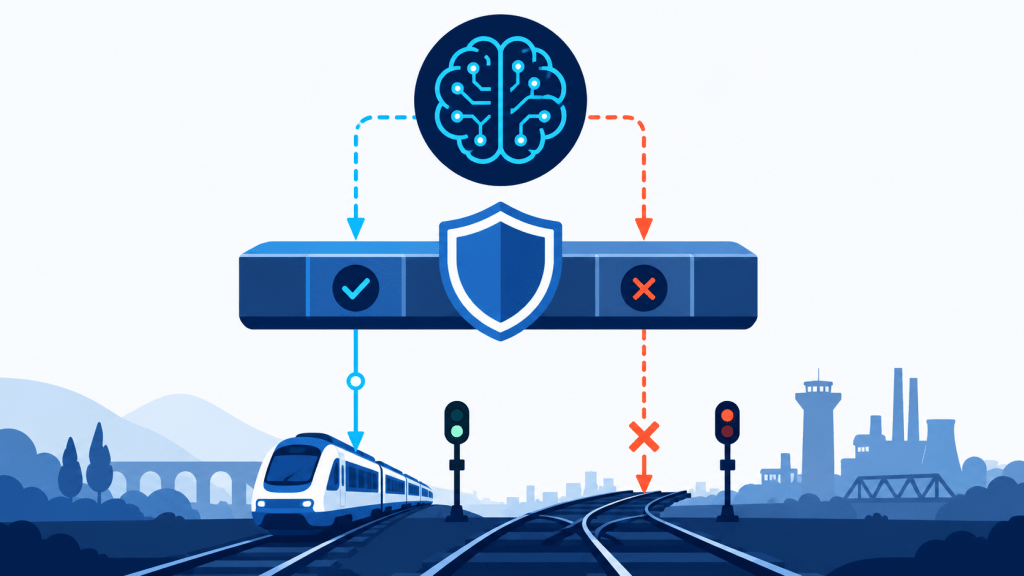
What’s really interesting here is that agents will do their job twice during the whole app lifecycle, but their actions will be still “isolated” by human control:
- AI as developer. First, an agent develops an IIoT solution (“app”) atop of a platform. In our case it perfectly works via an MCP server as the platform offers a huge contract which makes agents “very capable” during the implementation stage.
- Human-governed validation. Second, humans are validating the design. This validation may be a complicated testing, commissioning, and certification process, but still the final acceptance decision is made by a human. This is simple: as the app is potentially endangering human lives, only a human can make a decision about its readiness.
- AI as operator. Third, another agent sits atop of the validated app and starts operating the actual physical IoT ecosystem. Its decisions are not directly validated by humans – but they are relying on the pre-validated logic, still keeping the whole system safe and secure.
Simply speaking, AI helps build the operational envelope during engineering, another AI operates within that validated envelope at runtime. And an IoT platform guarantees integrity of this envelope.
In manufacturing, this can also include AI systems that analyze existing ERP, MES, SCADA, and machine data to prioritize operational improvement opportunities. ResEt AI is one example of an explainable AI platform that turns available industrial data into recommendations that operations teams can validate and act on.