

Predictive maintenance software helps manufacturers assess equipment condition and identify developing problems early enough to plan maintenance. Products differ substantially: some combine sensors with diagnostic services, others analyze existing machine data, and others provide tools for building custom applications.
This guide compares seven options: Siemens Senseye, Augury Machine Health, IBM Maximo, SAP Asset Performance Management, GE Vernova APM, ThingWorx with Kepware, and Iotellect.
Which approach should you choose? Start with your equipment, available data, and maintenance workflow. Shortlist products that can demonstrate a useful warning for a named failure mode, then compare integration effort, implementation responsibility, and total operating cost.
This guide compares seven best-fit operating models, then tests the path from source signal to verified maintenance action.
What Is Predictive Maintenance Software for Manufacturing?
Predictive maintenance software uses current equipment condition together with historical reliability or performance data to estimate a probability of failure, a failure window, or remaining useful life.
That is narrower than general machine monitoring software or equipment monitoring software and more demanding than a threshold alarm. A NIST-authored maintenance workflow study distinguishes predictive models from condition monitoring and frames predictive maintenance as support for condition-based decisions and preventive interval selection.
The terms are easy to blur, so a buyer should separate five analytical tasks:
- Threshold monitoring tests whether a value crosses a configured limit.
- Anomaly detection flags behavior that differs from a learned or defined normal pattern.
- Diagnosis proposes the fault or cause behind an observed condition.
- Failure prediction estimates whether an event will occur within a stated horizon.
- Remaining useful life (RUL) estimates time or cycles until a defined end-of-life condition.
An anomaly is not proof of a fault, and a fault classification is not automatically an RUL estimate. NIST’s review of manufacturing prognostics treats diagnostics, prognostics, data management, validation, and business analysis as related but distinct capabilities.
A procurement shortlist may mix condition monitoring software, a predictive maintenance platform, broader industrial maintenance software, and general smart manufacturing software.
Sensor-led products collect signals and may add expert diagnosis. Asset performance management (APM) suites add asset health monitoring, risk, and strategy. Enterprise asset management (EAM) and computerized maintenance management systems (CMMS) manage work. IIoT platforms supply connectivity, data models, analytics, UI, and application logic.
Focused monitoring connected to a mature CMMS can therefore be just as valid an architecture as adopting a broader predictive maintenance platform.
What Data Is Needed for Predictive Maintenance?
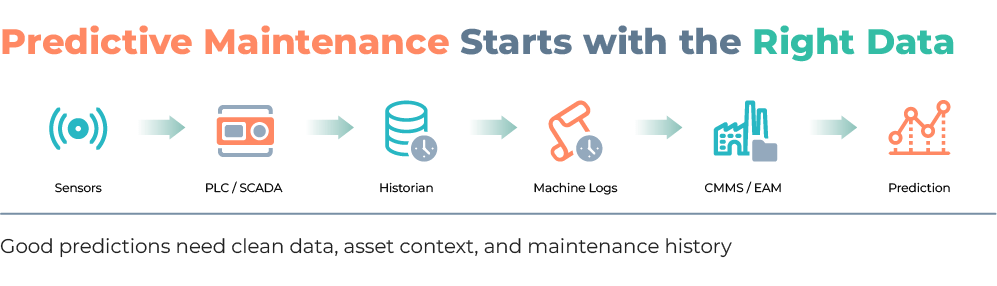
A usable dataset connects physical condition to a named asset, operating state, maintenance history, and the intended prediction.
The important question is not simply how much data a manufacturer has. It is whether that data describes the failure mode the organization wants to detect or predict.
IoT and Condition Sensors
Vibration, temperature, pressure, acoustic, current, and oil measurements can provide evidence of physical degradation.
Buyers should verify sensor placement, calibration, sampling, preprocessing, missing data, and whether the selected signal can actually observe the named failure mode.
PLC and SCADA Data
PLC and SCADA systems can provide speed, load, recipe, setpoint, state, alarm, and cycle context.
Evaluation should cover tag identity, timestamp alignment, engineering units, quality flags, and whether the system can distinguish idle operation, changeovers, abnormal conditions, and normal production.
Historian Data
Historical time-series data can support baselines, seasonality analysis, backtesting, and comparison between operating regimes.
Manufacturers should examine retention, aggregation, compression, missing intervals, renamed tags, and whether the required raw resolution is still available.
Machine Logs and MES Records
Machine logs and manufacturing execution systems can contribute fault codes, cycle counts, product context, operator state changes, and production events.
Consistent clocks, stable identifiers, clear event definitions, and correct links between events, assets, and production runs are essential.
CMMS or EAM History
Maintenance systems contribute inspections, confirmed causes, maintenance actions, dates, parts, work orders, and as-found or as-left conditions.
Buyers should check failure coding quality, duplicate or missing work orders, planned versus corrective work, and whether technician findings can become useful labels for future analysis.
There is no defensible universal sampling rate, history length, or minimum failure count. Requirements follow asset dynamics, failure physics, and the analytical task.
Historical data are also not automatically training-ready. Maintenance events, process changes, missing shutdown records, operating regimes, inconsistent asset IDs, and incomplete labels can all affect whether historical data can support a predictive model.
Treat data readiness as part of the predictive maintenance project rather than something that can be assumed before the project begins.
What Features Should Predictive Maintenance Software Include?
A feature matters only when it supports a defined maintenance decision. Buyers should evaluate the following capabilities against real equipment and workflows.
Sensors
Determine which named failure modes the proposed measurements can observe.
Also establish who owns installation, calibration, replacement, data quality, and cybersecurity throughout the sensor lifecycle.
PLC and SCADA Connectivity
Verify which controllers, industrial protocols, tags, timestamps, units, quality codes, and operating states have actually been demonstrated on the plant’s environment.
A large connector catalogue matters less than successful connectivity to the systems the manufacturer already operates.
Historian Connectivity
Check whether the integration preserves the resolution required by the use case and whether it can identify gaps, stale values, compression changes, or tag remapping.
Machine Learning
Define the analytical task before evaluating the algorithm.
Is the system performing threshold detection, anomaly detection, diagnosis, horizon prediction, or RUL estimation?
Then determine what labels, validation methodology, retraining process, and operational review support the model.
Dashboards
Each dashboard should serve a specific operational role.
A useful predictive maintenance dashboard should be able to show evidence, confidence, asset history, alert context, and ownership rather than displaying an unexplained health score.
Alerts
Test how the system suppresses duplicates, assigns priorities, handles escalation, records acknowledgement, and reviews false positives and missed events.
More alerts do not automatically mean better predictive maintenance.
Work Orders
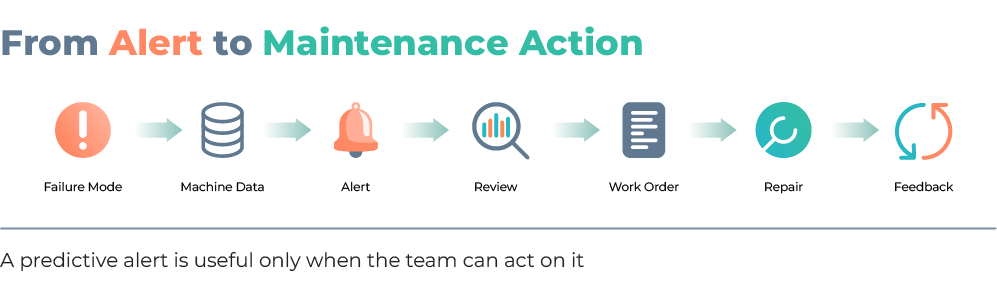
Determine whether an integration creates an advisory, maintenance request, draft work order, or scheduled job.
More importantly, determine whether completion data can return the confirmed cause and the as-found and as-left condition to the analytical workflow.
The work-order distinction matters because maintenance does not end when software generates an alert. A practical workflow continues through analysis, prioritization, planning, scheduling, execution, completion, and learning.
Digital Twins
Ask exactly what the vendor means by a digital twin.
It may refer to an asset record, contextual hierarchy, live operational representation, physics-based model, or simulation environment.
The important question is which maintenance decision the digital twin helps the team make.
Edge Processing
Determine whether an edge node simply collects and buffers data or can also transform signals, run analytics, trigger local actions, survive connectivity interruptions, and receive model updates.
Those are different levels of edge functionality and should not be treated as interchangeable.
How Does IoT Improve Predictive Maintenance in Manufacturing?
IoT and IIoT connect distributed machine data.
IoT predictive maintenance and IIoT predictive maintenance describe this connected evidence path rather than a separate analytical method.
Edge gateways can buffer data through network interruptions, process information locally, and host low-latency logic, while centralized systems compare equipment across production lines, plants, or geographic locations.
The result is more continuous condition evidence. It does not automatically prove that a failure is predictable.
OPC UA, MQTT, databases, APIs, and industrial drivers move data, but prediction still requires asset identity, operational context, synchronized timestamps, engineering units, and quality information.
Edge connectivity also expands the operational technology attack surface. Asset inventory, segmentation, access control, secure communications, and justified remote access should therefore be incorporated into the architecture. NIST SP 800-82 Rev. 3 provides guidance for securing operational technology environments.
Manufacturers should also separate continuity from autonomy.
What continues operating during disconnection? Which analytical decisions can be performed locally? Can the edge layer only buffer information, or can it also perform inference and initiate an action?
Buffering, local inference, and autonomous control are different commitments.
Rule of thumb: connectivity is a prerequisite, never the evidence.
How Should Predictive Models Be Validated?
For machine failure prediction, do not accept one generic predictive maintenance analytics score.
Validation methodology can materially affect reported performance. Leakage between related samples, assets, time periods, or operating regimes can make a model appear significantly better than it will perform after deployment.
Rare failures create another problem.
When normal observations dramatically outnumber failure events, a high overall accuracy or apparently strong ROC score may hide poor operational usefulness. Precision-recall analysis can better expose how many alerts are useful and how many important events are actually found, as demonstrated in the widely cited work by Saito and Rehmsmeier.
A predictive maintenance pilot should therefore report operational measures such as:
- missed failures;
- false alarms;
- warning horizon;
- time spent in warning;
- number of actionable alerts;
- maintenance action taken;
- confirmed cause after inspection or repair.
Example: Evaluating Early Warning for Pump Bearing Degradation
Consider a plant testing whether its available measurements can provide early warning of bearing degradation on a defined group of pumps. This is an illustrative evaluation scenario, not a reported customer result.
Before the pilot, the maintenance and engineering teams agree on:
- Target condition: Which bearing problem the system should identify.
- Warning time: How much notice is needed to arrange inspection or maintenance.
- Alert workload: How many unnecessary inspections the team can reasonably handle.
- Confirmation: How technicians will document whether an alert corresponds to a real problem.
- Acceptance criteria: What evidence would justify expanding the deployment.
During evaluation, the team records alerts, inspection findings, missed events, and the maintenance actions taken. It also checks whether changes in pump load or operating state affect the results.
A health score alone is insufficient. The system must provide evidence that helps the team make a useful maintenance decision. If too few confirmed events occur during the pilot, the team should report that limitation rather than claim validated failure prediction.
Validation should resemble deployment.
Separate assets, time periods, sites, batches, or operating regimes wherever the real production environment will separate them. Price false alarms and missed events, test whether the warning arrives early enough for maintenance action, and monitor data and model drift after deployment.
Unlabelled operational data may still support anomaly detection because a model can learn expected behavior and identify values or patterns outside it.
But anomaly detection alone does not validate the fault cause, failure horizon, or remaining useful life.
Warning sign: a single headline accuracy figure with no explanation of how the data were split or how failures were evaluated.
What Are the Best Predictive Maintenance Software Platforms?
This editorial shortlist covers different buying approaches, including specialized analytics, sensor-led machine health, enterprise maintenance systems, and configurable industrial platforms. It is not an independent performance ranking.
Disclosure: Iotellect publishes this guide and is included in the comparison. Product capabilities should be verified against current vendor documentation; performance and implementation costs require evaluation on your own equipment.
Predictive Maintenance Software Comparison at a Glance
| Platform | Buying approach | Main question to verify |
|---|---|---|
| Siemens Senseye | Specialized predictive analytics | Can existing plant data support useful warnings? |
| Augury Machine Health | Sensor-led machine health | Does equipment coverage match the target assets? |
| IBM Maximo | EAM-centered maintenance | Which predictive capabilities and licenses are required? |
| SAP Asset Performance Management | SAP-centered asset management | How do findings enter existing maintenance workflows? |
| GE Vernova APM | Broader asset performance management | Is the implementation scope appropriate for the reliability program? |
| ThingWorx with Kepware | Configurable industrial applications | Who builds and maintains the final application? |
| Iotellect | Low-code industrial application development | Who owns configuration, validation, and maintenance integration? |
1. Siemens Senseye
Siemens Senseye supports condition and contextual time-series data and is designed around predictive maintenance analytics and case management.
It can fit manufacturers that already collect useful machine or historian data and want an analytics layer that helps identify and manage equipment issues across multiple assets or locations.
Best fit: Manufacturers with established machine-data collection that want a specialized predictive maintenance analytics layer.
Verify during the proof of value: Direct signal limitations, required preprocessing, integration depth with the maintenance system, data ownership, and how warnings become maintenance actions.
2. Augury Machine Health
Augury takes a sensor-led approach to machine health, combining vibration and other condition measurements with software and diagnostic support.
This model can appeal to plants that want a more packaged condition-monitoring program rather than building the entire machine-health stack internally.
Best fit: Plants seeking sensor-led machine monitoring with diagnostic support.
Verify during the proof of value: Equipment eligibility, supported failure modes, sensor coverage, service dependency, integration with existing maintenance systems, and how diagnostic findings are converted into work.
3. IBM Maximo
IBM Maximo combines asset records, maintenance information, inspections, and operational data with predictive and asset-health capabilities.
Its strongest buying hypothesis is typically an organization already using Maximo for enterprise asset management and looking to place predictive capabilities closer to existing maintenance records and workflows.
Best fit: Maximo-centered organizations that want predictive analysis integrated with broader EAM processes.
Verify during the proof of value: Required model-building skills, historical label quality, workflow approvals, licensing boundaries, integration with industrial data sources, and how predictions become maintenance actions.
4. SAP Asset Performance Management
SAP Asset Performance Management is closely aligned with SAP technical objects, asset master data, measurements, alerts, and S/4HANA maintenance processes.
It can be attractive to manufacturers whose asset and maintenance architecture is already centered around SAP.
Best fit: SAP-focused manufacturing environments that value shared asset data and an established maintenance path.
Verify during the proof of value: Data replication, analytical scope, rule versus machine-learning functionality, alert-to-notification and notification-to-order processes, and governance of technical objects.
5. GE Vernova APM
GE Vernova Asset Performance Management is aimed at asset-intensive environments requiring equipment analytics, risk management, asset strategy, condition-based maintenance, and predictive maintenance capabilities.
Its broader APM orientation can make it suitable when predictive maintenance is one component of a wider asset reliability program.
Best fit: Asset-intensive operators requiring fleet context, asset strategy, equipment risk analysis, and predictive maintenance within the same program.
Verify during the proof of value: Data mapping, integration depth, model lifecycle, implementation effort, service requirements, maintenance workflow integration, and deployment architecture.
6. ThingWorx with Kepware
ThingWorx and Kepware combine industrial connectivity, data modeling, analytics, dashboards, events, and application logic.
Rather than functioning only as a preconfigured maintenance application, this architecture can support teams building their own industrial monitoring and predictive maintenance applications around existing equipment and systems.
ThingWorx and Kepware became part of Velotic following the March 2026 ownership transition announced by TPG.
Best fit: Teams needing configurable industrial connectivity, analytics, dashboards, and application logic rather than a narrowly preconfigured predictive maintenance product.
Verify during the proof of value: Licensing after the ownership change, edge functionality, validation design, maintenance-system integration, and responsibility for building and supporting the final application.
7. Iotellect
The Iotellect predictive maintenance platform supports the development of industrial applications that combine sensors, PLC and SCADA connectivity, OPC, MQTT, databases, edge processing, analytics, machine learning, dashboards, alerts, digital-twin structures, and low-code integration with external systems.
Deployment can be organized across edge, cloud, on-premises, or hybrid environments.
Unlike an out-of-the-box predictive maintenance product, Iotellect is a development platform. Teams configure the data model, analytics, dashboards, workflows, integrations, and application logic required for their specific equipment and maintenance processes.
Best fit: Manufacturers, system integrators, and industrial solution providers that want to build a custom predictive maintenance application across connectivity, analytics, visualization, and workflow layers.
Verify during the proof of value: Failure-mode definition, data readiness, model validation, CMMS or EAM integration depth, responsibility for application design, and how completed maintenance feedback returns to the system.
How Much Does Predictive Maintenance Software Cost?
Predictive maintenance software costs depend on equipment coverage, instrumentation, analytical scope, integrations, and service requirements. Compare vendors using the same deployment assumptions rather than comparing subscription prices alone.
A useful cost comparison separates five categories:
| Cost category | What buyers should include |
|---|---|
| Software | Subscription or license fees, required modules, user access, and licensing limits |
| Instrumentation | Sensors, gateways, installation, calibration, and replacement |
| Integration | PLC and historian connections, CMMS/EAM integration, asset mapping, and data preparation |
| Analytics and implementation | Application configuration, model development where needed, validation, and specialist review |
| Ongoing operations | Training, diagnostic services, support, integration maintenance, and model monitoring |
Request both the first-year implementation cost and the recurring annual cost. Confirm what happens to pricing when you add machines, sites, users, data volumes, or service coverage.
For a fair comparison, ask vendors to quote the same asset scope and clarify which responsibilities remain with your team. A sensor-and-diagnostics service and a configurable development platform may cover different amounts of implementation work.
Our IoT platform pricing models comparison explains different software charging models. Use it for the licensing part of your evaluation, alongside instrumentation, engineering, and service costs.
How Can Manufacturers Choose the Right Platform?
Start with one consequential failure mode, not an enterprise dashboard.
A credible predictive maintenance system should answer seven questions before rollout.
1. Decision
Which asset and failure mode matter, and why would an earlier warning change the current maintenance strategy?
2. Evidence
Which sensor, PLC, SCADA, historian, machine log, MES, CMMS, or maintenance fields represent the degradation and its operating context?
3. Task
Is the system applying a threshold, detecting an anomaly, diagnosing a fault, predicting failure within a specific horizon, or estimating remaining useful life?
4. Validation
Are assets, events, periods, and operating regimes separated to reduce leakage?
Are missed events, false alarms, precision, warning time, and maintenance outcomes measured?
5. Action
Who reviews the signal?
Which object enters the CMMS or EAM?
Can the team plan, schedule, execute, and complete the maintenance task before the predicted failure?
6. Learning
Does work-order closure capture the confirmed cause, as-found condition, as-left condition, replaced parts, and outcome so that the analytical logic can be reviewed and improved?
7. Ownership
Who maintains the sensors, industrial data mappings, security controls, thresholds, models, integrations, fallback logic, and stop criteria after the pilot ends?
If a few observable failure modes drive avoidable risk and the existing CMMS already manages maintenance effectively, focused monitoring combined with integration may be enough.
If many equipment classes, facilities, data sources, and reliability strategies require common governance, a broader APM or IIoT architecture may be more appropriate.
Neither architecture is automatically better.
The deciding factor is whether the system can detect a consequential condition early enough for the organization to take a useful maintenance action.
The proof of value also needs an explicit stop condition.
Do not scale a predictive maintenance project if the signal cannot reach the required warning horizon, false alarms consume more inspection capacity than the avoided risk justifies, or maintenance closure data remain too weak to validate the results.
Bottom line: a pilot without a stop rule is a subscription, not a test.
Where Iotellect Fits
The Iotellect Industry 4.0 platform is configurable for manufacturers and solution providers building industrial applications around machine data, analytics, dashboards, digital-twin structures, alerts, edge processing, and workflow logic.
It does not remove the need to define failure modes, prepare data, validate analytical models, or design the maintenance process. Those responsibilities remain with the team that understands the asset and the operational consequences of failure.
Iotellect also publishes fixed subscription pricing for dedicated platform instances rather than pricing primarily around devices, events, bytes, users, or API calls.
This can make platform licensing more predictable, but it does not automatically determine the complete cost of a predictive maintenance implementation. Instrumentation, integration, engineering, model validation, training, and ongoing support should still be included in the business case.
A useful technical demonstration should therefore start with one named asset and one named failure mode.
Ask the team to demonstrate the entire path:
source signal → operational context → analytics → alert → maintenance decision → completed work → maintenance feedback.
Limitations of This Comparison
No independent common benchmark compares these seven platforms using the same manufacturing assets, failure modes, datasets, validation methodology, workflows, costs, and operational outcomes.
Public product documentation also does not answer every implementation question around integrations, work-order depth, edge processing, digital twins, model lifecycle, or licensing.
Those gaps should be verified during technical evaluation rather than filled by assumptions.
Choose the failure mode first. Choose the platform second.
Frequently Asked Questions
Can predictive maintenance software use existing PLC and SCADA data?
Sometimes. Existing PLC and SCADA data can provide operating context or observable signs of degradation. Suitability depends on the failure mode, sampling resolution, timestamps, data quality, and maintenance history. Some applications require additional condition sensors because existing measurements cannot reveal the developing fault.
Does predictive maintenance software replace a CMMS?
Not necessarily. Predictive maintenance tools assess equipment condition and identify developing problems, while a CMMS manages maintenance planning and execution. Buyers should verify how findings become maintenance requests or work orders and how inspection and repair results return to the analytical workflow.
How should manufacturers compare predictive maintenance vendors?
Give shortlisted vendors the same asset scope, target failure mode, available data, integration requirements, and acceptance criteria. Compare warning usefulness, false alarms, implementation effort, maintenance workflow, and total cost. A demonstration on relevant equipment is more informative than a generic accuracy claim.
How much does predictive maintenance software cost?
Costs depend on the number and type of assets, sensors, software licensing, integrations, and diagnostic services. Compare first-year implementation costs and recurring annual costs using the same equipment scope. Include engineering, validation, training, and support alongside the subscription.
What is the difference between condition monitoring and predictive maintenance?
Condition monitoring tracks equipment health using measurements such as vibration, temperature, or current. Predictive maintenance uses condition evidence and analytical methods to support decisions about developing failures and maintenance timing. A threshold alert or anomaly score alone does not establish a validated failure prediction.