
..and if network devices are Things, is IT infrastructure management a part of IoT? These are two questions that are very interconnected.
Many IT infrastructure management and IoT applications share the same architectural tasks: representing connected assets, collecting their state and using that information to understand operational services. The boundary depends on which definition of IoT we use. For an IT team choosing software, the practical consequence is straightforward: a suitable IoT application enablement platform (AEP) deserves consideration as a foundation for custom infrastructure and business-service monitoring. Its usefulness should be judged by the IT capabilities and application-development tools it supplies. The category label, by itself, establishes neither.
This matters when the required application has to reflect how a particular organization operates. A company may already have excellent tools for diagnosing servers, networks and applications, yet still need a model connecting those systems to a customer-facing service, its suppliers and its physical operations. Building that model requires integrations, rules and interfaces specific to the business. An IoT application enablement platform can provide a foundation for that work, while established monitoring products continue doing the jobs they perform well.
The Architecture Crosses the IT and IoT Boundary
Definitions explain why the title does not have a universal yes-or-no answer. ITU’s overview of IoT includes identifiable physical and virtual things, with application software among its examples of virtual things. NIST acknowledges that there is no single widely accepted definition and uses a narrower scope for its cybersecurity program, involving interaction with the physical world through sensors or actuators. Connectivity alone therefore does not settle whether every router or server should be classified as an IoT device. These definitions support an architectural overlap without making all of IT management a universally agreed subset of IoT.
For an application designer, several familiar problems cross that boundary. A network switch, a power supply and an industrial controller each have an identity, observable state and relationships with other parts of a system. A monitoring application must acquire their data, interpret changes and present information in a useful context. Their protocols and operational requirements can differ substantially, so a common modeling approach does not make the devices interchangeable. It does, however, give IT teams a reason to examine technologies developed for connecting and modeling heterogeneous infrastructure.
A Business Service Extends Beyond its IT Components
Consider the complete journey of a bank card from application to delivery. A customer submits a request through a website or mobile application. The request enters an assessment process that may combine automated checks with human review, and approval then starts card production with an external supplier. The physical card passes through delivery stages before it reaches the customer. This generalized example contains software, queues, human work and physical logistics within one service. The customer’s experience depends on progress through the entire chain.
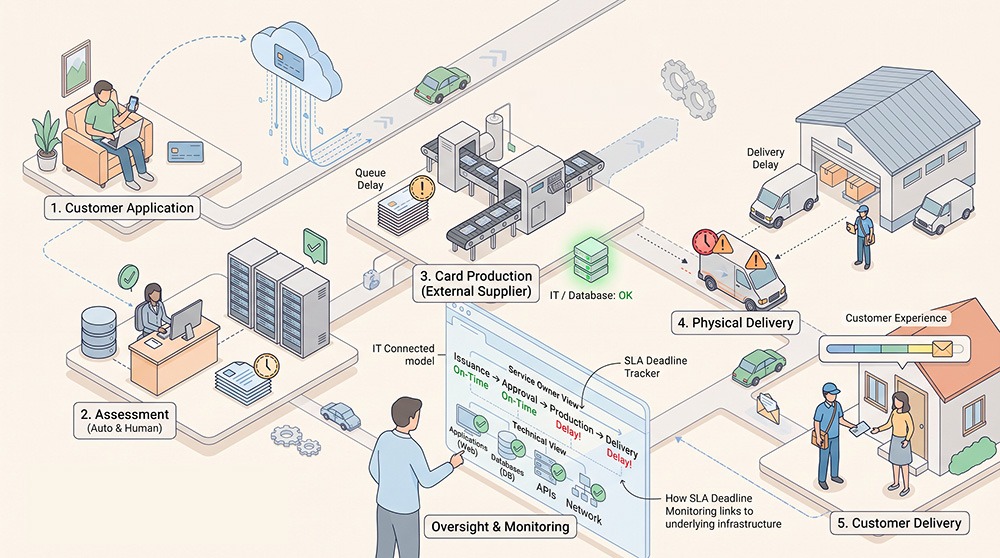
A database may be responding normally while approved applications accumulate before printing. The website may be available while a delivery stage falls behind its commitments. Monitoring the technical components remains useful, but the bank also needs to understand whether each request is progressing within its promised completion time. A service level agreement (SLA) can define the completion deadline for each request, while stage metrics and infrastructure diagnostics help staff locate delays that threaten it. A useful interface should let staff move from a delayed request to the evidence relevant to its delay.
The service model must consequently use the organization’s own concepts. A service owner wants to understand card issuance, approval, production and delivery; an infrastructure specialist needs to investigate the applications, databases or communication links involved. Those views can be connected through the model, with appropriate detail for each role. The physical steps also matter even when their status arrives through a supplier API or a staff-operated business system. The available integrations determine which stages and state transitions the application can observe.
A Useful Digital Twin Represents the State That Matters
The term digital twin becomes useful here when it describes a maintained operational model with a defined purpose. The model represents selected entities, their relationships and their observed state, connected to the sources that keep that state current. The definition includes real-world processes as well as entities and emphasizes synchronization at an appropriate frequency and fidelity. In this article, the focus is the operational model used for monitoring and diagnosis; simulation and autonomous control are separate capabilities that would need their own evidence. A diagram of dependencies is a view of that model, while its practical value depends on the information and logic underneath it.
The scope of the model should follow the questions the organization needs to answer. A service may have processing stages, completion targets and dependencies on particular applications or facilities. An individual request may have different identifiers in different systems, requiring explicit links before its path can be reconstructed. The partner building the application must decide how those identities, states and relationships are represented. The platform provides the modeling and application mechanisms, while the customer and implementer supply knowledge of what the service actually means.
Detailed monitoring records also need not duplicate every transaction in the production environment. One possible design observes request progress in source systems and creates a monitoring-side reference only when a request needs attention. That reference can have its own lifecycle, retain the relevant cross-system identifiers and provide access to history or diagnostics held elsewhere. Dashboards can then focus on exceptions without turning the monitoring application into a second copy of the entire transaction estate. This is a design choice about useful information, not a requirement that every digital twin reproduce everything it observes.
Standard IT Diagnostics Remain Essential
Application flexibility is valuable only if the team can obtain the information its application needs. An IT buyer should check the actual connectivity and diagnostic coverage for the environment: network equipment, server hardware, operating systems, applications, databases and middleware. Reading an arbitrary value through a protocol is only one part of that work. Ready-made checks and diagnostic views can save substantial implementation effort, but their coverage must be evaluated against the systems in the proposed deployment. An attractive service dashboard cannot compensate for missing or unreliable input.
At Iotellect, we combine an IT operations product, IT Operations Manager, with the underlying low-code framework. The standard product supplies familiar monitoring and diagnostic functions, while the platform supports applications specific to the customer. Our public connectivity documentation includes SNMP, IPMI, WMI, NetFlow, database queries, Java management interfaces and message-queue monitoring. Those mechanisms provide a practical starting point for IT applications; exact versions, required drivers and the scope of each packaged function still belong in an evaluation.
The comparison should also give existing products credit for their capabilities. Zabbix, for example, documents service monitoring, APIs and automated remote commands, while ThingsBoard documents an SNMP connector for its IoT Gateway. Service modeling, extensibility and IT connectivity should therefore be compared across the actual products under consideration. The useful comparison is the fit between the desired application and the capabilities available to build and maintain it. A suitable platform needs both the relevant IT foundation and enough freedom to express the customer’s own model.
A Manager of Managers Can Use the Tools Already in Place
An enterprise usually has good reasons to retain specialist management tools. A virtualization platform, network estate or storage environment may have vendor-specific diagnostics that engineers already know and trust. A broader monitoring system may also cover the general IT environment effectively. An umbrella application can bring information from these systems into a business-service model while preserving access to their detailed diagnostics. This is the Manager of Managers (MoM) role, which Iotellect explicitly describes in its network-monitoring architecture.
The level of information acquired from each source is an engineering choice. For one component, the application may need direct measurements from a device. For another, it may obtain summarized status through a management API, or consume only alerts and incidents because those contain the information relevant to the service. It does not have to repeat every low-level check performed elsewhere. Selecting the necessary detail can make the integration more focused and preserve the specialist tools as the place to investigate their respective domains.
Collecting information is only the beginning of the service model. The application must express what a reported condition means for the service, including dependencies, alternative paths and the processing stages affected. A component failure does not always mean that the customer-facing service has stopped, and a service delay does not always originate in a failed component. The model should also distinguish a healthy source from one whose information is missing or out of date. These relationships and interpretation rules are part of the application that the customer or partner must engineer.
IoT Application Enablement Provides a Framework for the Custom Work
The application-platform contribution is easiest to see in the work that remains after standard monitoring has been connected. An engineer needs to define business entities, relate them to infrastructure, implement service rules and build interfaces appropriate to the organization. Iotellect’s architecture represents physical and logical objects through a shared model whose elements expose variables, functions, events and metadata. Its visual interface tools bind screens to that model and support navigation between higher-level information and detailed views. These are mechanisms for constructing an application; the organization’s service definitions still have to be designed.
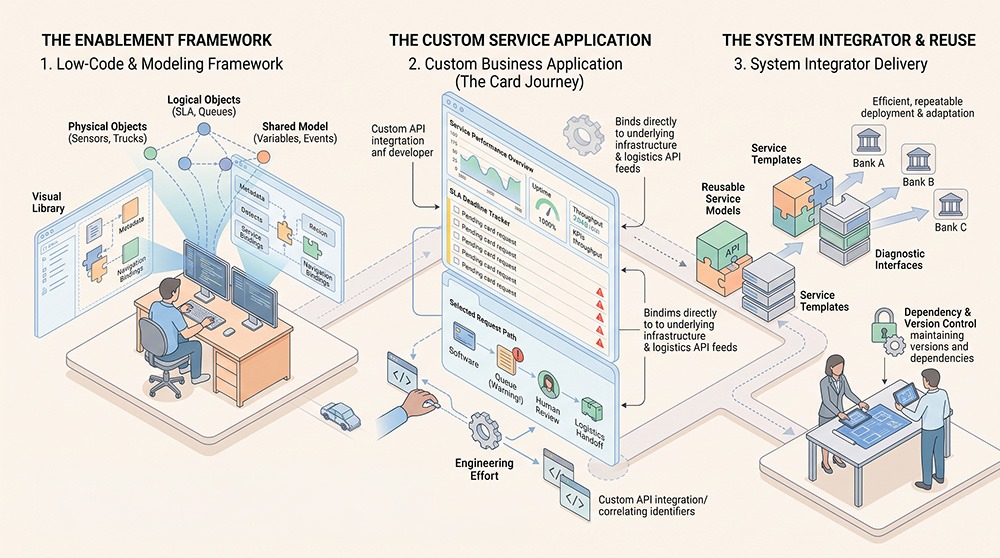
For the card-service example, the custom application could include an overview of service performance, a list of requests approaching their deadlines and a diagnostic view of a selected request’s path. That path may include software processing, queueing, human review and physical handoffs. The engineering effort includes deciding which events mark each transition, correlating identifiers and handling incomplete information. Low-code tools can provide reusable components for that implementation, while custom integrations or conventional code may still be required. A credible evaluation should expose that remaining work.
This also creates a useful role for system integrators. They can develop reusable service models, integration components and diagnostic interfaces, then adapt them to successive customers where the underlying requirements match. Iotellect documents application packaging and programmatic extension alongside its visual development tools. Reuse still requires deliberate separation of common behavior from customer-specific configuration, including clear handling of versions and dependencies. The commercial opportunity depends on delivering and maintaining those applications efficiently, so it should be assessed through actual implementation work rather than a feature list.
Scale Changes the Economics of Service Monitoring
A small network of car-wash sites provides a useful illustration. With a handful of locations, an administrator may monitor payment terminals, network equipment, cameras, power and water-related signals, while local staff explain the operational situation through direct communication. The organization can often combine those sources informally because there are relatively few sites and exceptions. Across a much larger network, management may need a consistent view of whether each location can actually deliver the service. Payment availability, utilities, equipment and staffing then have to be considered together.
The number of sites is an illustration, not a fixed purchasing threshold. A small company with a complicated or important service may benefit from a platform, while a large organization with a highly standardized requirement may already have adequate tools. The relevant calculation includes the value of better service visibility, the complexity of the required application and the cost of owning it over time. Platform licensing, implementation, integrations and ongoing maintenance all belong in that calculation. Company size influences the decision without settling it.
Custom development remains a legitimate alternative. A tightly bounded application can be practical to build using existing software frameworks, especially when integration and administrative requirements are modest. Broader deployments require more engineering for identity, permissions, operational hierarchy, reliability, diagnostics, deployment and change management. A platform also introduces its own costs, skills and constraints, which must be considered honestly. The question is how much of the necessary foundation already exists, how well it fits, and which work the team is prepared to maintain.
The Management Value Often Comes Through Human Decisions
The umbrella scenario described here primarily supports monitoring, diagnosis and decisions. It helps the organization understand where requests are delayed, which stages repeatedly miss their objectives and which infrastructure conditions accompany those problems. A service owner can use that evidence to examine a supplier arrangement, revise a process, change staffing or commission improvements to an application. Teams then implement those decisions through operational work and projects. This is a concrete contribution to management even when the umbrella system does not directly control the systems it observes.
Selected integrations can extend that role. An application might send a work request to another system, notify a team or pass information needed to coordinate a response. Such behavior should be specified as a distinct capability and tested against the receiving system and the intended workflow. The business-service model can be valuable through better evidence and coordination without promising control over every component.
Evaluate the Platform Against One Service
The most useful starting point is a service the organization already understands but cannot observe adequately across its existing tools. Define what successful delivery means, identify the relevant stages and agree which delays or failures the application must explain. Then connect the available sources at the level of detail the model actually needs. A first evaluation should show how a user investigates a delayed request or a degraded service, including a case where an input is missing or outdated. That exercise reveals more about fit than a dashboard built around whichever data is easiest to collect.
Assess the engineering work as carefully as the visible result. Check how service entities and dependencies are represented, where customer-specific rules live, how access is controlled and how the application changes when the service evolves. Establish which standard IT functions are included and which require additional development. Compare the resulting effort with extending the current tools or building the application another (read “vibecoding”) way. For a system integrator, also examine which parts can become reusable assets for future projects.
IT teams do not need to settle the classification of every network device before making this evaluation. They need a foundation that can connect the necessary evidence, represent their services and support the people responsible for improving them. Some IoT application enablement platforms, including Iotellect, address that combination. Their place on an IT shortlist should depend on demonstrated capabilities and the application the team needs to build. Bringing one real service to that evaluation is a practical way to find out.