

If an IoT platform lets you replace its logo, choose your colors, and publish a branded dashboard, is it ready to become the foundation of your product? For a one-off deployment, that may be enough. An OEM selling software under its own name has a broader responsibility: the customer encounters the product during installation, administration, troubleshooting, and updates. A credible white-label arrangement has to cover that whole experience and remain workable throughout the product’s life.
A Solution, a Product, and a Service Have Different Needs
It helps to distinguish three delivery models. A solution is built and deployed for a particular customer; its dashboards may carry the customer’s identity, sometimes alongside the integrator’s or platform vendor’s branding. A software product is something the OEM distributes for customers to install, including on-premises deployments in environments isolated from the internet. A service delivers the application online, but SaaS does not necessarily mean a single installation: the provider may operate several separate instances of its infrastructure.
These differences change what the OEM must put its name on. With an installable product, the customer receives software bundles, administrative tools, and documentation as well as the application itself. A service also has an administrative and operational experience whose branding needs attention. The scope should follow everything the customer can encounter.
The Whole Product Needs a Consistent Identity
Consider a hypothetical medical-equipment manufacturer supplying an MRI machine with monitoring and management software. The clinic installs that software and later checks the system event log. Some messages refer to the equipment manufacturer, others to an unfamiliar platform company, and a few mix both identities. The same inconsistency appears during installation and in administrative screens, making an expensive, integrated offering feel unfinished.
For an OEM, the branding scope therefore includes installation bundles, operator and administrative interfaces, log messages, system events, and the documentation shipped with the product. Platform documentation matters because it accompanies the OEM’s own instructions and may be used by the customer’s technical staff. Where customers can inspect or modify application scripts, even names inside those scripts deserve attention. Each of these is part of the product the OEM is asking its customers to trust.
Rebranding Must Remain Manageable Across Releases
A complete first release is only the starting point. If every platform update creates another substantial rebranding project, the OEM has acquired a recurring maintenance burden. The platform supplier needs to design for rebranding throughout development, including how names, images, links, and documentation are produced.
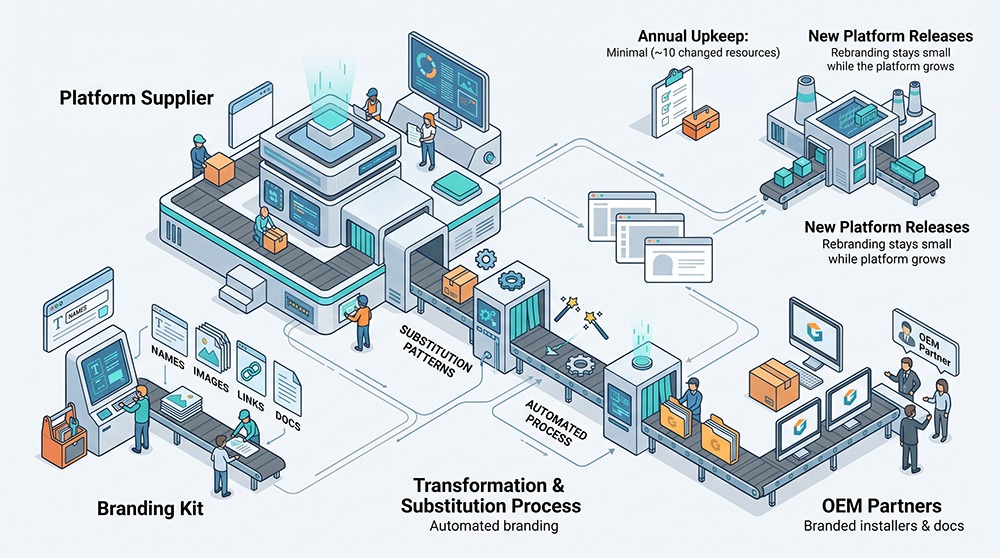
Our team has spent around 15 years refining this process. At Iotellect, OEM partners customize a branding kit containing the essential graphical and textual resources, while substitution patterns handle repeated references automatically. We also keep most documentation screenshots free of corporate identity wherever practical, so a screenshot change does not automatically create work for every OEM. Partners then receive installers and documentation produced with their branding already applied.
New resources occasionally require attention, but we work to keep that set small. In our experience, annual maintenance of an OEM’s branding kit has involved around ten new or changed resources or fewer. That estimate concerns branding upkeep; application changes, testing, and deployment still have their own workload. The initial design effort should establish a reusable basis for future releases.
The Commercial Agreement Must Fit the Product
An OEM also needs confidence in the economics of the years ahead. Future pricing and support costs deserve explicit treatment in the partnership agreement, alongside arrangements for platform discontinuation or the supplier ceasing to operate. These are long-term dependencies the OEM takes on when it builds its offering around someone else’s technology. They need attention before the product reaches customers.
At Iotellect, OEM pricing is negotiated individually because the underlying businesses differ substantially. Relevant factors include installation volumes, required platform capabilities, and the value of the software and platform within the OEM’s overall offering. A platform embedded in a hardware product may occupy a different economic position from one supporting a standalone software service. The commercial model needs to leave a viable business for both the OEM and the platform supplier.
The OEM Owns the Customer Support Relationship
When customers buy the finished product, they turn to its vendor for support. In our OEM model, that vendor is the OEM, which takes responsibility for the complete offering and determines whether an issue originates in its application or the platform. Iotellect supports the OEM when platform expertise or fixes are needed. We have a supplier support relationship with the OEM, without entering its customer’s support chain directly.
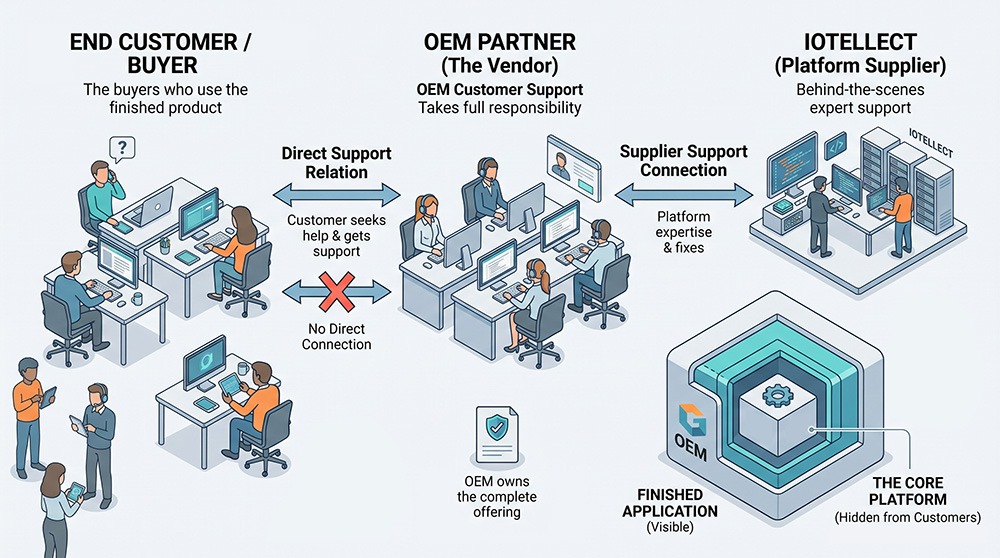
The analogy is a software library or framework. Buyers seek help from the company that sells them the application; that company works with its underlying technology suppliers as necessary. An OEM IoT platform occupies the same position. Customers may never know which platform is inside, and they should still have a clear place to obtain support for the product they purchased.
Ask Where the Platform Vendor’s Name Still Appears
The most useful question during evaluation is specific:
“Where exactly will our customers see your company or platform name when they install, administer, and use our product?”
Ask the supplier for the complete list and examine every remaining occurrence. We learned how deep this inspection can go when our original vendor name remained in Java package names after the more visible branding had been addressed. Although Iotellect supports no-code development, Java remains available, and customers of a flexible application may occasionally inspect or modify those scripts. We renamed the relevant packages because those names were still part of an experience the OEM could expose to its customers.
A supplier should be able to account for those details and explain how branding remains consistent through future releases. For an OEM requiring a complete product identity, each remaining appearance of the platform brand is a gap to resolve before launch. Start with that inventory, then establish the maintenance process, commercial arrangements, and support responsibilities. That gives the white-label commitment a concrete scope extending through the product’s life.