
SCADA has been one of the foundations of industrial automation for roughly half a century. I believe that in another ten years, however, the term may describe what industrial software actually does about as accurately as the word “telephone” describes the device we carry in our pockets today. This does not mean that every SCADA installation will disappear by 2036, because industrial systems have long lifecycles and enormous numbers of conventional SCADA systems will continue operating well beyond that date. It also does not mean that today’s SCADA vendors will disappear. The more interesting possibility is that the two capabilities that gave SCADA its name — supervisory control and data acquisition — will gradually stop being the center of value.
Data Acquisition Is Becoming A Commodity
Thirty years ago, data acquisition was a serious competitive advantage. An industrial software platform had to communicate with PLCs and controllers from dozens or even hundreds of vendors, many using proprietary or poorly documented protocols that were difficult to implement reliably. Over time, vendors also had to support different generations of OPC, multiple Modbus variants, BACnet and many other industry-specific protocols. Building and maintaining a large collection of reliable communication drivers required significant engineering effort, and the resulting connectivity library could legitimately differentiate one SCADA product from another.
That world is gradually changing. OPC UA is moving the industry toward a much more standardized way of exposing industrial data, events, methods and equipment models, and I expect this process to continue. It is unlikely that every existing protocol will simply disappear, but the strategic importance of having hundreds of proprietary drivers will steadily decline as PLC and equipment vendors increasingly expose their systems through a smaller number of broadly supported standards. Eventually, excellent support for the major industrial interoperability standards will simply become something every serious platform is expected to provide.
That makes the DA in SCADA progressively less interesting as a competitive differentiator. Data still has to be acquired, obviously, and connectivity must remain reliable, secure and fast. But being able to establish that connection will increasingly resemble having an Ethernet stack or an Internet connection today: essential infrastructure, but hardly the reason someone buys one platform instead of another.
Supervisory Control Is Changing Even Faster
The other half of SCADA is supervisory control, and this part may change much more dramatically. Traditionally, supervisory control means human operators sitting in front of HMIs, alarm lists and trends, continuously watching an industrial process and reacting when something happens. In many facilities that still means people monitoring screens 24 hours a day, seven days a week, because the human operator remains the intelligent layer responsible for noticing anomalies, interpreting situations and deciding when intervention is necessary.

AI changes that operating model. For many non-critical industrial processes, there is little fundamental reason why a human must continuously stare at a set of screens waiting for something unusual to happen. An AI agent can work directly with the underlying industrial model, continuously evaluating equipment state, measurements, calculated values, events and historical behavior without needing a graphical mimic diagram to understand the process. Instead of requiring a human to visually inspect hundreds of values, the AI can monitor the same system continuously and involve a person only when something falls outside the scope of what it is authorized or capable of handling.
This does not mean handing an LLM unrestricted control over a factory. The architecture should instead separate probabilistic reasoning from deterministic execution. A typical path might be AI observation → AI decision → deterministic validation → actual control action, with the amount of authority given to the AI depending heavily on how critical the process is. In a relatively low-risk manufacturing environment, AI might eventually perform much of the routine supervision and reconfiguration itself after deterministic validation. In a power plant, chemical facility or other safety-critical environment, the same AI might primarily analyze, recommend and escalate, while humans remain responsible for approving or executing important actions.
The important point is not that humans disappear. It is that continuous human supervision becomes less central. For many systems, humans increasingly become the escalation path rather than the primary monitoring mechanism, and that gradually weakens the SC in SCADA just as standardization weakens the competitive importance of the DA.
HMIs Won’t Disappear. Their Importance Will.
HMIs will almost certainly survive this transition, but their role will change significantly. There is a very good chance that AI will generate a substantial portion of industrial HMIs during the project engineering stage, because creating screens from an already defined industrial model is exactly the kind of structured work that AI can automate well. It is also plausible that some interfaces will eventually be generated dynamically at runtime when a human needs to investigate an unusual situation, although generating a safe and useful interface on demand is obviously a more difficult problem than generating one during engineering and commissioning.
What changes most is the economic importance of the HMI. Today, the HMI is usually the primary operating surface through which humans understand what is happening in the industrial system. In the future it may increasingly become a contingency, diagnostic and intervention interface. When everything is operating normally, there may simply be no reason for a person to continuously browse through screens, because AI agents will be supervising the underlying system directly through its data and model.
When something unusual happens, however, a human may still need a visual representation of the process. The system can then present the relevant equipment, trends, alarms and surrounding context so that the operator can understand the problem and intervene. HMIs therefore do not need to disappear for the traditional SCADA model to lose importance; they merely need to stop being the place where industrial supervision happens most of the time.
Alarms Split Into Two Worlds
Alarm handling will survive as well, but it will probably evolve into two rather different layers. The first layer consists of the deterministic alarms we already understand today: a temperature exceeds a predefined safety threshold, a pressure becomes dangerous, a fire detector activates, a calculated process condition enters a known prohibited state. The rules creating those alarms may increasingly be generated with AI assistance, but important rules will still be tested and approved by humans during engineering and commissioning. Once deployed, they behave predictably, remain auditable and can be relied upon as part of the deterministic industrial system.
Alongside them, however, another category of alerts will emerge. An AI agent might observe a combination of signals and conclude that something is wrong even though nobody previously defined an exact rule corresponding to that condition. The agent may also understand that the situation is outside its authority, that it cannot confidently determine the correct response, or that physical intervention is required. In that case it will create a higher-level incident, describe what it believes is happening and escalate the situation to a human or another agent.
Future industrial systems may therefore operate with two alert planes at the same time. Deterministic alarms describe conditions that engineers understood and formalized in advance, while AI-generated incidents represent situations recognized dynamically during operation. Both remain important, but the second category makes the traditional picture of an operator continuously watching a giant alarm table increasingly obsolete.
What Actually Replaces SCADA?
If data acquisition becomes a commodity and permanent human supervision becomes less important, the obvious question is what remains. My answer is not an AI platform. AI itself is likely to become a commodity remarkably quickly, in much the same way that Internet connectivity was once revolutionary and is now simply assumed to exist. The important platform is the infrastructure underneath the AI: the layer that provides industrial data, context, deterministic controls and predictable access to everything that needs to work with the industrial process.
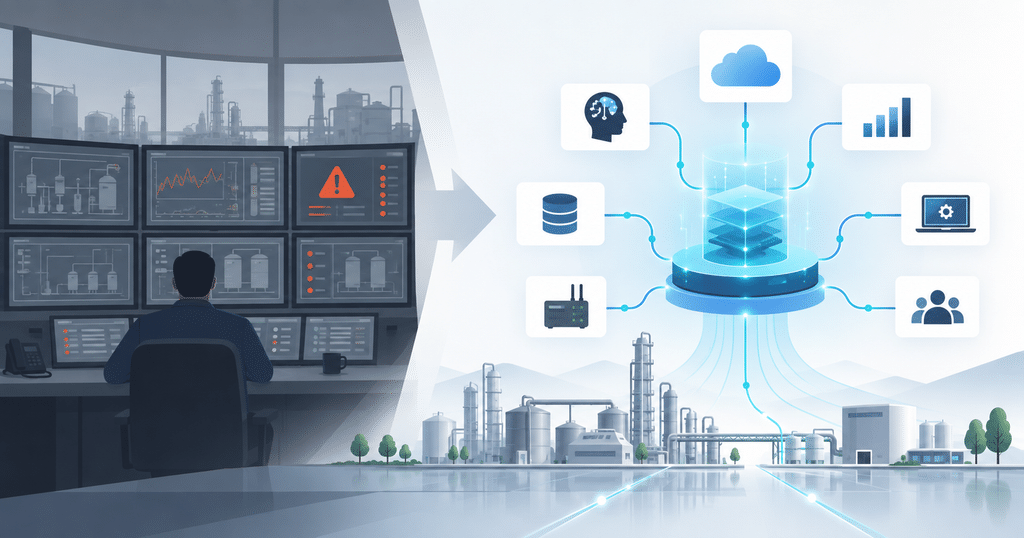
This future platform still acquires industrial data, most likely through standardized interfaces such as OPC UA, and it still contains a high-performance historian because historical machine data remains essential. It performs deterministic calculations, processes events, executes workflows and exposes current and historical industrial information to higher-level systems such as MES, EAM, ERP and many others. It also exposes that information to AI agents, but it does so according to a carefully controlled model defining exactly what each entity can see, change, invoke or command.
The central value therefore shifts away from acquiring data and drawing screens and toward deterministic distribution and access control over enormous industrial data flows. Industrial systems already generate huge streams of structured machine data, and those streams will only become larger as equipment becomes more instrumented and higher-frequency information becomes useful. In some of our larger systems today, more than a million events per second can already move through a single cluster. Multiply that by many factories, richer devices and increasingly automated consumers of industrial data, and the volume that future platforms must govern becomes enormous.
The Platform Lives Everywhere
The architecture cannot be reduced to one central server in the factory, and it cannot simply be moved into the public cloud either. The platform will live throughout the industrial infrastructure: at the edge near machines, on the shop floor, inside factory data centers, within the company’s private cloud and, where appropriate, inside public clouds. Different parts of the same industrial model and the same data streams may exist at different levels depending on latency, security, reliability and business requirements.
The real value lies in moving industrial data between these layers quickly, reliably and securely while preserving deterministic control over what moves where. Some information may remain entirely local. Some may be continuously aggregated before being sent upward. Some may be provided only when requested. Time-series information may need compression, filtering, encryption, guaranteed delivery, pre-aggregation or post-aggregation, and AI agents operating at different levels may require very different views of exactly the same underlying process.
An agent running at the edge may need high-frequency raw machine data for a short period. A corporate optimization agent in the cloud might need only aggregated production statistics. An MES system may require another subset, while a maintenance system requires different events and historical information. The platform’s job is to make the required information predictably available at the right place and time without turning every consumer into an unrestricted participant in the entire industrial network.
The Unified Industrial Model Becomes The Foundation
If I had to choose one architectural requirement that matters more than everything else, it would be a strong unified industrial data model. The future system cannot merely consist of millions of loosely organized PLC tags. Humans and AI agents need to operate against meaningful representations of the physical enterprise: facilities, production areas, lines, machines, reactors, pumps, conveyors and whatever other objects actually exist within the industrial process. The incoming PLC and machine data should then be bound to those models rather than becoming the model itself.
This matters because the industrial platform must describe far more than values. It must also represent calculations, events, functions, methods, actions and relationships between entities. Imagine one AI agent detecting an unusual condition and generating an event that another agent must receive and process. Publishing that event is an action governed by the platform, subscribing to it is another governed operation, and neither one can be represented meaningfully as simply reading or writing a tag.
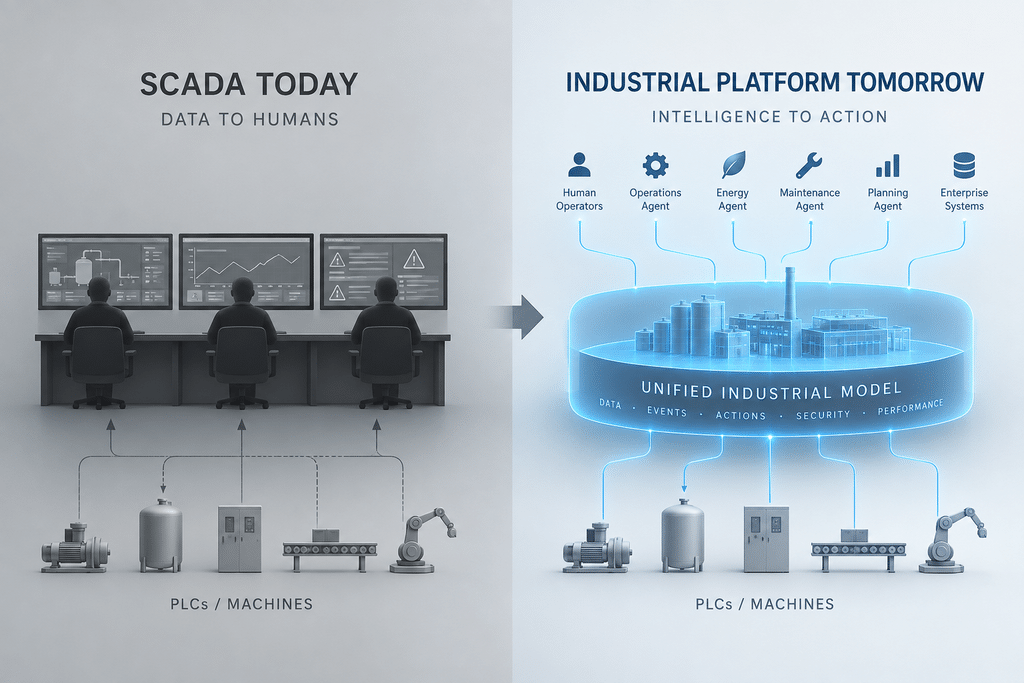
The same applies to control. An AI agent may be allowed to read some properties of a machine but not others, subscribe to certain events, invoke one method, generate another type of event and remain completely prohibited from issuing particular commands. Another agent may have an entirely different role. Access control therefore needs to operate around the industrial model and the capabilities associated with its entities, not merely around network addresses and tag namespaces.
That unified model is what turns raw industrial data into a contract that both humans and machines can understand. It becomes the common language through which AI agents, enterprise applications, deterministic rules and industrial equipment interact.
Security Becomes Even More Important When The Users Are Machines
The second major requirement is a strong security and governance model. Traditional industrial permissions were designed primarily around human users and applications operating at human speed. Autonomous agents are different: they can inspect, request, calculate and act extremely quickly, they can operate continuously, and they may interact with other agents without a person reviewing every step. A poorly constrained human might make several bad decisions before someone notices; a poorly constrained machine could make thousands.
That means permissions cannot simply be an afterthought added to an AI connector. The platform must deterministically constrain every agent according to exactly what it is allowed to access and which actions it can perform within the unified industrial model. This includes not only reading data but also publishing events, subscribing to information, invoking functions, initiating workflows and ultimately sending commands toward PLCs and machines.
The faster and more autonomous the intelligent layer becomes, the more important this deterministic substrate becomes underneath it. Paradoxically, a future dominated by probabilistic AI requires an exceptionally strong deterministic infrastructure to keep that intelligence within safe and predictable boundaries.
Performance Is The Third Pillar
The third requirement is performance. None of the architectural ideas above are particularly useful if the platform can model everything beautifully but becomes a bottleneck as soon as millions of industrial events begin moving through it. The system has to process enormous quantities of structured information while simultaneously enforcing permissions, maintaining histories, executing deterministic logic, delivering events and transferring selected information between edge, factory and cloud layers.
This problem becomes more important rather than less important with AI. Agents will create additional consumers of industrial information, and the natural tendency will be to ask for more data at higher resolution because machines can analyze volumes that human operators never could. The platform therefore has to make increasingly large data streams available without simply copying everything everywhere, which brings aggregation, filtering and distributed processing back to the center of the architecture.
The future successor to SCADA is therefore not defined by a beautiful AI assistant. It is defined by its ability to govern huge machine-data flows predictably, securely and fast enough that humans, enterprise systems and many different autonomous agents can all operate on top of the same industrial foundation.
There Won’t Be One Industrial Agent
It would also be a mistake to imagine the future factory as today’s SCADA system plus one giant AI operator. There will probably be many agents performing roles analogous to the many human and software roles that already exist around an industrial enterprise. One agent might supervise production. Another might optimize energy consumption. Another could focus on quality, maintenance, raw-material availability, supply levels or long-term capacity planning. Higher-level corporate agents may operate across many facilities, while specialized local agents remain close to individual machines or processes.
These agents will also communicate with conventional enterprise systems and with one another. One agent might generate an event because it has detected an unusual condition, another may evaluate its effect on production planning, and another may adjust a procurement forecast. The industrial platform becomes the common deterministic environment through which these entities acquire information, publish information and perform authorized actions.
In that sense, replacing the 24/7 human SCADA operator is only one relatively obvious use of AI. The much larger change is that industrial software will contain a growing population of autonomous machine actors, all requiring structured access to the same physical enterprise. The platform underneath them becomes more important precisely because the intelligent actors above it become more numerous and more independent.
Will We Still Call It SCADA?
I have worked in what is now called the Internet of Things business for 26 years, but we certainly did not always call it IoT. At different points we used terms such as M2M, Intelligent Device Management and Remote Monitoring and Service. The technology evolved continuously, while the industry kept changing the language used to describe it. If someone had asked me in 2005 what this software category would be called in 2026, I would never have confidently answered “Internet of Things platform.”
The same thing may happen again. What replaces today’s SCADA could eventually be called an Industrial IoT Platform, Industrial Data Platform, Industrial Application Platform, Industrial Data Fabric or something we have not invented yet. It may even continue to be called SCADA simply because old names often survive long after their original meaning becomes inaccurate. We still “dial” phone numbers without a rotary dial, send a “CC” without carbon paper and talk about network interface “cards” that may no longer be cards at all.
The smartphone provides an even better analogy. It replaced the landline phone, camera, notebook, calendar, calculator, music player, navigation device and many other standalone products, yet we do not describe it as a phone-calendar-camera-calculator combination. Those capabilities survived, but none of them remained sufficient to define the new product category. Something similar may happen to SCADA: supervisory control and data acquisition will still exist, but they may simply become inherited capabilities inside a much broader industrial platform.
Why Ten Years?
Ten years is obviously not a precise technological deadline. The transition will be gradual, and industrial automation changes much more slowly than consumer software because equipment and production systems remain in service for decades. One year is clearly too short for the operating model of industrial facilities to change completely, while one hundred years would make the prediction almost meaningless given the pace of technological progress. Ten years is simply a useful horizon for thinking about what happens when today’s rapidly developing AI technology meets a software category that has been evolving for roughly half a century.
In five years, I expect the transition still to be visibly in progress. Conventional HMIs, 24/7 human operators and classic SCADA architectures will remain common, both because old systems will still be operating and because many new systems will continue to be engineered according to familiar patterns. At the same time, AI-assisted engineering, agent-based supervision and platform-oriented architectures should become much more visible. By ten years, I expect the difference to be large enough that designing a major new industrial system around the assumptions of classic SCADA will increasingly look outdated.
The Biggest Risk Is Not That SCADA Stops Working
For industrial companies, the danger is not that today’s SCADA products suddenly stop functioning. A perfectly engineered conventional SCADA system may continue operating reliably for decades. The danger is that it becomes the wrong architectural foundation for everything a company wants to add around it.
For a relatively small manufacturer with one factory, that cost may remain manageable. The company may employ more human operators than necessary, perform more custom integration work and have more difficulty introducing autonomous agents, but the consequences may not justify rebuilding the entire automation architecture. For a large industrial corporation operating many facilities, however, the same decision can become much more expensive because every limitation is multiplied across factories, applications, data flows and future automation initiatives.
A corporation that eventually wants hundreds of agents, cross-site optimization, enterprise-wide industrial analytics and tightly governed machine-to-machine workflows needs its industrial systems to expose a consistent model and consistent contracts. If each factory is instead built around a separate conventional SCADA architecture whose primary abstractions are screens and tags, converting that environment later may require significant re-engineering rather than merely installing another software component.
What Should Companies Building Systems Today Do Differently?
The most important decision is therefore not whether the product you buy today has the letters SCADA on its website. The question is what sits underneath it. A future-ready industrial architecture should begin with a strong unified model of the physical enterprise, where equipment, facilities, events, actions and data all exist within a consistent structure that external applications and autonomous agents can understand.
Around that model, the platform needs a strong deterministic security layer capable of restricting machine actors just as carefully as human users, except at much greater speed and granularity. It also needs the performance and distributed architecture required to handle increasingly large industrial streams from the edge to the factory and into multiple clouds without making unrestricted data movement the default solution.
HMIs, alarms, historians, connectivity and even AI agents then become services and applications around that foundation rather than the foundation itself. Some of those capabilities sound very familiar because today’s better industrial platforms and SCADA systems already contain pieces of this architecture. The difference is where the center of gravity lies.
Classic SCADA was built around acquiring industrial data and presenting it to humans so that humans could supervise the process.
The next generation of industrial platforms will be built around modeling the industrial enterprise and deterministically governing enormous flows of data, events and commands among machines, software systems, humans and autonomous agents.
Whether we still call that SCADA in 2036 is almost beside the point.