
The SCADA–MES–ERP pyramid is a traditional way to implement ISA-95, not a requirement of the standard. ISA-95, the international standard for integrating enterprise and control systems, defines which job belongs to which functional level – and that split shows where one system ends and the next begins.
Short answer: SCADA supervises the physical process in real time, working with the PLCs that execute control. MES manages production execution: orders, work in progress, quality and traceability across shifts. ERP plans and accounts for the business: orders, inventory, purchasing and finance. They work together by passing orders down and confirmed results up.
IEC publishes ISA-95 as IEC 62264. The levels describe functions rather than products, so a single product can cover more than one of them.
SCADA vs MES vs ERP at a Glance
The table compares the three systems on seven dimensions, from ISA-95 level to the typical effect of an outage.
| SCADA (with PLCs) | MES | ERP | |
|---|---|---|---|
| Primary job | Supervise and control the process | Coordinate and record production execution | Plan and account for the business |
| ISA-95 functional level | Level 2, with some SCADA functions reaching Level 3 | Level 3 | Level 4 |
| Typical activity horizon | Sub-seconds to seconds | Days, shifts, hours, minutes, seconds | Months, weeks, days, shifts |
| Main unit of data | Tag: value, timestamp, quality | Order, operation, lot, event | Business transaction |
| Typical users | Operators, control engineers | Supervisors, planners, quality, operators | Finance, supply chain, planners, management |
| Example functions | HMI screens, alarms, setpoints, trends, history | Dispatch, WIP, genealogy, quality, labor, OEE | Orders, inventory, purchasing, costing, finance |
| Typical effect of an outage | Supervision and alarms are lost, PLC control continues if designed to | Dispatch and production records stop, lines run on fallback procedures or hold | Planning and postings stall, machines keep running |
The horizons follow ISA’s and the OPC Foundation’s descriptions of ISA-95 and describe how far ahead each activity plans and reacts, not guaranteed latency. The outage row reflects typical designs, and real effects vary: NIST notes that control failures “could cause substantially different impacts across domains”.
The Layers: PLC, HMI, SCADA, Historian, MES and ERP
ISA-95 defines five functional levels: Level 0 is the physical process, Level 1 senses and manipulates it, Level 2 covers monitoring, supervisory and automated control, Level 3 is manufacturing operations management, and Level 4 is business planning and logistics. ISA states that the scope “prioritizes activities, not technologies”. Dennis Brandl and Charlotta Johnsson add in a 2021 ISA InTech article that the familiar pyramid is “one traditional implementation” of the model, “not imposed by the ISA95 standard”.
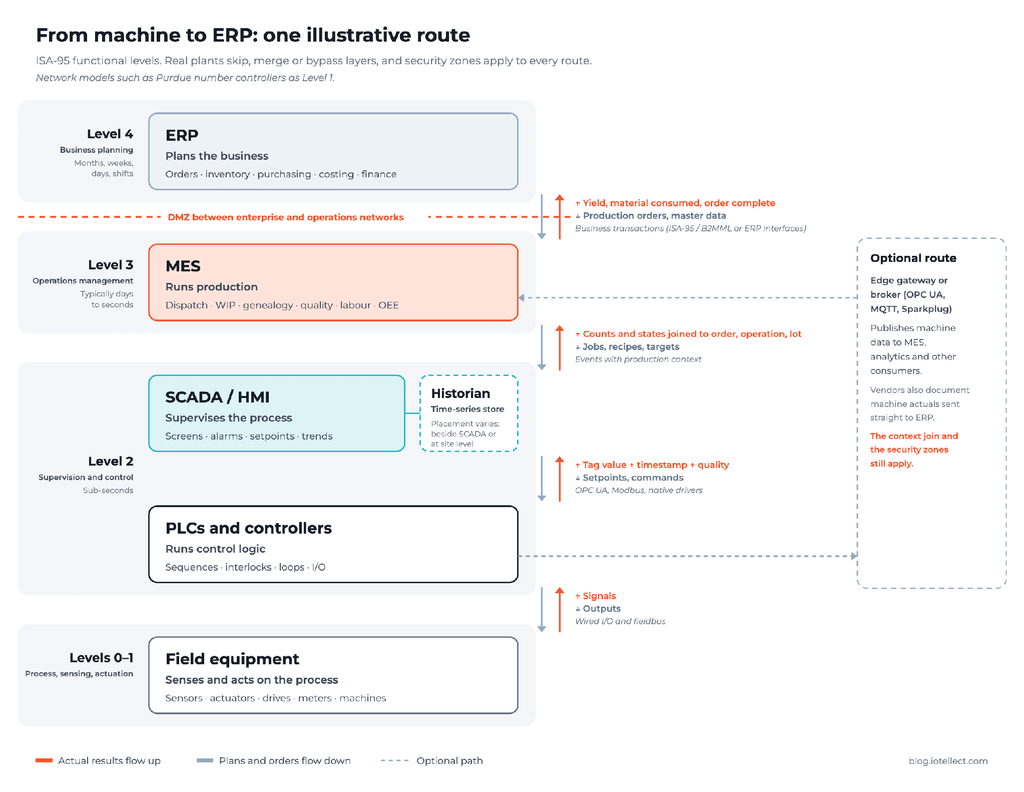
One illustrative route from machine to ERP, drawn on ISA-95 functional levels. Real plants skip, merge or bypass layers, and security zones apply to every route.
PLC. A programmable logic controller executes logic, timing, counting and control loops from user-programmable memory, in NIST’s definition. The OPC Foundation’s ISA-95 summary places Level 2 responses “measured in sub-seconds” on PLCs and distributed control systems. Network models such as Purdue number controllers as Level 1, so a diagram should state which convention it uses.
HMI. A human-machine interface is the screen or panel through which an operator interacts with a controller, and it can sit next to a machine or inside a SCADA system.
SCADA. Supervisory control and data acquisition collects data from many controllers, presents it to operators, raises alarms and sends supervisory commands. In NIST’s typical architecture “the RTU or PLC controls the local process”, where an RTU is a remote terminal unit. ISA’s own overview also lists SCADA systems “that manage manufacturing operations” at Level 3, which is why the label alone does not fix a level.
Historian. A historian is a time-series database for process values and events – NIST calls it “a centralized database” that supports analysis. Some architectures draw it beside SCADA and others at site level, so it serves several levels rather than forming one.
MES. A manufacturing execution system covers production “from order launch to finished goods” and “guides, initiates, responds to, and reports on plant activities as they occur”, in MESA’s 1997 definition.
ERP. Enterprise resource planning integrates finance, procurement, sales, supply chain and the business side of manufacturing. In SAP’s description, “each ERP module typically focuses on one business area”.
How Data Travels From a Machine to ERP
The path below is one illustrative route, and it shows the data changing shape at every boundary: signal, tag, event with context, business transaction.
Order down. ERP releases a production order with its material and routing references. In SAP’s documented integration with its Digital Manufacturing MES, that transfer “is handled asynchronously” (SAP, 2025).
Job to the line. MES splits the order into jobs for specific lines and equipment. The OPC Foundation’s ISA-95 Job Control specification (OPC 10031-4, 2024) starts a stored job “as soon as the Job Order receiver is ready to start”.
Tags up. PLCs expose counts and machine states. SCADA reads them through native drivers or OPC UA, and a historian keeps each sample’s “timestamp, tag quality, and the original value” (Inductive Automation, 2026).
Context join. MES assigns those counts to an order, an operation and a material lot. SAP’s plant-connectivity example shows why: the shop-floor event it maps “requires the SFC, plant, resource, and the operation”, where SFC is SAP’s identifier for a unit of work on the shop floor (SAP, 2021).
Transactions up. ERP receives separate business messages – SAP’s documented flow sends a production order yield confirmation, a goods movement for consumed material and an order-complete message. ISA-95 Part 5 (IEC 62264-5:2016) defines the business-to-manufacturing transactions behind this exchange. Teams that exchange ISA-95 XML should pin the schema version, because the 2026 edition of IEC 62264-2 “cannot ensure backward compatibility to implementations based on older editions”.
Rule of thumb: ERP should receive production facts it can post, not raw tag streams. A record of value, timestamp and quality cannot say which order it belongs to.
The chain is not the only route: SAP also documents machine “actual data for yield, scrap, and manual rework” flowing straight into an ERP confirmation, and an MQTT broker can publish the same machine data to several consumers at once. MQTT is “agnostic to the content of the payload” (OASIS, 2019), so a broker distributes data without adding order context.
Every route still crosses a security boundary. In NIST’s example architecture for operational technology (OT), communication between the enterprise and operations levels is “required to go through services within the DMZ” (NIST SP 800-82r3, 2023). A DMZ is a buffer network between the two. IEC 62443-3-2:2020 frames the same design as zones and conduits, each assessed for risk.
What SCADA Should Control
SCADA owns the operator’s view of the process and the supervisory layer of control: HMI screens, alarm management, setpoints and commands to controllers, data acquisition, trends and short-term history. ISA-101.01-2015 provides “a comprehensive framework for designing and managing HMIs in process automation systems”, and ISA-18.2 covers “all alarms presented to the operator through the control system”.
The control itself stays below SCADA: PLCs execute sequences, interlocks and loops, and NIST notes that “some systems require reliable, deterministic responses” – timing that belongs in a controller rather than an application server. Safety functions sit apart again in the safety instrumented system (SIS): “An SIS is often independent from all other control systems,” in NIST’s words.
Warning sign: a design that routes a machine interlock or a safety trip through MES logic.
What MES Should Manage
MES owns production execution: which order runs where, with which material, by whom and with what result. That covers dispatching, work in progress, genealogy and traceability, quality workflows such as sampling plans and statistical process control (SPC), labor and qualifications, and the execution record. AVEVA describes its MES as a way to “manage plant schedules and job execution” and “automate quality sample plan execution”.
Detailed scheduling often sits in the same layer: Sepasoft notes that detailed scheduling of shift personnel, lines and maintenance “tends to occur at the MES level”, with ERP work orders imported and adjusted there. ISA-95 Part 3 extends the same layer to quality, inventory and maintenance operations, so an MES rarely covers all of manufacturing operations management alone.
Bottom line: MES turns a planned order, usually from ERP, into dispatched, executed and recorded work.
Where Responsibilities Overlap
The split is firm for control, operator alarming and safety on one side and for order execution, genealogy and labor on the other, while four functions appear on both sides in current vendor documentation.
OEE. Siemens computes overall equipment effectiveness on edge devices and operator panels (“Automatically compute OEE, MTBF, MTTR and TEEP”), while Sepasoft and AVEVA calculate it inside MES.
Recipes. WinCC Unified and FactoryTalk View handle recipes on the supervisory side, and MES products manage recipes, bills of materials and batch records. Sepasoft’s reminder applies: “Machine Recipes are not Batch Recipes.”
History and reporting. Both layers store and report data. AVEVA System Platform, for example, collects time-series process data “with native built-in historian” on the supervisory side and offers MES as a plug-in extension of the same platform.
Alarms and stops. Sepasoft lets MES “generate alarms and even stop production runs if you choose”. That is an operational action, not a safety function, and ISA’s guidance separates alarms from informational notifications.
Five questions settle the boundary for a specific plant:
- Who may issue production, recipe and supervisory commands?
- What must keep running, stop or degrade when the upper layer is unavailable?
- Which system holds the authoritative record for recipes, WIP, genealogy and quality results?
- Which events are operator alarms, which are notifications and which are safety actions?
- Which modules and licenses are actually in scope?
Does MES replace SCADA? No standard says it must or must not. MES does not take over control, operator alarming or safety, although it can absorb some reporting, OEE and recipe tasks that a SCADA installation performs today. Replacement is a function-by-function decision, not a product swap.
Three Integration Architectures
The three patterns below are not a maturity ladder, and some plants run two at once: HighByte, which sells a data layer, notes that some architects “leave operational integrations in place” while adding one.
Separate Systems With Direct Interfaces
Each application talks to the others through its own interface: SCADA to MES, MES to ERP, sometimes SCADA to ERP. IBM calls point-to-point integration “often a lower-cost option for basic systems with minimal software integrations” and warns that in larger landscapes “scalability can become difficult”. The arithmetic explains why: a full mesh of n applications needs n(n−1)/2 links, so six fully connected systems need 15, and each connection “needs to be uniquely defined, designed, and implemented” (IBM Redbooks, 2002).
Fits when: few systems, few exchanges and a clear owner for every interface.
Shared Industrial Data Layer
Producers publish to a shared layer, often an MQTT broker organized as a unified namespace (UNS), a single structured view of the business’s current state and events. The USCAR/CESMII roadmap credits the term to Walker Reynolds of 4.0 Solutions. It is an architecture rather than a standard, and a 2026 FIR paper from RWTH Aachen cites a “lack of standard and common definition”. The layer still needs payload design and adapters for applications without MQTT, and HiveMQ, another vendor in this space, notes that “building a UNS takes time and effort”. Sparkplug 3.0.0 standardizes topics and device state but leaves host application behavior “not specified by the Sparkplug specification”.
Fits when: several consumers need the same contextualized data.
Unified Operational Platform
SCADA and MES applications run on one platform with a shared data model. The pattern is documented: Sepasoft’s simplest architecture is “a single Ignition server with all the HMI, SCADA and MES modules installed”, and AVEVA describes System Platform as software “for deploying advanced SCADA software, MES, and IIoT”. One platform is not one server or one purchase. Sepasoft’s modules “require purchase of Inductive Automation’s Ignition Platform to operate”, and Inductive Automation’s scale-out design splits workloads so that “should a server fault, only that part of the system is hindered”. In manufacturing under good manufacturing practice (GMP) rules, EU Annex 11 adds that “the application should be validated” whichever platform hosts it.
Fits when: the required functions fit the platform’s modules and one change process can serve both supervision and execution.
Warning sign: SCADA and MES on one server, one database and one release train with no tested restore. That puts supervision and production records in one failure domain, a choice the same platforms let teams avoid.
Whichever pattern a plant chooses, someone still has to own the join between process data and orders and draw the zones and conduits.
Brownfield Example: Adding MES Between Existing Systems
A published Iotellect case shows the integrate-first pattern in mineral processing rather than discrete manufacturing. The customer, an open-pit gold mining group, runs a full cycle from ore haulage and crushing through heap leaching and electrolysis to smelting of Doré bars. Before the pilot, “production data lived in disconnected systems and spreadsheets”, and dispatchers coordinated operations by phone and radio.
The pilot built on Iotellect did not replace those systems. The MES imports “shift-daily production plans from the corporate ERP” together with the equipment registry, combines them with the fleet management system, truck scales, laboratory (LIMS) results, plant data historians and telematics, and feeds production actuals to corporate BI tools. Connections used protocol drivers and low-code configuration “rather than custom middleware”, on premises, with role-based access and an audit trail of manual corrections.
The same pattern can apply in discrete plants: the existing ERP and historians stay as sources of record, and the new layer supplies the context between them. Replacement becomes the right call when support runs out or a documented function is missing. NIST’s SA-22 control asks teams to replace components “when support for the components is no longer available” or to provide “options for alternative sources for continued support” (NIST SP 800-53r5, 2020).
Platform-Selection Checklist
Integrators scoping a new project and plant engineering teams reviewing a vendor proposal can use the same ten checks.
- Context join. Name the system and the team that assign process data to orders, operations and lots.
- ERP contract. Specify the messages, identifiers, acknowledgements and schema version for every ERP exchange.
- Boundary. Map each overlapping function with the five ownership questions above.
- Existing equipment. Check driver and interface coverage for the PLCs and systems already installed.
- Failure domains. Ask for the server and database layout, a tested restore and the disconnected-operation procedure.
- Security zones. Require a zone and conduit design with the permitted flows for the new integration path.
- Scope. Confirm modules, licenses and third-party dependencies in writing.
- Exit. Test data and model export, not only open protocols. Microsoft lists proprietary data models and deployment restrictions as lock-in mechanisms alongside interfaces.
- Validation. In regulated production, validate the configured application, not the product brochure.
- Migration. Plan phases where support allows, with a supportability decision for each legacy component.
SCADA keeps the process under control. MES keeps production on record.
How Iotellect Supports Unified SCADA and MES Applications
Iotellect is a low-code industrial platform whose Edge, SCADA, MES and BI tiers form one automation pyramid and run on the same architecture, data model and engineering environment. According to the Edge product page, every tier also stands on its own.
On the supervisory side, Iotellect SCADA connects to PLCs, collects process data, shows it on operator screens, logs history, raises alarms and generates reports. It talks to equipment over OPC UA, OPC DA/HDA/AE, Modbus, Siemens S7, Omron FINS and the other protocols listed on the connectivity page.
On the execution side, Iotellect MES ships modules for planning and scheduling, OEE and performance, track and trace, quality and reporting, and it “reads directly from the same tag database your SCADA uses”. Between Iotellect SCADA and Iotellect MES, that shared tag database replaces a separate SCADA-to-MES interface, while external systems still connect through documented interfaces. Iotellect states that the MES core includes a built-in ISA-95 compliant enterprise asset hierarchy. A published SMT assembly line case describes dispatching, defect analysis and equipment performance data built on Iotellect SCADA and Iotellect Integration Manager.
The ERP can stay in place: Iotellect’s MES documentation describes keeping “master data at the EAM/ERP and SCADA levels”. The development and integration page lists HTTP, MQTT and JDBC/ODBC among the supported enterprise protocols, with REST, SOAP and SQL database interfaces documented separately. The MES can also take data from third-party SCADA systems and from direct PLC and gateway streams. Nodes run at the edge, on premises or in the cloud as one distributed system, and each “operates independently during connectivity drops”. The platform architecture adds active-active and active-passive failover clustering for servers.
Iotellect does not replace an ERP, and a specialized MES can remain the right choice where validated or industry-specific workflows require it. ERP integration still needs interface design and data mapping, and the REST API, for example, does not create or delete objects. Projects are built by the customer’s engineers or by an implementation partner, and the Iotellect MES page names system integrators and engineering companies as the firms that deliver turnkey projects. Iotellect provides the software, demos, technical training, integration help and architecture review.
To check one PLC-to-ERP route against the checklist on a working system, request a demo from the Iotellect MES or Iotellect SCADA page.
Frequently Asked Questions
What is the difference between SCADA and MES? SCADA supervises equipment: it shows operators the live process, raises alarms and sends setpoints to PLCs. MES manages the work done with that equipment: which order runs, which material is used, what quality results came back and how long each step took. SCADA works mainly in tags and seconds, MES mainly in orders and shifts.
Does MES replace SCADA? Not as a whole – MES does not take over machine control, operator alarming or safety functions. Depending on the products involved, it can take over part of the reporting, OEE calculation and recipe management. Plants decide the boundary function by function, asking who owns each command, record and alarm.
Where do PLCs, historians and ERP systems fit? PLCs execute control at ISA-95 Level 2, under SCADA supervision. Historians store time-stamped process data and support several levels, so their placement varies. ERP sits at Level 4 and handles planning, inventory and finance, exchanging orders and confirmations with MES rather than raw sensor data.
How does data travel from a machine to ERP? Signals become PLC tags, tags reach SCADA and the historian, MES joins them to an order, operation and lot, and ERP receives business transactions such as yield confirmations and material consumption. Some plants use brokers or direct ERP connections, but the context join and the security zones remain.
Can one platform support both SCADA and MES? Yes – several vendors document SCADA and MES modules running on a shared platform and data model. The practical checks are module scope, licensing, separate failure domains for large or multi-site systems and, in regulated production, validation of the configured application.
When should a manufacturer integrate rather than replace systems? Integrate when existing systems are supported, fit their function and can exchange the required data. Replace when vendor support has ended without a credible alternative, when the old system lacks a function the plant has documented as required, or when security and safety requirements cannot be met around the old system.