

Your customer does not have a SCADA business. It has a manufacturing business, an agricultural business, a fuel-retail business, or something else that happens to need SCADA. The boundaries between SCADA, MES, building automation, fleet management, and industrial IoT matter to software vendors and engineering teams. They matter considerably less to an enterprise trying to make its operations work better.
For a system integrator, that difference creates an opportunity. A customer may initially hire your company to automate a production facility, but its next important problem could involve remote sensors, equipment analytics, warehouses, or vehicles. You already have a relationship, understand part of the operation, and have demonstrated that your engineers can deliver. The question is whether your team can follow the customer into that next problem – or whether the opportunity falls outside the boundaries of its tools.
Becoming a “universal IoT/IIoT superpower” does not mean turning every SCADA engineer into an expert in every industry. It means giving a capable team a technological foundation broad enough to address substantially more of a customer’s needs, without mastering a completely different platform for every new application. The commercial destination is not a more impressive list of technical skills. It is a larger and more valuable role within the businesses your company already serves.
Your Customer’s Next Project May Not Look Like Your Last One
Consider an agricultural holding with fields, harvesting operations, storage facilities, processing plants, and enterprise systems coordinating the business. Your team might enter that customer through a conventional SCADA project in a processing facility. After a successful delivery, the customer asks whether you could also connect field sensors and monitor soil and weather conditions through an LPWA network. From the customer’s perspective, this is a reasonable next assignment for a trusted automation company.
For your engineering team, however, the requirements have changed. You now need to work with distributed sensors, different connectivity arrangements, geographical information, GIS-style visualization, and perhaps mobile equipment or tracking devices. The underlying purpose, i.e. collecting operational information and using it to improve the business, is familiar. The technology required to deliver it may extend well beyond the environment your engineers currently use.
This is why expansion cannot always follow a tidy sequence from SCADA to the closest neighboring software category. Building automation may be a comfortable first step because many familiar concepts carry across, while other opportunities lead toward data centers, asset management, IT infrastructure, or connected equipment. The customer will not necessarily offer these projects in the order most convenient for your training plan. A broader platform gives the team more freedom to follow the opportunities that actually exist.
The attraction is not that existing customers become an unlimited source of easy revenue. It is that winning additional work does not always require starting a relationship from zero. Every new part of the operation your team understands can reveal further needs and make your company more useful. That gives account expansion a place alongside acquiring new customers, rather than forcing growth to depend entirely on the latter.
Keep the Tool, Expand the Work
Think of an operator who knows an excavator thoroughly: its controls, behavior, maintenance requirements, and limitations. Learning a different kind of excavation, e.g. in a complicated soil type or within abundant underground infrastructure, still requires effort and judgment, but the operator does not have to relearn the machine at the same time. Switching to a different type of equipment, such as a bulldozer, introduces another learning problem. The distinction is between mastering a new use of a familiar tool and mastering both a new tool and a new use.
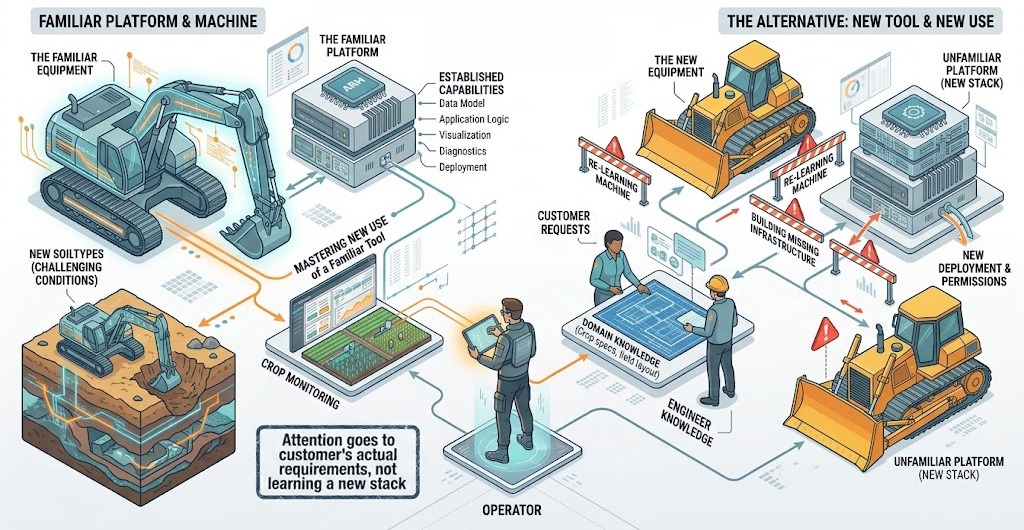
For an engineering team, the investment in a platform extends far beyond knowing where to click. It includes understanding its data model, application logic, visualization, diagnostics, deployment, permissions, and maintenance. It also includes learning how the platform evolves and how to troubleshoot problems under delivery pressure. Reusing that knowledge across application categories leaves more attention available for the customer’s actual requirements.
There is an important condition: the platform must genuinely support the broader work. A familiar interface is not enough if every new application requires your engineers to build and maintain substantial missing infrastructure. Conversely, there is no reason to replace an existing platform merely because it is marketed as SCADA if it already supports the intended scope effectively. The useful test is how much of the new solution can be engineered with established capabilities, and how much requires your team to become the developer of additional platform functionality.
Nor does a broad platform remove the need for domain knowledge. An engineer designing crop monitoring still needs to understand what the customer wants to observe, how the information will be interpreted, and what decisions it should support. That knowledge may come from the customer, equipment suppliers, or relevant specialists. The advantage is not that these questions disappear, but that learning the application does not automatically require learning another complete technology stack.
One Team, One Customer, Several Very Different Applications
One of our partners provides a practical example. The company began by automating a gas-station network for a large oil-and-gas enterprise, connecting more than 1,500 stations to a central system. The scope included fuel pumps and storage tanks alongside refrigeration, lighting, multimedia equipment, and other station systems. This was a SCADA-centered assignment, but its purpose extended beyond displaying equipment status.
The partner also changed how incidents were handled. Instead of relying on call-center operators to coordinate every equipment problem, incidents could be reported directly to local service subcontractors responsible for repairs. This reduced the call center’s workload and the amount of manual coordination required. The result was a successful operational system and a customer willing to discuss additional needs with the same supplier.
The next request concerned coffee machines. Coffee operations were important enough to this customer to justify a separate diagnostics and analytics project, rather than a small addition to the station dashboards. Initial diagnostics used electrical-current measurements; later, the team worked with the coffee-machine manufacturer to obtain richer machine data. The work expanded into custom device connectivity, protocol implementation, and detailed analytics: a different assignment from the original station-supervision project.
After that came fuel-depot operations, introducing workflows and operational requirements closer to MES than the original SCADA application. The customer then wanted visibility across fuel deliveries from the depots to the stations. The partner extended its work into fleet tracking, following trucks as they traveled, loaded fuel at depots, and unloaded it at stations. The relationship had grown across equipment supervision, connected-device analytics, depot operations, and transport logistics.
All of this was delivered by the same engineering team. Its members knew the platform at senior and architect levels, which allowed them to concentrate on understanding each new requirement and delivering the corresponding application. They did not need to establish a separate technology practice for every category of work. The customer’s expanding needs became substantial additional projects for a partner it already trusted.
That is the transformation worth pursuing. The team did not become more versatile merely because a vendor added categories to a capabilities slide. It used its existing platform expertise to undertake genuinely different assignments for the same customer. The breadth became commercially meaningful because the engineers could deliver it.
The Platform Is Already Known on Both Sides
There was another advantage in this case: the platform had already been adopted by the customer. The partner knew how to engineer with it, while the customer’s IT security and architecture stakeholders were already familiar with the underlying technology. New proposals did not always require the same introductory discussions that would accompany an unfamiliar software environment. The partner could explain the additional application within a technological relationship that already existed.
This does not mean that approval of one application automatically approves every subsequent use. New interfaces, information flows, and operational responsibilities can still require scrutiny. But extending an understood platform is a different conversation from asking an enterprise to adopt another product with another architecture and support model. The partner reuses engineering competence, and the customer reuses its knowledge and adoption of the technology.
That combination is easy to overlook when evaluating a platform only through its feature list. The value is not simply that the engineers can build the next application. It is also that they can propose it within an established technical and organizational context. Both sides have less to rediscover.
Expand the Business Model Without Replacing It
Broader capabilities do not require an integrator to abandon its existing commercial model. A company can continue delivering SCADA or MES projects, supporting installed systems, and undertaking modifications while adding new kinds of work. The proposition is extension, not an exchange in which familiar revenue must be sacrificed to obtain broader opportunities. How the additional work is contracted remains a business decision between the integrator and its customers.
In the oil-and-gas example, the relationship developed into a division of responsibilities. The partner remained the principal external competence center for the platform and normally received substantial new deliveries, each with its own budget, contract, and timeline. Meanwhile, the customer developed an internal competence center to make smaller changes to existing applications. A new dashboard or modest feature did not have to become an entire procurement exercise.
That arrangement is one possible outcome, not a mandatory destination. Other customers may prefer broader support agreements or more extensive outsourcing. Equally, a customer may decide to implement more work internally, including larger projects. Broader platform adoption does not eliminate that risk, but neither does remaining a specialist SCADA or MES integrator eliminate it.
The business case should therefore rest on having more valuable work you are capable of delivering, not on guaranteeing customer dependence. A wider scope can make your company relevant to more initiatives and bring it into conversations it previously missed. Stronger margins, continuing development work, and broader support relationships are opportunities to earn. They are not automatic rewards for changing software.
Start With a Small Project, Not a Company-Wide Migration
None of this makes the initial transition effortless. A team that has spent years mastering a particular SCADA environment has a real investment in that expertise, and learning a broader platform introduces cost and delivery risk. A successful specialist may reasonably decide that expansion is not its priority. This approach is for companies that want to broaden their capabilities, not an argument that every focused integrator must change.
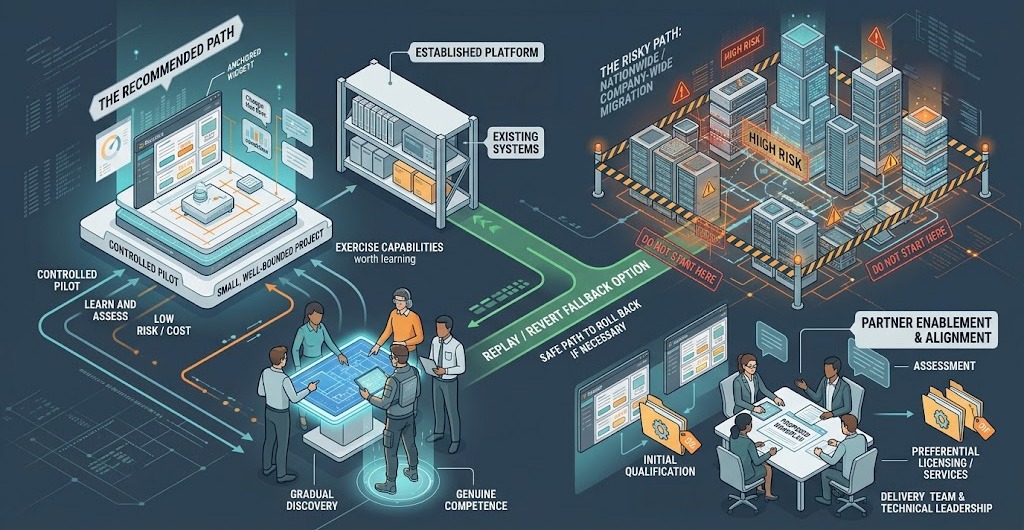
For those companies, the first step should be a small, well-bounded project rather than a migration of the existing business. It could be a pilot with clearly understood expectations or a modest delivery whose schedule leaves room for a realistic fallback. Existing systems and established delivery processes do not need to be discarded. The first project should create a controlled opportunity to learn, not put the company’s most important customer commitment at stake.
Choosing the project requires more judgment than simply selecting the smallest contract. It should be achievable for the team, exercise capabilities worth learning, and leave enough time to address unfamiliar problems. Where reverting to the established platform is part of the plan, that option needs to be considered before the schedule and budget are exhausted. The objective is to limit exposure while still completing work that demonstrates genuine competence.
At Iotellect, this is where initial partner qualification and enablement matter. We discuss the proposed work with the partner’s delivery team and technical leadership, assess its readiness, and identify the assistance required. For suitable first projects, preferential licensing and discounted enablement services can reduce the financial burden of learning. They do not remove every risk, but they let both organizations invest in making the first delivery a sound foundation for the next.
The Partner Must Do the Work
The most important part of that assistance is what we do not do. We do not take the project away, build the application ourselves, and return a finished solution with an explanation of how it works. That would demonstrate our team’s competence while leaving the partner uncertain about its own. A successful customer delivery is necessary, but it is not the only purpose of the first project.
Instead, the partner’s engineers perform the implementation. Our team trains and supervises, helping them plan the architecture, make implementation decisions, test, debug, and, where practical, commission remotely. The partner remains responsible for building and understanding the application throughout the process. The assistance reduces the difficulty of learning without removing the learning itself.
The desired result is a team that understands what it has delivered and can maintain, extend, and apply that knowledge to subsequent work. Independence does not mean never asking the platform vendor another question. It means not needing the vendor to build every unfamiliar piece on the partner’s behalf. That is the difference between obtaining one completed application and acquiring a broader engineering capability.
A Broader Role for the Team You Already Have
The opportunity is not to promise that your engineers can solve every problem in every industry. It is to stop making the boundaries of a narrow toolset the automatic boundaries of your business. A team with deep knowledge of a sufficiently broad platform can approach more customer requirements from a familiar foundation. It still has to learn, exercise judgment, and deliver. But it does not have to restart its technological education with every change of application.
A practical starting point is to look at an existing customer and identify one meaningful need your company currently turns away, outsources, or finds disproportionately difficult to deliver. Then ask whether the obstacle is missing domain knowledge, missing platform capability, or both. Choose a contained opportunity, build the necessary competence through real work, and let the results determine the next step. The ambition is not a different team for every application: it is the same capable team becoming useful across much more of the customer’s business.