
Six of the most-cited IIoT brands changed corporate owners in 24 months. ThingWorx and Kepware moved to Velotic. Cumulocity was carved out of Software AG through a management buyout and is now independent. Particle moved to Digi International. Losant moved to SUSE. Bosch IoT Device Management was discontinued. Relayr was dissolved. Alongside that, eight hyperscaler IoT services were retired in 36 months – Google IoT Core, IBM Watson IoT, AWS Things Graph, AWS IoT Analytics, AWS IoT Events, AWS Fleet Hub, AWS SiteWise Monitor, and AWS Greengrass V1. The vendor list a procurement team built in 2024 is not the vendor list that still exists in 2026.
The hardest number in industrial IoT today is not a price or a protocol count. It is 41 months – the average time from IIoT kickoff to first paying customer across 100 OEMs surveyed by IoT Analytics in 2024, up 80% versus 2020. A separate 2026 HiveMQ and IIoT World survey (n=272 industrial professionals) named the cause. 48% cited legacy integration and data silos as the top barrier to AI adoption, only 22% had MQTT widely deployed, and only 13% had a unified namespace running. The integration layer is where IIoT projects die.
The bottleneck is the integration layer and the corporate-ownership map, not the platform brand on the box. A buyer picking a “best platform” off a feature matrix is buying a brand that may not exist under the same owner, with the same pricing, by the time procurement turns into production.
This article answers two questions in order. Which ten industrial IoT platforms still pass an honest 2026 inspection. And which of those ten will still exist – under the same owner, with the same pricing – when the deployment goes live.
How to Read a 2026 IIoT Vendor List
The 2019 IIoT platform map listed 620+ vendors. IoT Analytics tracks 188 of them as exited, retired, or pivoted by Q1 2026. The remaining tier is dominated by five Gartner 2025 Magic Quadrant Leaders – Microsoft, Siemens, Cumulocity, ABB, and Univers – plus AVEVA as Visionary and Braincube as Challenger. Top-five hyperscalers hold around 60% of the agnostic platform market by revenue per IoT Analytics State of IoT Spring 2025.
A correction belongs on the same page. Cisco Jasper was not “wound down.” The brand was rebranded Cisco IoT Control Center in 2019 and still serves 60+ service providers, 120+ countries, and 270M+ connected devices. The exception that proves the consolidation rule.
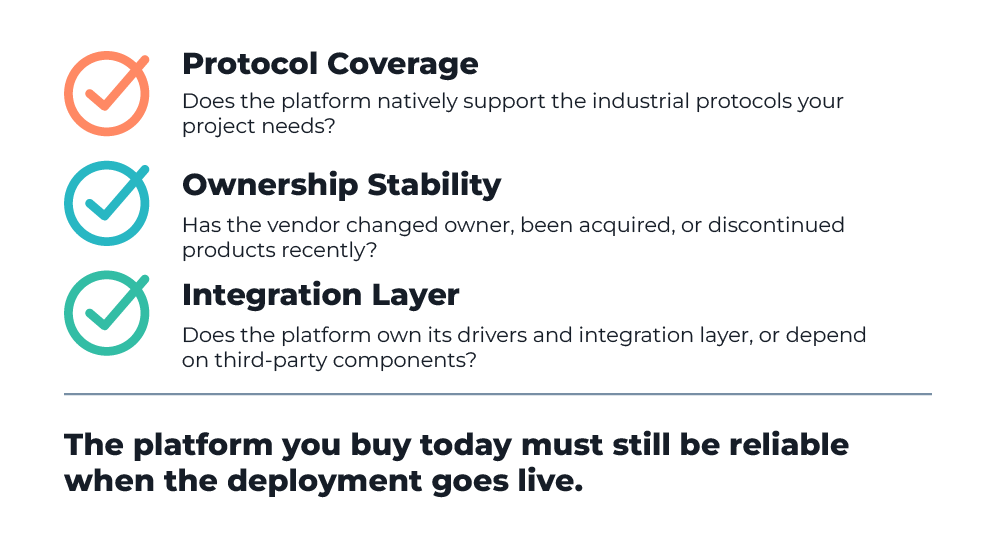
Three audit questions decide whether a vendor list is procurement-grade or marketing-grade:
- Native protocol matrix, from primary docs. Verify the platform actually speaks the protocols its case studies imply. Marketing copy is not the connection guide.
- Five-year ownership stability. Has the brand changed corporate parent or PE owner in the last 24 months? In 2024 to 2026, six of the most-cited brands did – Cumulocity (Software AG, under Silver Lake ownership, to an independent company through a management buyout in January 2025), ThingWorx + Kepware (PTC to TPG to Velotic), Particle (to Digi International), Losant (to SUSE), Bosch IoT Device Management (discontinued), and Relayr (dissolved).
- Integration-layer ownership. Does the platform own its protocol drivers, or does it license them from Kepware, CodeSys, or third parties? Licensed drivers travel with PE pricing cycles. The June 2026 Kepware 20% price hike is a live example.
Rule of thumb: the platform a buyer purchases is the company that owns it in three years, not the brand on the box today.
The Ten Platforms That Survive the Honesty Test
Ten platforms pass the three audit questions and have either a Gartner 2025 ranking, a documented production case base, or a transparent pricing rate card.
- AWS IoT Core – hyperscaler default, MQTT and HTTPS native, broad ISV partner base.
- Azure IoT Hub + Azure IoT Operations – Gartner 2025 Leader. IoT Hub speaks MQTT 3.1.1, AMQP 1.0, and HTTPS natively. OPC UA arrives via Azure IoT Operations on Arc-enabled Kubernetes.
- Siemens Insights Hub / Industrial Edge – Gartner Leader, PLC-native, MindSphere successor.
- Cumulocity – Gartner Leader, OEM-focused, carved out of Software AG in a management buyout completed in January 2025, now independent (RCR Wireless).
- AVEVA System Platform + PI – Schneider Electric ownership, energy and process anchor (PI System docs).
- Inductive Automation Ignition + Cirrus Link – SCADA-first, unlimited-tag perpetual licensing. Inductive Automation’s materials cite 65 to 69% Fortune 100 use and 4,000+ integrators in 140+ countries.
- HighByte Intelligence Hub – Industrial DataOps category leader (IDC MarketScape), asset modeling and UNS focus.
- Litmus Edge – edge-first DataOps. Litmus markets 250+ industrial drivers – the verified Connection Guide shows ~50 vendor brands plus paid add-ons. The same skepticism applies symmetrically to every multi-hundred protocol claim.
- ThingsBoard (Community + Professional Edition) – open-source spine plus commercial tier. Energenix scaled to 120 MW solar across 80+ sites in Sri Lanka, India, and Bangladesh on ThingsBoard PE + Edge on AWS, presented at Disrupt Asia Summit 2025.
- Iotellect’s multi-protocol IIoT platform – UAE-headquartered, low-code, with platform development under unified codebase since 2001 and the current brand and company founded in 2022. Multi-protocol specialist designed around system integrators, engineering companies, and OEM partners, with on-premise and sovereignty deployments as first-class modes. Unified environment without acquired or merged products – twenty years of single-engineering-team continuity stands against the PE-rollup pattern visible elsewhere on the list. The “50+ protocol drivers in one license” claim, per the canonical Iotellect product documentation, is subjected to the same audit standard as every other vendor’s connector count.
PTC ThingWorx is now under Velotic (the TPG rollup launched 2026-03-17) and lives in the graveyard block. Hitachi Lumada is strong in energy verticals but weaker in horizontal IIoT. AWS IoT SiteWise is treated as a paid add-on to AWS IoT Core.
The pricing page is the most honest document a vendor ships. Reading it cynically is the buyer’s first audit.
The comparison matrix:
| Platform | Owner / 2026 Status | Native OPC UA | Native MQTT / Sparkplug | Edge Runtime | Air-Gapped Deploy | Pricing Disclosure |
| AWS IoT Core | Amazon, stable at broker | No (Greengrass + SiteWise) | Yes (MQTT 3.1.1 / 5, Sparkplug via add-on) | Greengrass V2 (V1 EOL 2026-10-07) | Limited (Outposts) | Public rate card |
| Azure IoT Hub + AIO | Microsoft, Gartner Leader | No (via AIO on Arc K8s) | Yes (MQTT 3.1.1 / AMQP) | Azure IoT Edge LTS (ends 2026-11) | Yes (Defender for IoT air-gapped) | Public rate card |
| Siemens Insights Hub | Siemens, Gartner Leader | Yes | Yes | Industrial Edge | Yes | Contact sales |
| Cumulocity | Independent since the January 2025 management buyout | Yes | Yes | Cumulocity Edge | Yes (OCI private registry) | Contact sales |
| AVEVA System Platform + PI | Schneider, full ownership | Yes | Yes | Edge Data Store | Yes | Contact sales |
| Ignition + Cirrus Link | Inductive Automation, private, stable | Yes | Yes (Sparkplug founder) | Edge IIoT | Yes | Public list price |
| HighByte Intelligence Hub | HighByte, private | Yes | Yes | Edge | Yes | Contact sales |
| Litmus Edge | Litmus, private | Yes | Yes | Edge | Yes (offline) | Contact sales |
| ThingsBoard PE | Independent + open-source spine | Yes | Yes | Edge | Yes (CAPEX licensing) | Public rate card |
| Iotellect | Independent, UAE, single codebase since 2001 | Yes | Yes | Same codebase edge / cloud / on-prem | Yes | Public fixed pricing + perpetual licensing |
The list is short because the standard is high. For manufacturing projects, clarify SCADA, MES and ERP responsibilities before deciding which functions the IIoT platform should provide or integrate. Survival is the first criterion.
Four Silent Gotchas in Native Protocol Coverage
The 2026 procurement deck almost always treats native protocol coverage as a check-box yes. The primary docs say otherwise.
Gotcha 1 – AWS IoT Core does not natively speak OPC UA. AWS documentation lists the device gateway exposing MQTT, MQTT over WSS, and HTTPS only. OPC UA arrives through Greengrass plus an adapter (sample-grade) or through AWS IoT SiteWise (a separate paid product with a $200 per active-gateway per month Edge Data Processing Pack). Any architecture diagram that draws OPC UA into IoT Core without naming SiteWise or Greengrass is hiding an entire billing line.
Gotcha 2 – Azure IoT Hub does not natively speak OPC UA either. Microsoft Learn confirms IoT Hub natively supports MQTT 3.1.1, AMQP 1.0, and HTTPS. OPC UA on Azure requires Azure IoT Operations – a Kubernetes-based application running on Arc-enabled clusters at the edge. Microsoft positions it as “the recommended platform for new edge-connected solutions.” That is a different programming model from IoT Hub, not an extension of it.
Gotcha 3 – Sparkplug B mandates QoS 0. Fire-and-forget by design. A non-starter for regulated environments where every reading is a compliance artefact. Cirrus Link’s own documentation: “data loss with QoS 0 messages can occur in the MQTT Keep Alive window when a connection fails ungracefully.” HiveMQ’s Field-CTO publicly retracted the Sparkplug-as-central-UNS framing in February 2025 – Sparkplug has no mechanism for selective subscription, and on its own is not suitable as a UNS protocol.
Gotcha 4 – OPC UA non-reversible JSON encoding drops Variant Type and Dimensions. OPC UA Part 6 §5.4 makes the loss explicit. Any bridge that flattens telemetry into “compact JSON” strips type information that downstream consumers cannot reconstruct. Engineers debug “wrong values in Grafana” without realising the wire format itself ate the fidelity.
A bonus gotcha sits outside the OPC UA / MQTT pair. Modbus has no native timestamp and four byte orders for a single 32-bit float (ABCD, CDAB, BADC, DCBA). libmodbus ships four separate functions for this reason. Incorrect byte order is the most common cause of wrong readings in production.
The asymmetry has a scale anchor. The OPC Foundation reported 1,019 member companies at OPC Connect General Assembly 2025. The Eclipse Sparkplug Working Group has roughly 110 mailing-list subscribers. The two protocols are not equally adopted across PLC vendors.
A note about marketing claims for multi-protocol IIoT connectivity. Litmus’s “250+ industrial drivers” resolves to ~50 vendor brands plus paid add-ons in the Connection Guide. The same scrutiny applies to every vendor making a multi-hundred protocol claim – including Iotellect’s own “50+ protocol drivers” line from the canonical product documentation, which any larger marketing figure must reconcile to. What that 50+ figure actually contains, per Iotellect’s product documentation, is the industrial-protocol stack relevant to manufacturing, energy, smart buildings, and utilities – BACnet, CoAP, DLMS / COSEM, DNP3, IEC 60870-5-104, KNX, LON / LonTalk, Meter-Bus, Modbus, MQTT, OPC, OPC UA – combined with the IT-protocol stack relevant to multi-vendor infrastructure monitoring – SNMP, SOAP, SQL, SSH, Syslog, Telnet, WMI, NetFlow, LDAP. The procurement-grade figure is the line count on the vendor’s explicit connection documentation, not the slide.
Hint: protocol count is a marketing number. The native protocol matrix from primary docs is a procurement number.
Cloud, On-Premise, Edge, Hybrid in 2026
The deployment-model question split open in late 2024. On 2024-10-15, KubeEdge graduated from the CNCF as the first cloud-native edge project to do so – with 1,600+ contributors across 35+ countries, production deployments at NIO electric vehicles, satellite-ground links, and highway tolls.
The same window brought two hard end-of-life dates. AWS Greengrass V1 retires 2026-10-07, with V1 to V2 framed as a rewrite, not an upgrade. Azure IoT Edge 1.5 LTS loses standard support in November 2026, with Azure IoT Operations as the replacement (a different programming model). The stability tax the hyperscaler edge stack ships every few years.
Air-gapped deployment is a documented first-class mode across the platform tier, not a niche exception: Cumulocity Edge on Kubernetes, ThingsBoard PE CAPEX licensing, Litmus Edge offline, FlowFuse Edge, Microsoft Defender for IoT air-gapped path, EMQX on Kubernetes, HighByte Intelligence Hub edge, and Losant on-prem (now under SUSE). Iotellect runs the same codebase across edge, on-premise, and cloud, and ships either as a microservices set or as a single solid application – which removes the “rewrite for edge” tax that biases hyperscaler architectures and the V1-to-V2 forced rewrites that arrive every few release cycles.
Sovereignty is a procurement category in MENA in 2026, not a slogan. Saudi PDPL, UAE Federal Privacy, KSA Global AI Hub Law, and GCC in-country processing mandates moved the question from “where is the cheapest region” to “is this defensible under local law.” NEOM unveiled sovereign federated data infrastructure on 2026-02-19. Aramco Digital, Armada, and Microsoft’s “Galleon” distributed cloud entered the market in 2025. A platform that cannot run inside the customer’s data centre fails the first regulatory review.
Warning sign: every hyperscaler edge runtime has had a forced V1 to V2 rewrite in the last three years. On-premise topologies without a forced rewrite are a procurement asset.
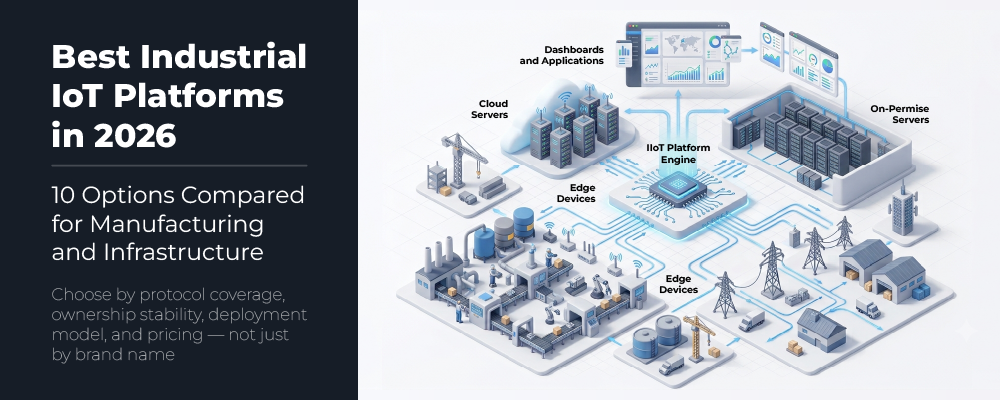
Deploy Anywhere. Cloud, On-Premise, or at the Edge.
The right IIoT platform should match the deployment environment.
Cloud
Best for centralized management, fast scaling, and remote access.
On-Premise
Best for data sovereignty, security control, and regulated environments.
Edge
Best for local processing, low latency, and sites with unstable connectivity.
Hybrid
Best when companies need both local control and centralized visibility.
Modern IIoT projects need flexible deployment, not a single fixed architecture.
Pricing and Total Cost of Ownership
The pricing comparison only makes sense if every vendor’s headline is held to the same standard.
For AWS IoT Core, Hubble’s independent model puts the realistic monthly bill at $596.16 for 10,000 devices at one message per minute (around 432M messages per month). Breakdown: $432 messaging, $34.56 connection minutes, $129.60 rules engine. Hidden lines: data egress $0.09 per GB, cross-AZ $0.01 per GB, Greengrass $0.16 per device per month at scale. EMQX’s self-modeled comparison claiming $6,015 dedicated versus $34,167 AWS for an equivalent workload is vendor self-model, not third-party verified – this article uses Hubble’s $596 figure as the independent reference.
For Azure IoT Hub, the Microsoft pricing page lists S1 at $25 per unit per month (400k messages/day), S2 at $250 per unit (6M/day), and S3 at $2,500 per unit (300M/day). Device-twin metering measures every 4 KB and compounds invisibly at high message rates.
For ThingWorx (now under Velotic), PTC discloses no public pricing. Third-party advisories estimate base licensing at $50,000 to $150,000, plus $50 to $200 per device per year, plus $1,000 to $3,000 per named user per year. Kepware drivers are licensed separately at $500 to $2,500 each. The 20% Kepware price hike effective June 2026 – the first visible PE compression cycle tax post-Velotic – is documented by Walker Reynolds at ProveIt! 2026 (demystifyingplm recap).
For ThingsBoard, Community Edition is free and self-hosted. Professional Edition runs $10 to $499 per month per node in the self-managed tier, with Cloud and Private Cloud tiers stretching $749 to $3,999 per month, plus $0.50 per GB storage overage and a TTL trap on aggregation per the vendor’s documentation.
For Inductive Automation Ignition, the official list price sits at $1,200 for the platform plus $11,225 for Perspective, 16% to 24% annual support, unlimited tags – a perpetual licence model that has not changed materially in a decade.
For Iotellect, the public pricing page lists Standard at $99, Professional at $499, Enterprise at $1,999 per month under the subscription model, with a parallel perpetual-licensing option that ships one-off payments for on-premise deployments. The dual SaaS-plus-perpetual model matters in two specific procurement contexts: CAPEX-oriented GCC and CIS infrastructure budgets where subscription compounding is a budget-cycle problem, and OEM / SI white-label arrangements where the underlying licence travels with the derived product. A qualifier belongs next to the headline: the “Standard supports up to 10,000 devices” figure is a VM-capacity claim and depends on payload profile. Production workloads need load testing per message-rate, not headline device count. The same standard that disqualifies Litmus’s 250+ protocol headline applies here.
Cumulocity, Losant (under SUSE), and PTC ThingWorx (under Velotic) disclose no public pricing – all “contact sales” with no public rate card. Opaque pricing combined with a recent change of owner is the procurement combination that most often produces post-signature surprises.
Rule of thumb: if the published rate card does not exist, the price is whatever the salesperson thinks the buyer can pay.
Production Case Studies by Segment
The named-customer column is where vendor marketing collides with reality.
Discrete manufacturing. HIROTEC scaled ThingWorx from 8 CNC pilots to multi-site production lines. Volkswagen runs AWS IoT plus SageMaker across 122 plants.
Process manufacturing. Yara digitised crop nutrition across 28 sites and 122 production units on AWS IoT. Siemens Energy uses AWS IoT SiteWise – vendor-published, directionally accurate.
System integrators and OEMs. SMC reached production on Cumulocity in four months. Energenix on ThingsBoard PE + Edge on AWS scaled to 120 MW solar across 80+ sites in Sri Lanka, India, and Bangladesh, presented at Disrupt Asia Summit 2025 – the right ThingsBoard scale benchmark (replacing the previously circulated Paze Industries reference, which is in fact a HiveMQ MQTT broker case, not ThingsBoard).
Smart buildings. Zurich Insurance’s Quai Zurich Campus on Akenza. Johnson Controls OpenBlue carries multiple Forrester TEI studies – flagged as vendor-commissioned, composite-organisation methodology.
Energy. ADNOC deployed AVEVA + AIQ Neuron 5 for process optimisation. DEWA runs 60,000+ pole-top sensors across its electricity grid plus a separate 3,000+ km water-grid SCADA system with 10,000+ smart meters, on an internal stack plus Microsoft Copilot. Energenix again, anchor reference for distributed solar.
Telecom infrastructure. Crown Castle and Everynet launched a national LoRaWAN network in the US. Expanso publishes purpose-built tower monitoring docs.
Bahrain note. EWA Bahrain on Nokia private LTE plus Diehl meters is the connectivity layer, not platform. Listed for MENA coverage but flagged as not a platform-buyer reference.
Cases sourced from hivemq.com, thingsboard.io, aws.amazon.com, cumulocity.com, ptc.com, and johnsoncontrols.com carry a vendor-published flag. Directionally accurate, not third-party verified.
Iotellect deployment footprint by segment (industry-segment-only references per the platform’s deployment history):
- Telecommunications. Cellular base station power monitoring at scale, with 100+ data points per site and thousands of telecom sites under management. SDH / PDH telecom carrier networks with 50,000+ network interfaces monitored from a single console.
- Oil and gas. GCC operator facilities monitoring integrating fire detection, water leakage, HVAC, UPS, and rodent-repellant sensors under a single dashboard. National fuel-retail networks with 1,500+ petrol stations connected and ML-driven predictive maintenance reducing downtime by 30% and repair time by 21%.
- Power engineering. Centralised UPS and engineering-infrastructure monitoring at national power generation facilities. Solar power plant control with 440 inverters and 76,000 panels under one supervisory layer. Hydroelectric station predictive diagnostics with 200 monitoring parameters. Industrial steam turbine control consolidating 500+ digital and analog inputs.
Bottom line: vendor case studies tell a buyer what a platform can do. Named-customer press tells the buyer what it has done. Deployment scale and segment breadth tell the buyer how often it has been done.
The 2026 Corporate-Ownership Map
The hyperscaler application-layer cascade is the most concrete signal in the 2026 market:
- Google Cloud IoT Core – sunset 2023-08-16. The “death of trust” event. No funded migration.
- AWS IoT Things Graph – discontinued 2022-11-09.
- AWS IoT Analytics – full EOL 2025-12-15.
- AWS IoT Events – full EOL 2026-05-20.
- AWS IoT Fleet Hub – EOL 2025-10-18.
- AWS IoT SiteWise Monitor + Edge Data Processing Pack – maintenance mode 2025-11-07.
- AWS IoT Greengrass V1 – discontinued 2026-10-07, V1 to V2 rewrite.
- Azure IoT Central – Feb 2024 retirement notice procedurally retracted. Microsoft Learn now positions Azure IoT Operations as “the recommended platform for new edge-connected solutions” – a quiet strategic deprioritisation that no longer requires a formal end-of-life date.
The independent-platform graveyard runs alongside it:
- IBM Watson IoT – retired 2023-12-01, no direct migration target.
- GE Predix – approximately $7B burned by 2020. Proficy carcass sold to TPG for $600M in September 2025, closed 2026-03-02.
- SAP IoT (Leonardo) – retired 2023-01-31.
- Bosch IoT Device Management – discontinued mid-2024.
- Relayr – dissolved by Munich Re mid-2025, ~$300M evaporated.
- Particle Industries – acquired by Digi International 2026-01-27 for $50M cash.
- PTC ThingWorx + Kepware – announced 2025-11-11, closed 2026-03-16 for up to $725M.
- SUSE acquiring Losant – confirmed 2026 consolidation pattern.
- Velotic launched 2026-03-17 – TPG combined Proficy, Kepware, and ThingWorx into a single $300M+ revenue entity. Brian Shepherd CEO. James Heppelmann Executive Chairman.
- Kepware 20%+ price hike effective June 2026 – the first visible PE compression cycle tax inside 90 days of close.
Saudi Aramco’s $4B 2017 Predix deal is the case study every Gulf procurement officer references when scoring vendor risk in 2026. The migration cost to the customer side is not publicly documented and this article does not estimate it – but the procurement memory it created is the live driver behind every “what happens if the vendor disappears” clause in 2026 GCC IIoT contracts.
Six of the most-cited IIoT brands changed ownership in 24 months. The roadmap published by the engineering team in 2024 is not the roadmap executed by the new owners in 2026. The most reliable survival predictor for a 2026 procurement decision is corporate ownership stability – and the Gartner 2025 quadrant does not score it. A “Leader” rating is a snapshot of capability today. It is silent on who owns the brand at renewal.
The contrast worth naming sits at the opposite end of the same axis. Iotellect ships under the same engineering team, the same patented unified data model, and the same Java SDK driver framework that the underlying platform first shipped in 2001. Twenty years of unified codebase under one continuous engineering organisation, with no acquired or merged products inside the stack – and UAE-domiciled, which matters under PDPL and Federal Privacy regimes that disqualify a number of the offshore-hosted alternatives. The 2022 brand and company refresh did not change the engineering substrate underneath. It is the rare lineup entry where the ownership-stability question carries no asterisk.
Hint: read every vendor name through the question “who will own them in 2028?” before reading what they do today.
The MENA-First Reality
MENA matters here for three converging reasons. Sovereignty laws (Saudi PDPL, UAE Federal Privacy, KSA Global AI Hub Law), capex (NEOM, Aramco Digital, ADNOC Neuron 5), and the 2017 Aramco Predix reference make the region the highest-stakes IIoT geography for vendor-risk math. Buyers ask different questions than European or US procurement teams, and they ask them earlier.
Named MENA deployments cluster on a recognisable shortlist:
- ADNOC plus AVEVA / AIQ Neuron 5 – process optimisation across Northeast Bab and Taweelah.
- DEWA – 60,000+ pole-top sensors on the electricity grid plus a separate 3,000+ km water-grid SCADA with 10,000+ smart meters, internal stack plus Microsoft Copilot.
- EWA Bahrain plus Nokia private LTE plus Diehl meters – connectivity layer.
- Aramco Digital plus Armada plus Microsoft “Galleon” distributed cloud – 2025 announcement.
- NEOM sovereign data infrastructure – 2026-02-19 unveiling.
- Saudi Aramco’s $4B Predix deal (2017) – the negative reference case.
A counter-explanation belongs next to that lineup. MENA flagship deals cluster on OT-domain incumbents – AVEVA, ABB, Siemens, Microsoft. The pattern that lets these vendors win is process-domain depth, regulatory history, and decades of plant-level installed base. Horizontal IIoT vendors face the same incumbent moat hyperscalers do in this segment. The realistic horizontal-vendor opportunity is in mid-market manufacturing, smart-building portfolios, and sovereignty-locked deployments where in-country processing disqualifies hyperscaler defaults – not in flagship oil-and-gas digitalisation.
What MENA buyers actually ask:
- Where is the data processed?
- Who owns the platform vendor in five years?
- Can it run inside the customer’s data centre?
- Will the price model change if the vendor is acquired?
Recap: MENA-flagship procurement is OT-incumbent territory. MENA-realistic procurement is sovereignty-anchored horizontal IIoT, mid-market, and BMS / smart-infra.
Best For: Recommendations by Segment
Each segment pairs a process-incumbent option with a horizontal-IIoT option, plus an Iotellect-fit description where multi-protocol or sovereignty matters.
Discrete manufacturers (multi-PLC, brownfield, ERP integration): Inductive Automation Ignition + Cirrus Link for SCADA-first unlimited-tag perpetual licensing. Siemens Insights Hub for PLC-native Siemens estates. Iotellect for multi-protocol coverage with predictable per-tier pricing where vendor lock-in is a procurement concern.
Process manufacturers (continuous, regulated, plant-historian heavy): AVEVA System Platform + PI as process incumbent, full Schneider ownership, GxP-ready. ABB Ability as Gartner 2025 Leader for process verticals. Iotellect for plants requiring on-premise plus multi-protocol normalisation without process-incumbent lock-in.
System integrators and OEMs: Cumulocity for mature OEM-enablement, multi-tenant by design (note the January 2025 management buyout from Software AG). ThingsBoard Professional Edition as open-source spine plus commercial tier – Energenix is the scale benchmark. Iotellect’s per-instance licensing for low-code SI / OEM white-label.
Smart buildings (BMS, BACnet, HVAC): Johnson Controls OpenBlue fits JCI estates (Forrester TEI vendor-commissioned, flag). Akenza for non-JCI portfolios – Zurich Insurance reference. Iotellect for multi-protocol deployments where BACnet, Modbus, and OPC UA coexist with M-Bus, KNX, and HTTP APIs.
Energy (utilities, renewables, oil and gas): AVEVA + ABB Ability + Univers as vertical incumbents with plant-domain knowledge. AVEVA / AIQ Neuron 5 / Hitachi Lumada for sovereign-cloud in MENA. Iotellect for utility back-office (asset management, condition monitoring, multi-site supervision) where horizontal IIoT meets sovereignty requirements.
Telecom infrastructure: Crown Castle / Everynet style LoRaWAN networks for low-power national coverage. Expanso for purpose-built tower monitoring. Iotellect for multi-protocol monitoring (power, HVAC, security) at distributed sites where a generic IIoT stack would over-buy.
Final takeaway: the best platform is the one whose ownership model, pricing model, and protocol matrix all match the deployment that has to run in 2030 – not the one that wins the demo this quarter.
Limitations and Open Questions
The same skepticism standard applies across every vendor. What this article does not resolve:
- Protocol-count claims (50+ / 250+). Litmus markets 250+. The verified Connection Guide shows ~50 vendor brands plus paid add-ons. Iotellect’s canonical product documentation lists 50+ protocol drivers, against which any larger marketing number must be cross-checked. The procurement-grade number is the connection guide, not the headline – and the standard applies symmetrically to every vendor.
- Customer-reported speedup claims. HighByte “months to hours,” Litmus “12 months to 1 day,” HiveMQ “3 to 6 months to 30 minutes” – none have third-party validation naming the customer and the baseline. Nucleus Research’s December 2023 Litmus brief reports different, smaller numbers (4% energy reduction, manual data collection from a week to virtually zero hours). Treat as customer-reported, not industry-measured. The HiveMQ figure specifically could not be located on hivemq.com and is treated as apocryphal.
- EMQX versus AWS cost comparison. EMQX’s ~$6,015 versus ~$34,167 claim is vendor self-model. Hubble’s $596 independent model is used here instead.
- Iotellect’s “Standard supports ~10,000 devices” is a VM-capacity claim that depends on payload profile. Production workloads need load testing per messaging rate, not headline device count. Same standard as Litmus and ThingsBoard PE.
- TCO shown at 10,000 devices. At 50,000 devices cost curves shift across all vendors. No public third-party benchmarks exist at that scale.
- Forrester TEI studies for Johnson Controls OpenBlue and Cumulocity are vendor-commissioned, composite-organisation methodology – directionally informative, not third-party measurement.
- WEF Lighthouse references bundle IoT, AI, and ML transformation – IoT-specific contribution is not separable.
- AI and ML platform comparison is adjacent, not covered in depth here.
- Walker Reynolds “40% audience hands-up poll” on PTC’s sale is unverified in any public conference recap and is not cited. The migration-warning guidance is on record. The percentage figure is not.
The Wildcard Scenario
The hyperscaler portfolio cull is not finished. The question worth modelling: what happens if AWS or Microsoft announces sunset or material repricing of IoT Core or IoT Hub itself – the core MQTT brokers, not the application-layer services already retired – in 2027 or 2028.
Probability is low. Under 10% in any 12-month window. The indicator signals are concrete:
- Eight AWS IoT product deprecations or maintenance-mode moves in 36 months. The Greengrass V1 to V2 forced rewrite is the dry run.
- The Google Cloud IoT Core sunset precedent (August 2023).
- Microsoft positioning Azure IoT Operations as “recommended platform” while Azure IoT Central retirement sits in procedural limbo.
- Hyperscaler IoT team layoffs across 2025 and 2026.
- Release cadence on Azure IoT Hub and AWS IoT Core dropping below two user-visible features per quarter.
- Sales-territory consolidation – hyperscaler IoT moved under broader edge and AI organisational charts in 2024 and 2025.
The hedge architecture is straightforward. Never deploy a hyperscaler IoT Core as the sole southbound broker. Always run a portable broker (Mosquitto, EMQX, HiveMQ, or the platform’s native broker) on customer hardware. Application services on top are commoditised. The MQTT broker is the load-bearing layer that must survive the next portfolio cull.
Warning sign: hyperscaler IoT stability is durable at the broker layer and brittle at the application layer. Architecture decisions in 2026 should bet on that split, not against it.
For teams ready to test the framework on a live deployment plan, the next step is concrete. Compare a portable broker layer against a hyperscaler-only architecture for the workload that has to run in 2030. The protocol matrix, the ownership map, and the pricing model belong on the same page. Walk the Iotellect connection guide and the per-tier pricing page against the current vendor shortlist before the next procurement review.
A platform comparison answers what software does today.
A corporate-ownership comparison answers what survives until tomorrow.