
Tag: IoT
-
Modbus vs OPC UA: Which Is Better for Industrial IoT?
Modbus and OPC UA are both widely used in industrial automation, but they serve different integration needs. Modbus is generally simpler for bounded device communication, while OPC UA provides richer data modelling, stronger built-in security mechanisms, and more structured interoperability options. This article compares their architecture, data structure, security, interoperability, performance, PLC and SCADA integration,…
Posted on
by
-
Looking for an Azure IoT Central Alternative? Top IIoT Solutions

How to Evaluate an Azure IoT Central Alternative Evaluate Azure IoT Central alternatives by device connectivity, data modeling, dashboards, rules, integrations, security, migration complexity, deployment flexibility, and long-term product roadmap. The right shortlist depends on the estate already running, the workload it serves, and how much operating responsibility the buyer is willing to carry. Feature…
Posted on
by
-
BMS Architecture Explained: Components, Levels, Protocols, and Integration

BMS architecture is the framework that connects building sensors, meters, controllers, networks, servers, databases, and operator interfaces. It typically includes field, automation, and management levels and uses protocols such as BACnet, Modbus, KNX, OPC UA, and MQTT to integrate HVAC, lighting, energy, security, and other building systems. ISO 16484-3 does not standardize BMS architecture. Every…
Posted on
by
-
Best Industrial IoT Platforms in 2026
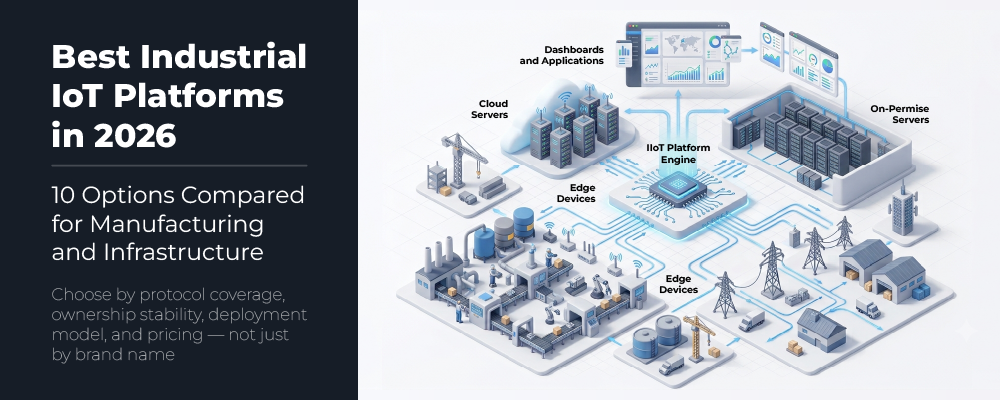
Six of the most-cited IIoT brands changed corporate owners in 24 months. ThingWorx and Kepware moved to Velotic. Cumulocity was carved out of Software AG to Silver Lake and IBM. Particle moved to Digi International. Losant moved to SUSE. Bosch IoT Device Management was discontinued. Relayr was dissolved. Alongside that, eight hyperscaler IoT services were…
Posted on
by
-
Best SCADA Software in 2026: Traditional SCADA vs Modern IIoT Platforms

The most-cited “best SCADA software” lists in 2026 share a structural problem. They rank UI features and protocol counts on products whose runtime architecture, corporate owner, and pricing model can all change inside a single procurement cycle. Velotic launched on 17 March 2026 with Proficy CIMPLICITY + iFIX + Kepware + ThingWorx under one PE…
Posted on
by
-
Iotellect on Google Cloud Platform

Many IoT architectures are designed around a cloud provider’s built-in device platform. That pattern exists in several clouds, but not in Google Cloud. Google once offered a managed service called Cloud IoT Core, but the product was discontinued in 2023. Since then, Google has taken a different approach. Instead of providing its own IoT platform…
Posted on
by
-
Iotellect on Amazon Web Services

AWS provides a powerful and mature cloud foundation. Iotellect builds on top of it to drastically reduce the time, cost, and risk of creating real-world IoT applications. This article explains how Iotellect runs on AWS, what value it adds, and how it integrates with AWS services – without turning AWS into a lock-in. How Iotellect…
Posted on
by
-
IoT Platforms vs Open Source: choosing the right way to develop an IoT product

IoT Application Enablement Platforms (AEPs) are no longer a new market. System integrators and engineering companies often consider them when choosing a way to implement a customer-tailored solution for their large enterprise customers. But what if you are a device manufacturer (OEM/ODM) or an independent software vendor (ISV) developing a brand new open market product…
Posted on
by
-
Efficient Remote Power Management for Telecom Sites

Project Name Real-Time Field Monitoring and Loss Prevention Customer Under NDA Industry Telecommunications Country Eastern Europe Solution type IoT Platform Project Description Flexenclosure eManager, built on the Iotellect platform, is a cloud-based power management system designed for telecom site networks. It enables proactive monitoring, faster response, and long-term optimization. Integrated with eSites, the system collects…
Posted on
by